
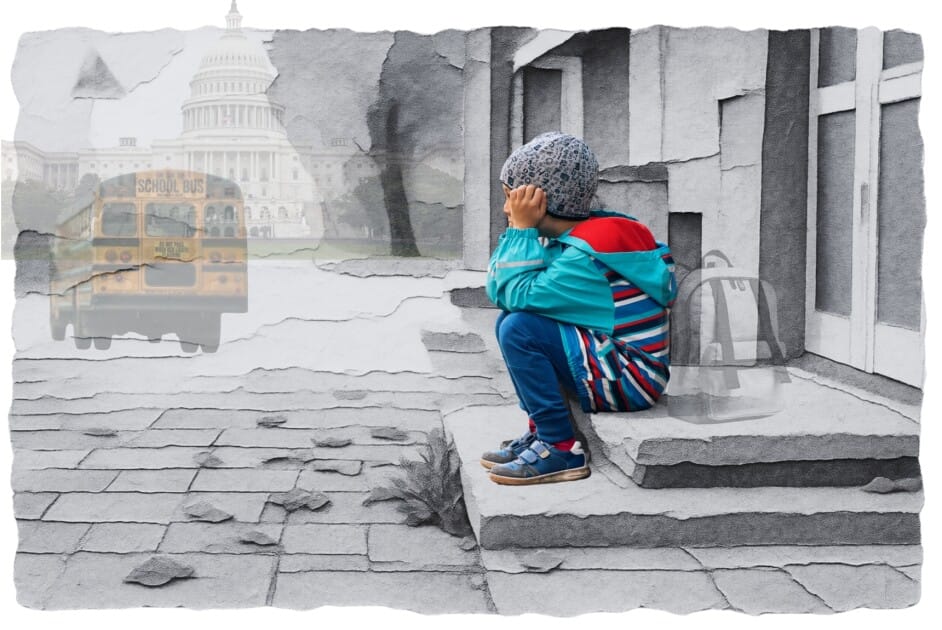
Lawmakers in Washington state and Oregon have codified federal protections for homeless students into state law, and other states are considering similar measures as advocates flag concerns that President Donald Trump’s administration might cut funding for the program or fail to enforce it.
The McKinney-Vento Homeless Assistance Act requires schools to identify students experiencing homelessness, appoint liaisons to serve them, address barriers to their enrollment and achievement, and transport them to attend their school of origin—even if they move outside of attendance boundaries.
“These states want to ensure that no matter what happens at the federal level, basic access to education would still exist,” for students experiencing homelessness, said Barbara Duffield, the executive director of School House Connection, an advocacy organization.
Trump has repeatedly proposed eliminating designated federal funding for homeless students. In April, the White House proposed a budget that would cut more than 40 separate grant programs for education, including nearly all discretionary programs that serve K-12 schools, as part of a larger plan to slash more than $8 billion in K-12 spending. Under that plan, the current $129 million in annual funding for McKinney-Vento programs would be consolidated along with 17 other K-12 programs into a single block grant worth $2 billion—$4.5 billion less than they now collectively receive.
Congress rejected a similar plan last year, leaving designated funding for homeless students intact, but the repeated proposals have served as a “wakeup call” for advocates, Duffield said. Without federal funding, there would be no mechanism for federal enforcement, she said.
Student homelessness is at an all-time high
The actions at the state level come as factors like inflation and the high cost of housing drive concerns that more students lack adequate, stable places to sleep, living in shelters or sleeping on borrowed couches—all circumstances that meet the definition of homelessness under the McKinney-Vento law. It can be challenging for schools to identify and locate such students, who may be highly mobile or unaware they qualify for additional services, administrators have said.
Public schools identified 1.5 million homeless students in the 2023-24 school year, federal data released in February show. That’s a record high since the data collection began in 2004, surpassing even 2017-18, when three hurricanes displaced thousands of students.
Advocates attribute the higher numbers in part to outreach and support efforts funded by an additional $800 million in one-time funding for homeless students provided through a bipartisan amendment to the American Rescue Plan, a COVID-19 relief bill. Even as numbers of homeless students increased, rates of chronic absenteeism and graduation rates improved, in part because schools had more money to provide simple resources like transportation, food supplies, and in-school laundry machines, those advocates said.
Now, educators and lawmakers who once hoped to see Congress maintain that additional funding for homeless student programs fear they will lose the designated funding stream entirely.
“I’m watching an administration that is purposely and maliciously targeting communities like mine,” Washington state Rep. Kristine Reeves, a Democrat, said in a Feb. 18 state Senate education committee meeting where she proposed her bill.
Most states’ laws provide few protections for students experiencing homelessness
Reeves said she was homeless for two years in high school. She credited teachers with helping her stay on the right track. Reeves’ bill, which encoded the McKinney-Vento protections into state law, became law when Washington Gov. Bob Ferguson, a Democrat, signed it in March 24.
“What this does is ensure that the program as it is currently working gets codified in state law so we can protect those kids moving forward regardless of what happens on the federal level,” Reeves said.
Oregon Gov. Tina Kotek, a Democrat, signed a bill similar to Washington’s on March 31. Lawmakers in at least four other states—Connecticut, Hawaii, Minnesota, and Vermont—have proposed similar bills in their current legislative sessions.
The momentum toward state-level protections is a promising trend, Duffield said. In a June 2025 analysis, School House connection found limited protection and funding to address student homelessness under current state laws. Four states—Colorado, Maine, New Mexico, and Washington—provide some funding to support educational stability, the analysis found. But no state’s law replicated federal protections until the recent legislative session.
“There’s not substitute for federal law,” Duffield said. “It comes with funding, and children move between states. But [under new state laws] at least the very core function of basic access to education would not be lost.”
2026-04-23 19:32:24
Source link