
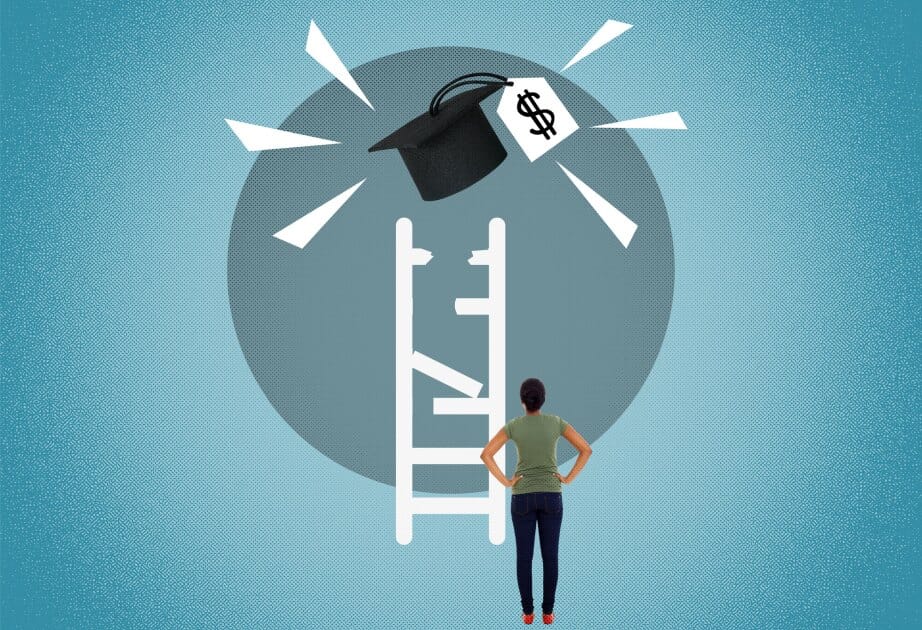
Graduate students in education programs will face new limits on federal student loans under a regulation finalized by the U.S. Department of Education on Thursday.
President Donald Trump’s administration argues that the “common sense” regulation, which excludes education from a list of “professional” graduate degrees subjected to higher loan limits, will help control growing costs for higher education.
The broader regulation, which includes a slate of changes to student loan programs, will address “decades of failed policies that have lined the pockets of colleges and universities, enabled overborrowing, and created a confusing repayment system,” the Education Department said in a statement.
But K-12 professional organizations have warned caps on borrowing for education students could hamper efforts to train new special education teachers, principals, and district administrators, and address critical school staffing needs.
“If education is not included in the professional student category, we can expect reduced enrollment in education graduate programs, higher drop-out rates when students do enroll, and increased shortages in key education occupations,” a coalition of 14 education organizations led by the American Association of Colleges for Teacher Education, wrote in a March 2 comment on the regulation.
Defining “professional” degree fields
The One Big Beautiful Bill Act that Trump signed into law in July 2025 imposed new limits on federal graduate student loans.
When the regulation developed under that law takes effect July 1, graduate students pursuing “professional degrees” may borrow up to $50,000 annually or $200,000 total, while students in fields not defined as “professional” will face lower loan caps: $20,500 annually or $100,000 total.
The regulation also prorates part-time graduate students’ borrowing limit according to their courseload. For example, a half-time student could borrow half as much as a full-time student.
In the 2019-20 school year, half of education graduate students attended part-time, according to the most recent federal data. Forty-seven percent of half-time education master’s students borrowed an average of $12,000 a year, which would exceed the limits in the regulation, an AACTE analysis of the data found.
Congress defined “professional” degrees as those that signify both “completion of the academic requirements for beginning practice in a given profession and a level of professional skill beyond that normally required for a bachelor’s degree.” But the bill left it to the Trump administration to more clearly define what programs are deemed professional.
The final rule lists the following graduate degrees as “professional”: pharmacy, dentistry, veterinary medicine, chiropractic, law, medicine, optometry, osteopathic medicine, podiatry, theology, and clinical psychology.
Department acknowledges concerns from educators
In discussion of the 81,000 comments the Education Department received on a preliminary version of the rule before its March deadline, the agency addressed concerns about leaving education off the list of professional fields.
“Many commenters argued that the Department’s approach understates the role of graduate and post-baccalaureate education in modern educator preparation, particularly for school leadership, specialized instructional support, endorsements, and career change pathways,” the final rule said. “Commenters also argued that limiting graduate borrowing for educators will disproportionately burden lower income, first-generation, and part-time students and weaken the teacher pipeline, including in specialized teaching fields and underserved communities.”
But education does not meet the law’s test for professional degrees because, though graduate degrees may be conditions for administrative roles in some states, entry-level teaching positions only require an undergraduate degree, the Education Department wrote.
In a statement Thursday, AACTE said it was “dismayed” by the final rule and urged Congress to adopt a formal definition of “professional” fields that includes education.
“Education, like health care and social work, requires rigorous preparation,” the statement said. “Limiting access to federal loans for these programs does not reduce their costs but merely shifts the burden onto students who are already weighing whether they can afford to enter the profession at all.”
2026-05-01 18:32:36
Source link