
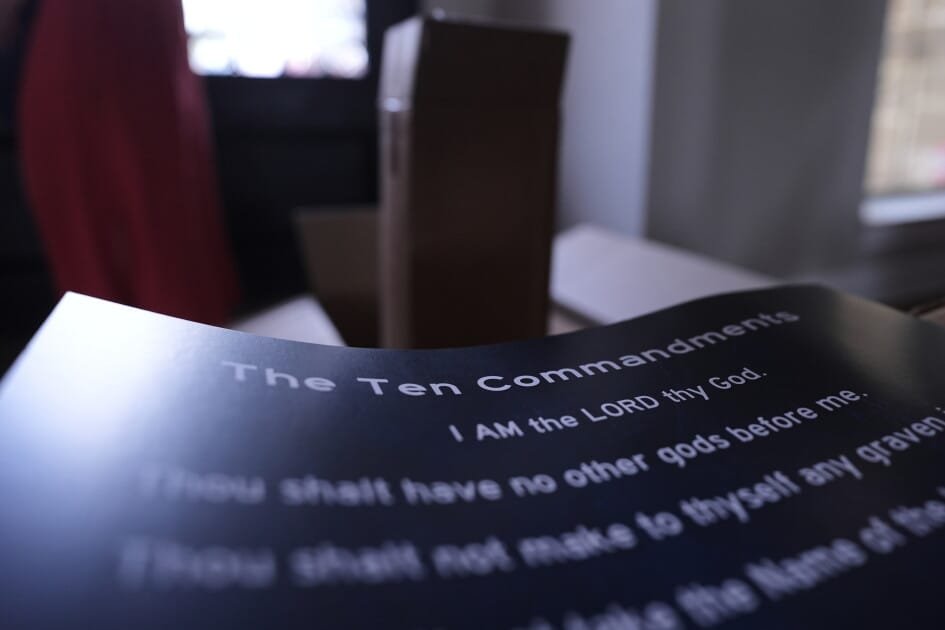
Does posting the Ten Commandments on classroom walls constitute religious instruction that is part of a state-mandated curriculum?
That is one of the key questions in a debate percolating in state legislatures, schools, and courts. Five states now have laws requiring or authorizing Ten Commandments displays in public school classrooms, and more than 20 states have considered such measures. The U.S. Supreme Court could take up the issue in its new term that begins Oct. 5, but other courts are still grappling with challenges to the laws.
“Schools use their limited classroom walls to teach,” Jonathan K. Youngwood, the lawyer representing families challenging Arkansas’ Ten Commandments law, told a three-judge panel of U.S. Court of Appeals for the 8th Circuit, in St. Louis, on Sept. 22. “This is instruction. These are all commandments. And they are directly religious.”
Arkansas told the court that its required posters are “passive displays” that are not part of classroom instruction.
The state law “does not require the Ten Commandments to be incorporated into the curriculum and have that active instruction,” Arkansas Solicitor General Autumn Hamit Patterson told the appellate court. “There’s no requirement for teachers or other school officials or students to interact with, bring attention to, or even acknowledge the posters in any way.”
Two states’ laws have reached the U.S. Supreme Court
Besides Arkansas, the other states mandating such classroom posters are Alabama, Louisiana, and Texas. Tennessee passed a law this year authorizing, but not requiring, its public schools to post the commandments.
There are variations among the laws, with some dictating the exact size, and even the font, of classroom posters. Some authorize the inclusion of contextualizing documents, while one—Texas—prohibits them.
Arkansas, Louisiana, and Texas all require the same text that the Supreme Court has upheld on a monument at the Texas Capitol, while Alabama dictates somewhat modernized language. But all are forms of the Ten Commandments that appear in the Protestant King James version of the Bible, in contrast to Roman Catholic, Lutheran, or Jewish formulations.
There are other major legal questions swirling around the debate, such as whether the Ten Commandments have a historical and traditional place in American public education and whether parents might have a right to opt their children out of classrooms displaying the posters.
While the 8th Circuit panel ponders the fate of the Arkansas law, the neighboring U.S. Court of Appeals for the 5th Circuit, in New Orleans, has allowed Louisiana’s 2024 law to take effect, and has essentially ruled that the Texas law is constitutional. (The Alabama and Tennessee laws took effect only recently.)
“The Texas law creates no religious curriculum designed to shape children’s beliefs or subvert their parents’ teaching,” the full 5th Circuit said in its 9-8 decision on April 21 in Nathan v. Alamo Heights Independent School District. “Teachers are not required or encouraged to offer religious reflections on the Ten Commandments. Nor are they told to proselytize students who ask about the displays or disagree with the Commandments.”
The 5th Circuit concluded that Stone v. Graham, the 1980 U.S. Supreme Court decision that struck down a Kentucky Ten Commandments requirement, was no longer good law because a key precedent on which it had relied had been overruled by the Supreme Court in 2022.
The challengers have now appealed the 5th Circuit decision to the Supreme Court, arguing that not only did the appellate court get its analysis wrong, but it also overstepped by disregarding the 1980 Stone decision.
Many legal observers believe the justices are likely to take up the case and decide not just whether Ten Commandments displays are permitted but possibly lay the groundwork for overruling landmark precedents prohibiting government-sponsored prayers in public schools. (Currently, students and teachers can pray privately in public schools.)
“There are broad implications here if the court takes the case,” said Daniel Mach, director of the program on freedom of religion and belief with the American Civil Liberties Union, which is among the groups representing challengers in several Ten Commandments lawsuits.
“The cases have implications for the state of religious liberty law in general, particularly in the context of public schools, where the court has historically been most vigilant in guarding against government-imposed religious indoctrination,” said Mach, whose organization is the key group behind taking the Texas case to the high court.
The challengers’ appeal argues that the Texas law “ensures that students will read and meditate on the Commandments and receive them as a religious curriculum designed to shape their beliefs or subvert their parents’ teaching.”
That runs counter to the Supreme Court’s 2025 decision in Mahmoud v. Taylor, which upheld a challenge by religious parents who sought to opt their children out of LGBTQ+ storybooks and lessons, the Texas challengers argue.
Texas has until Oct. 28 to file a brief defending its Ten Commandments law. Legislative sponsors and other backers of such measures tend to argue that the commandments are intertwined with the foundation of American law and history.
“Public recognition of the Ten Commandments as a bedrock of legal norms, respect for life, property, truth, and social order, has long appeared in our courthouses, legislative chambers, National Archives, architecture, and educational materials without being treated as religious instruction,” says a friend-of-the-court brief filed in the 5th Circuit by the two lead Texas legislative sponsors of that state’s measure.
Meanwhile, a teacher who has challenged Louisiana’s law has also asked the Supreme Court to take up the issue.
Christopher Dier, an AP U.S. history and government teacher at a New Orleans charter high school, says in court papers that he objects to having the state-mandated poster in his classroom.
“Posting the Ten Commandments on the walls of a public school classroom, in my role as a teacher and during time set aside specifically for educational instruction, is a religious act” that “coerces me into the role of messenger of a state-sponsored program of religious proselytization,” the teacher said in a court declaration.
Louisiana has not yet responded to the teacher’s appeal in Dier v. Landry, but in a separate filing with the high court, state Attorney General Elizabeth B. Murrill said the 5th Circuit’s decisions upholding the Texas law and allowing her state’s law to go into effect were correct and did not require the justices’ intervention. But if the court did grant review in the Texas case, she argued that it should also take up Louisiana’s law.
“Louisiana has a significant interest in defending its own law here on its own terms,” Murrill, a Republican, noted in her brief in Brumley v. Roake.
She noted that in contrast to the Texas law, which prohibits any supplementary documents to accompany the classroom posters, Louisiana’s law requires a three-paragraph “context statement” about the history of the Ten Commandments in American public education. Schools may also display the commandments alongside other documents such as the Declaration of Independence or even the “Ten Commandments of Dueling” from the musical “Hamilton.”
States’ choices on wording have legal consequences, scholars say
A recent law review article by three church-state scholars has attracted notice in legal circles for its argument that the states’ required Ten Commandments displays prescribe particular religious teachings—even as the states claim that’s not what they’re doing.
“When the legislatures of Alabama, Arkansas, Louisiana, and Texas prescribed a particular form of the Ten Commandments for public school classrooms, the forms they chose provided theological answers to contested theological questions,” said the paper by Samuel L. Bray of the University of Chicago law school, Nathan S. Chapman of the University of Georgia law school, and Brent A. Strawn, a professor of law and the Old Testament at Duke University.
“These laws take the sum of those theological answers and present them in the didactic setting of a classroom as the religious orthodoxy of the state,” in violation of the First Amendment’s prohibition on government establishment of religion, the scholars write.
The scholars note that three of the states sought to avoid some thorny theological issues presented by the Protestant version of the commandments by not numbering their required lists.
“What these state legislatures gained in avoiding the explicit numeration of a particular faith community, they have lost in mathematical propriety: their list has either twelve (!) commandments, or else a prologue followed by eleven commandments, but under no reading does this text have ten,” the article says. “By not numbering the text, the Arkansas, Louisiana, and Texas legislatures seem to be saying, ‘There are ten commandments in there somewhere—go find them!’”
Those states also do some delicate dancing around the commandment against “coveting,” the scholars point out, by turning the Hebrew word typically translated to “slave” into “manservant” and “maidservant,” while the Alabama text simply says, “You shall not covet.”
They also note that by adopting the language from the 1950s-era Texas Capitol monument that the Supreme Court had upheld in Van Orden v. Perry, Arkansas, Louisiana, and Texas accept a version that changed traditional language in the coveting commandment from “nor his [neighbor’s] ox, nor his ass” to “nor his cattle.”
That version seems “calculated to avoid childish snickers at the word ass,” the scholars write.
During the 8th Circuit argument in the Arkansas case, Youngwood, the lawyer for the challengers, said some students exposed unwillingly to Ten Commandments posters in their classrooms were “coming home and saying, ‘Mom, what does it mean to covet?’”
“If you want the students of the state of Arkansas to learn about the Ten Commandments, you [should] teach it in World Religions, or history, or other classes where it is taught as something that is there, but not as a dictate in every classroom that you must believe and you must follow.”
Mark David Hall, a law professor at Regent University in Virginia Beach, Va., who has served as an expert witness in support of Ten Commandments displays in classrooms and other public places, argues that the state laws do not compel teachers to instruct about the commandments or students to recite them.
“If they simply put posters of the Ten Commandments on the schoolhouse walls, then I don’t think a passive display of anything—be it an American flag, the national motto, or an LGBTQ flag—is teaching [that message] per se,” he said in an interview. “It’s simply exposing students to an image or text.”
On the other side of the issue, Chapman, one of the law review article’s co-authors, said in an interview that he and his colleagues essentially think that Ten Commandments states are prescribing religious beliefs or doctrine, and not “more generic, providentialist beliefs.”
“We conclude that for a law that stipulates very specific religious teachings be displayed in a place that is ordinarily used for instruction, it’s really hard to conclude that [the state is] trying to do anything other than teach that those are true rules that people should follow,” he said. “I think indoctrination is the appropriate word for what’s happening here.”
2026-10-02 19:35:48
Source link