
Sign up for Chalkbeat New York’s free daily newsletter to get essential news about NYC’s public schools delivered to your inbox.
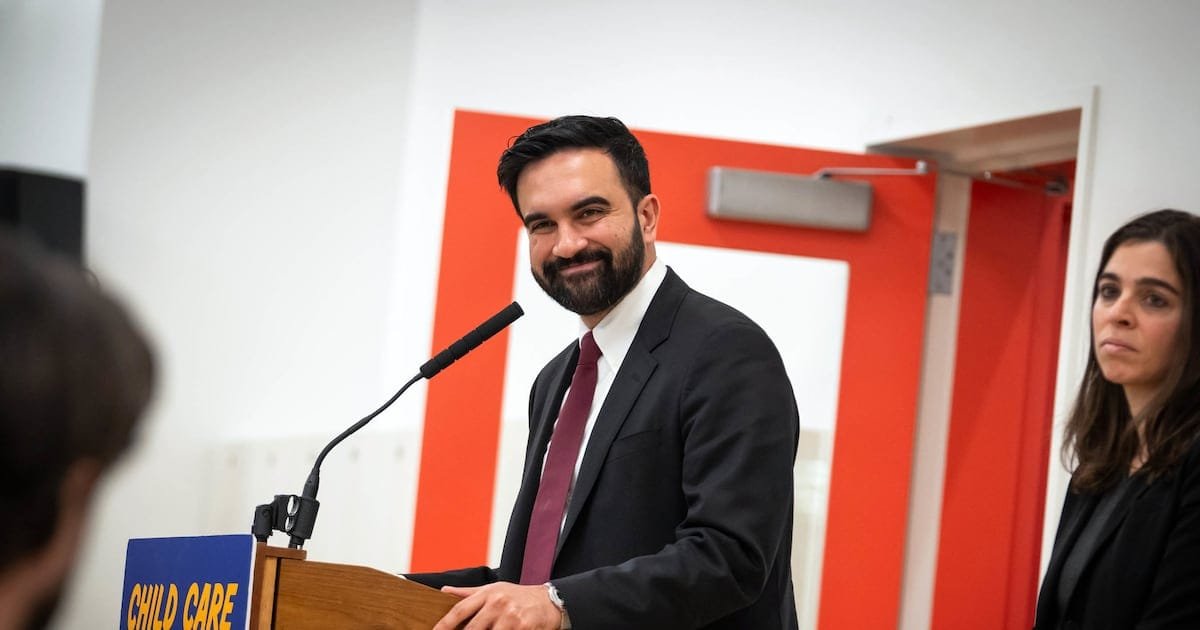
Mayor Zohran Mamdani on Monday pledged to address payment delays that are threatening the rollout of his signature free childcare program for 2-year-olds and pushing some providers to the brink of closure ahead of the Sept. 10 school opening.
Mamdani, who made the expansion of free childcare a major plank of his mayoral campaign, pledged to invest $43 million to rebuild depleted staffing at the Education Department’s Division of Early Childhood Education. He also vowed to reassign staffers from other parts of city government to help speed up the registration of new contracts and expedite interest-free loans to providers whose contracts haven’t been approved.
“We are bringing every resource to bear to get providers paid, get classrooms open and make sure families have the care they were promised,” Mamdani said in a statement.
At an unrelated press conference Monday, Mamdani said the Education Department has reached out to every childcare provider and tripled the number of staffers working on contracts. Providers who applied for a loan by Monday will have it processed by the end of the week, he added.
The inaugural year of free 2-K is set to enroll roughly 2,000 toddlers across five school districts. But some 2-K providers, as well as those contracting with the city to care for 3- and 4-year-olds, have been waiting weeks or months for money they need to pay staff, cover their electric bills, and purchase supplies.
“That puts a stress on providers, not knowing when you’re going to get paid,” said Doris Irrizary, a childcare provider in the Bronx and co-founder of the group ECE on The Move, which advocates on behalf of home-based providers. “Most of us live check to check.”
To provide subsidized childcare for about 150,000 kids under age 5, New York City’s Education Department relies on a sprawling system of private daycare operators like Irrizary who win contracts from the city to provide programs that are free to families.
Contract and payment delays have bedeviled that system for more than a decade. When former Mayor Bill de Blasio launched his Universal Prekindergarten program for 4-year-olds in 2014, roughly two-thirds of the new contracts were delayed by the start of school in September, the comptroller at the time said. In the years that followed, the early childhood department gradually built up the personnel and expertise to help mitigate those delays, former staffers recalled.
But when Mayor Eric Adams took office in 2022, the Division of Early Childhood Education faced a rocky transition. Some longtime staffers left, and the city reassigned hundreds of others as part of a reorganization, including 200 instructional coordinators who worked directly with providers.
Payment delays to providers again grew so acute that some organizations closed their doors for good. That prompted former Chancellor David Banks to deploy a “rapid response team” to speed up payments.
City officials say the staffing reductions from the Adams administration continue to hamstring the early childhood division. An Education Department spokesperson didn’t share the division’s current headcount and how it compares to past years. But Mamdani has pledged to hire 200 new staffers to expand the contracting and outreach teams and ensure there are more staffers providing direct support to programs.
Mamdani’s administration has already faced some operational complexity in recruiting providers — particularly the small, home-based providers who have largely been left out of past childcare expansions — and getting the word out about the program. The program is set to expand to 12,000 2-year-olds next year, and Mamdani has promised it will grow to cover any family who needs care by the end of his first term.
In July, Simone Hawkins, the deputy chancellor overseeing the Division of Early Childhood Education, announced her departure — a worrying sign for some advocates who said Hawkins was making long-needed changes. Mamdani and schools Chancellor Kamar Samuels have not yet named a replacement.
Some longtime providers are hopeful that the latest efforts can speed up payments, but wary after seeing similar reforms come and go over the past decade.
“To me, they keep on reinventing the wheel,” said Irrizary. The pressure to quickly open 2-K seats put further strain on a system already dealing with existing issues, such as low pay for providers, a long waitlist for state-funded childcare vouchers, and thousands of unfilled seats, she said.
Michael Elsen-Rooney is a reporter for Chalkbeat New York, covering NYC public schools. Contact Michael at melsen-rooney@chalkbeat.org.
Michael Elsen-Rooney 2026-08-31 18:47:31
Source link