
Sign up for Chalkbeat Philadelphia’s free newsletter to keep up with the city’s public school system.
For nearly two years, teacher Isabelle Ouyang and her colleagues have dealt with the presence of construction workers, shuffling between classrooms, stress over schedules, and a host of disruptive renovations.
Ouyang has, essentially, pardoned all that dust, because Philadelphia’s Kensington High School now has air conditioning. With an $17 million estimated price tag, it hasn’t come cheap. And she’s still worried about disruptions continuing into the next school year.
“Having AC in our school, I feel really lucky,” said Ouyang, a special education teacher. “But it felt a little bit like things were being figured out on the fly.”
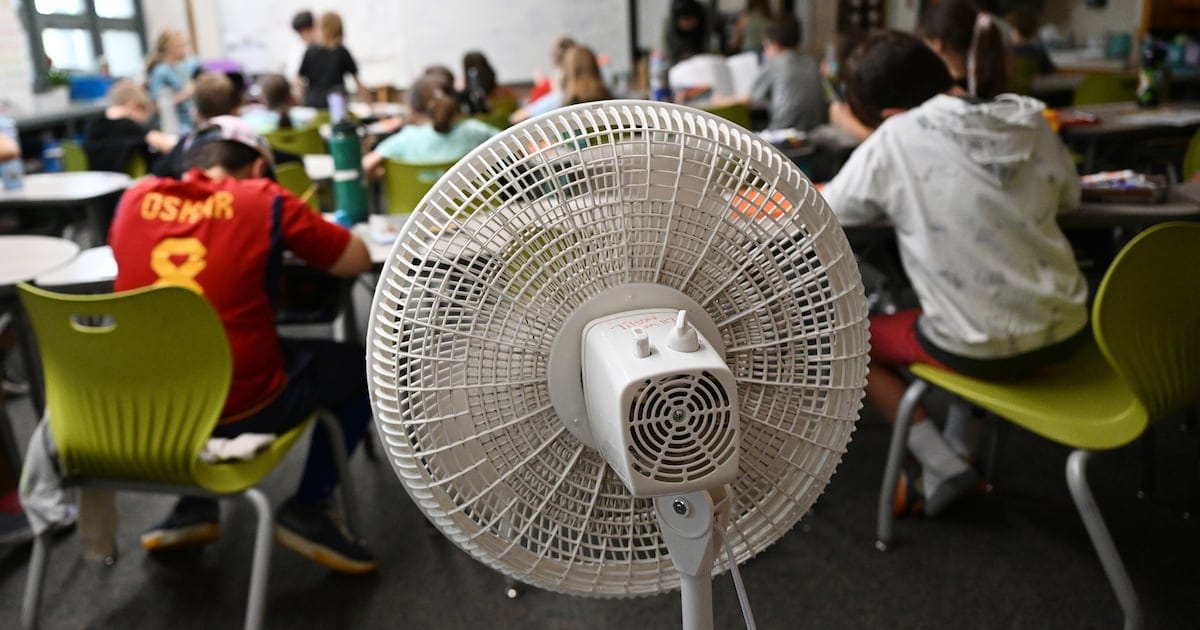
As climate change leads to more extreme weather and hotter summers, ensuring students can remain safe and comfortable in Philadelphia’s old schools has become a perennial challenge. Research shows that high temperatures take a toll on student learning, attendance, and behavior.
Around 50 Philadelphia schools — or nearly one quarter of district schools — still won’t have what the district considers to be adequate cooling when the school year begins later this month. That number has shrunk over the past few years after the district spent COVID relief dollars on upgrading HVAC systems and received a $200,000 donation from Eagles quarterback Jalen Hurts.
In the last four years, the number of Philly schools without air conditioning has fallen from 118 to 52. Still, the district seems unlikely to meet its previous goal of air conditioning all its buildings by 2027. The complicated and expensive process of adding cooling to old buildings like Kensington High, which was built over a century ago, illustrates why getting there can be so challenging.
The Philadelphia district has an official plan for extreme heat that includes sending students at schools without adequate cooling to learn remotely at home when outside temperatures are forecast to reach 85 degrees or above before 9 a.m. At the end of last school year, the district used that protocol twice, moving students to remote learning for approximately 50 schools without adequate air conditioning.
Superintendent Tony Watlington has said the district’s 10-year facilities plan is key to ensuring students go to school in buildings that have air conditioning and similar upgrades. It includes closing 17 schools, colocating several, and modernizing nearly 170 buildings.
“We want to get to a point where we don’t have to send kids home early” when it gets too hot out, he said during a tour of John M. Patterson Elementary School in Southwest Philadelphia earlier this summer.
Patterson doesn’t have adequate cooling, but is supposed to get a $45 million upgrade under the facilities plan to increase its capacity and add air conditioning to key parts of the buildings.
District spokesperson Naima DeBrest said in a statement that the district is “shifting from separate, immediate renovations to integrating cooling upgrades into the broader, long-term modernization projects planned over the next 10 years.”
The district, however, does not yet have all the funding to pay for the upgrades at schools slated for renovations under its 10-year plan.
Adding AC to old schools can take years
Kensington High School’s HVAC upgrades included replacing aging heating, ventilation, and air conditioning systems, along with updating ductwork.
Separately, the building also got new windows to replace ones that had become opaque with wear.
At other schools, the process of upgrading cooling systems has also become costly and drawn out.
John F. McCloskey Elementary School in Cedarbrook was one of the dozens of schools that had to send students home to learn remotely at the end of last school year due to high temperatures, because it does not have adequate cooling.
The local utility Philadelphia Gas Works has been studying whether installing a geothermal system, which would serve the school as well as a neighboring community center, could be a solution for the school. Geothermal systems don’t require burning fossil fuels, making them favored by climate advocates.
A PGW spokesperson said the utility expects that study to be released in the coming weeks, a year and a half after the utility first announced its plans. It estimates installing the system would cost around $19 million, without tax incentives, according to The Philadelphia Inquirer. Though that could save the district money on gas in the long run, there is no budget or timeline yet to install it.
That means for the upcoming school year, McCloskey still won’t have adequate cooling, and kids will once again learn remotely if temperatures get too hot.
Linnea Bond, environment and health education director at the advocacy group Physicians for Social Responsibility Pennsylvania, has been following PGW’s work on its geothermal study for years. She said she’s glad it’s made progress, but that’s only one step.
“I don’t want them to leave these kids hanging,” she said.
High temperatures take a toll on students, staff
When temperatures climb, students do worse on tests and can have more disciplinary problems, research shows. Attendance also declines on high-heat days, studies have found.
School districts need robust heat plans to prepare for those challenges, said Allison Poulos, an associate professor in the College of Health Solutions at Arizona State University. That can mean everything from ensuring staff and students have access to water to redoing schedules so school isn’t in session during the hottest times of the year.
It’s important that schools have “really thought through what resources they have, what they don’t have, and what decisions they will make,” said Poulos, who helps run the university’s HeatReady Schools initiative. “Because I think these are going to continue to persist and probably get more problematic as time goes on.”
One Philadelphia math teacher who asked not to be named because she was not authorized to speak by the district said the lack of air conditioning in her building frequently derails learning during the hottest months of the school year.
She’s rarely able to make significant curriculum progress on days when school goes remote due to heat, she said, because it happens with little warning. On days that are hot but don’t meet the district’s temperature threshold for closure, she notices absences spike in her classroom.
For students who do attend, the classroom heat is like an unavoidable, uncomfortable distraction.
“Nobody feels good,” she said. “Nobody’s learning.”
Rebecca Redelmeier is a reporter at Chalkbeat Philadelphia. She writes about public schools, early childhood education, and issues that affect students, families, and educators across Philadelphia. Contact Rebecca at rredelmeier@chalkbeat.org.
Rebecca Redelmeier 2026-08-04 14:11:07
Source link