
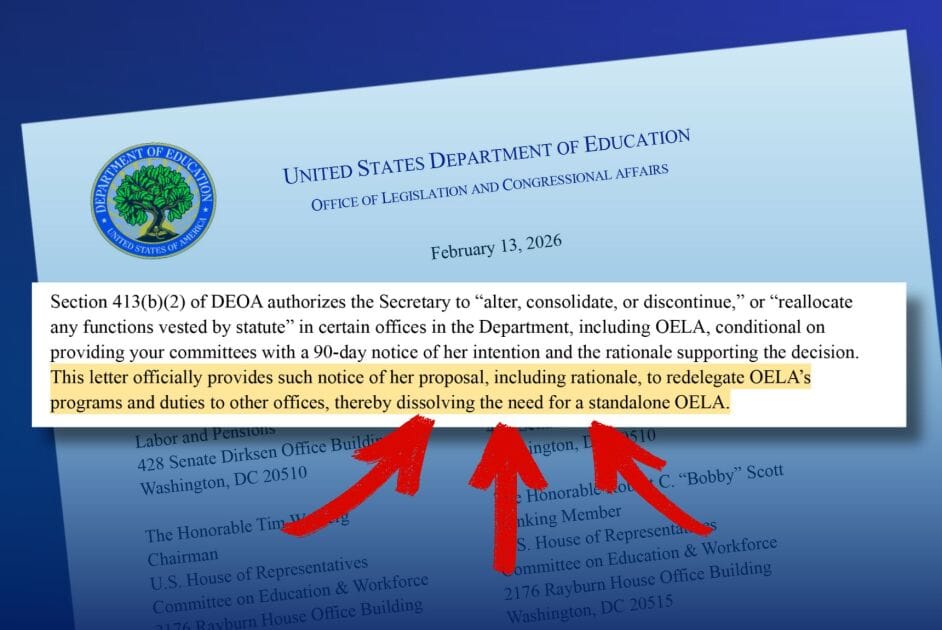
The U.S. Department of Education has given Congress official notice that it plans to dissolve its office that oversees federal programs for the nation’s more than 5 million English learners, according to a letter obtained by Education Week.
The shuttering of the office of English language acquisition, or OELA, follows a year in which the Trump administration has contracted the Education Department, dismissed virtually all of OELA’s staff, and tried to scale back federally funded services for English learners.
OELA has overseen the $890 million Title III grant program that helps schools pay for services for English learners, professional development grants to improve instruction for English learners, and the development of resources to help educators serve the growing student population.
In a letter dated Feb. 13, the Education Department informed key members of Congress that it planned to dissolve the office and “redelegate OELA’s programs and duties to other offices, thereby dissolving the need for a standalone OELA.”
The letter has not been previously reported.
In a statement to Education Week, Assistant Secretary for Elementary and Secondary Education Kirsten Baesler said the effort is part of the Trump administration’s larger project of “returning education to the states.”
“English learners should never be treated as a siloed program, set aside as an afterthought,” she said.
OELA is one of the offices established under the Department of Education Organization Act, the 1979 law that created the Education Department (OELA was initially called the office of bilingual education and minority languages affairs.) It was established in its current form in 2002 by the No Child Left Behind Act.
However, Secretary of Education Linda McMahon is using a mechanism in the Department of Education Organization Act that allows her to “establish, consolidate, alter, or discontinue” a handful of department offices, including OELA, by providing Congress 90 days’ notice stating the proposed action and rationale. Based on the Feb. 13 date of the letter to lawmakers, that 90-day window will expire next month.
“It is critical that we streamline operations to better support ELs,” Assistant Secretary for Legislation and Congressional Affairs Mary Christina Riley wrote in that letter.
English-learner experts and advocates remind educators that schools’ federal responsibilities to educate English learners and immigrant students remain with or without OELA, as do the programs that serve them, along with those students’ rights.
Still, the loss of a central federal office for these students would complicate states’ and schools’ ability to best serve them, they said.
“OELA mattered because it gave multilingual learners a clear and consistent voice at the federal level,” said Jose Viana, who led OELA during President Donald Trump’s first term. It “brought together expertise, research, and support focused specifically on language development and ensured that these students were visible in national policy conversations.”
The letter explaining OELA’s dissolution outlines where the programs OELA oversees will move within the Education Department:
- Title III formula grants will go to the office of elementary and secondary education’s division of state support and accountability that oversees other major formula grants such as Title I.
- OELA’s National Professional Development grants will move to the office of effective educator development programs.
- The Native American and Alaska Native Children in School Program will move to the department’s office of Indian education “to better align with other programs that support Native American children and youth.”
The Education Department, meanwhile, is in the middle of shifting day-to-day management of dozens of its programs to other Cabinet agencies. It’s previously said the Department of Labor will handle Title III grants, and the the Department of the Interior will take over the Native American and Alaska Native Children in School Program.
“Aligning this work across teams within the office of elementary and secondary education reduces administrative burden and empowers states to design integrated supports that reflect the needs of their English learner students and families,” Baesler said in her statement.
Multiple federal policy shifts are affecting English learners
This isn’t the first time OELA has faced consolidation or major restructuring.
In 2017, during his first term, Trump signed an executive order requiring all federal agency heads, including then-Education Secretary Betsy DeVos, to submit reorganization plans with an eye toward efficiency.
As a result, DeVos in 2018 considered folding OELA into the office of elementary and secondary education, which handles most K-12 grant programs and school accountability.
However, Viana, then OELA’s head, and English-learner advocates successfully pushed back against the idea, allowing OELA to remain a standalone office, he said.
Title III grants, which supplement states’ and schools’ spending on English learners, were under the elementary and secondary education office at that time and remained there until late 2023, when the Biden administration shifted them to OELA.
But OELA’s ability to offer guidance to states and schools hit a roadblock last year when all but one staff member was laid off as part of Education Department reductions that shrank the agency’s staff by nearly half.
Since last January, the Trump administration also has:
“What’s important right now is to make sure that schools, districts, and states know that their legal obligations to these students have not changed,” said Leslie Villegas, a senior policy analyst at the think tank New America. “What has changed is their ability to ask the federal government for help and how they could meet those obligations.”
OELA’s program remain even as the office dissolves
The various programs OELA oversees will continue under the proposed Education Department plan, Viana noted.
While it remains unclear precisely when members of Congress received the letter, lawmakers are likely limited in what they can do to prevent OELA’s dissolution, said Julia Martin, the director of policy and government affairs at the Bruman Group, an education-focused law firm.
They could pass legislation that puts OELA into the category of offices that the Education Department must maintain, or they could amend the appropriations bill passed in February—or add a provision to the next budget bill—to specify that OELA must still exist at least for this year, Martin said.
But either scenario remains unlikely at the moment, she saidadded, as those provisions would have to pass a Republican-controlled Congress and be signed into law by Trump.
Moving forward, experts on English learner education and advocates worry that OELA’s dissolution will diminish the quality of technical assistance and resources available to states and schools responsible for English-learner services.
“When I was with OELA, we didn’t have enough people to serve the 50 states with Title III resources,” said Montserrat Garibay, who led OELA during the last two years of the Biden administration. “And so to now see that it’s been dismantled to different agencies, these agencies don’t have the background or the necessary skills to provide effective technical assistance to states.”
2026-04-14 21:12:43
Source link