
Sign up for Chalkbeat Colorado’s free daily newsletter to get the latest reporting from us, plus curated news from other Colorado outlets, delivered to your inbox.
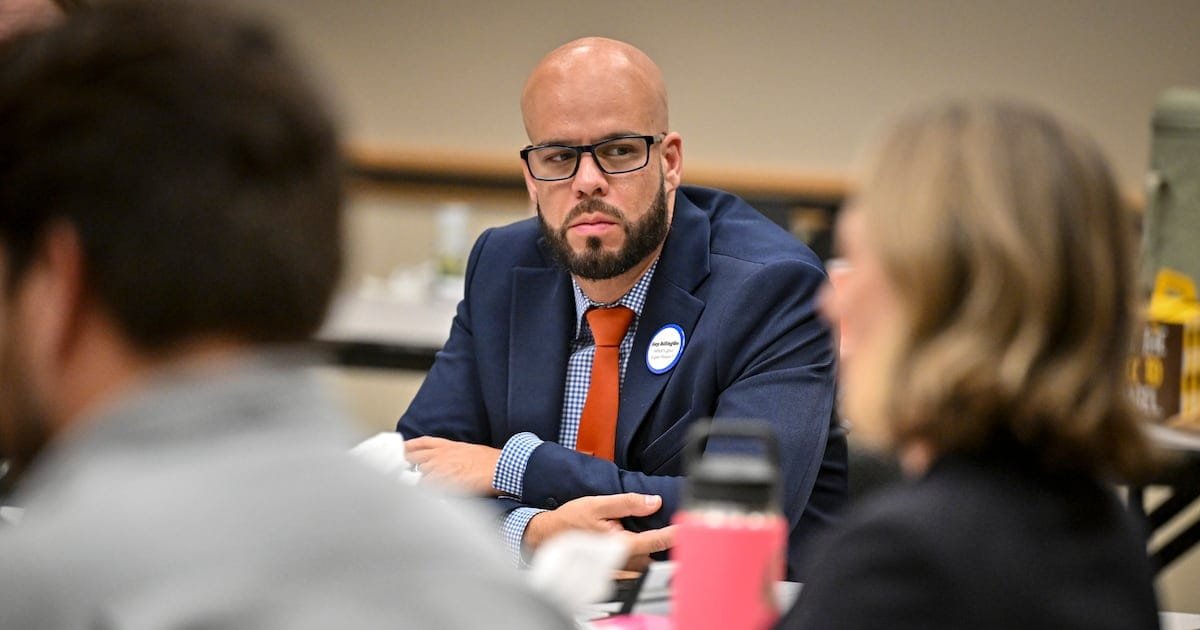
Denver Public Schools’ standardized test scores have gone up under the watch of Superintendent Alex Marrero, but not enough to meet all of his goals.
In 2022, a year into his tenure as superintendent, Marrero released his first-ever strategic plan. Among the plan’s academic goals: to increase the number of students scoring at grade level on math and literacy tests by 10 percentage points by 2026.
None of Denver’s overall scores improved by 10 percentage points, data released this week shows. The district’s early literacy score came the closest. In 2022, 60% of kindergarten through third grade students scored at grade level or above in reading. In 2026, 69% did.
Marrero wanted to accelerate the growth of certain student groups even more. At the time, Denver had the largest test score gaps by race in the state.
That’s still true. Black and Latino students’ scores have gone up in the past four years — some by 10 percentage points or more — but big gaps remain between them and their white peers.
The comparison comes as Marrero’s future with the Denver district has been called into question, partly because of friction with the school board responsible for hiring and firing him and partly because he’s been a candidate for at least two jobs in other cities that he didn’t get.
As has been the case with past superintendents, some people want Marrero to stay, and some don’t. He said recently that he’s “unapologetically committed” to Denver and close to finalizing a new strategic plan that will take the district through 2030.
When last spring’s standardized test scores were released earlier this week, Marrero characterized Denver’s results as a mix of pain points and all-time highs.
“There’s still a whole lot of work we need to do,” he said in an interview. “For my lovely critics out there, this is me celebrating the work of our educators. And I will never hold back from continuing to be the cheerleader for Denver Public Schools.”
District-run schools met the early literacy goal
Denver has had the most success with early literacy. It’s where Marrero has focused several of his signature initiatives, including a Black Student Success Team launched in 2023, a Latine Student Success Team launched in 2024, and the Elevate Schools Network, launched last year to help a cohort of low-performing elementary schools boost their test scores.
“It’s not a cheat code but a smart way of investing your talent and energy and resources,” Marrero said of the focus on the district’s youngest students. “Our youngest scholars become, ultimately, our oldest scholars.”
In the past four years, Denver also adopted a new early literacy curriculum aligned to the science of reading, a large body of research on how children best learn to read. And the district invested in teacher training and a new intervention program for struggling readers.
A state law called the READ Act requires school districts to test the literacy skills of all kindergarten through third grade students each year. Denver has used different tests over the years, but the one that most district-run schools currently use is called DIBELS.
Just counting district-run schools, 71% of kindergarten through third grade students were reading at grade level or above this past spring, according to district data — a number that surpasses the goal in Marrero’s strategic plan.
That number doesn’t include scores from Denver’s independent charter schools or the schools in its semi-autonomous innovation zone, neither of which Marrero directly oversees.
In a press release, the district called out “significant milestone achievements in district-run schools.” Marrero said he’s also proud of the progress made by students of color. In 2022, 48% of Black and Latino students in kindergarten through third grade were reading at grade level or above. In 2026, those numbers jumped to 58% for Black students and 63% for Latino students.
Big test score gaps by race remain
A similar pattern emerged in elementary and middle school. Colorado students in grades 3 through 8 take literacy and math tests called the Colorado Measures of Academic Success, or CMAS. Students in grades 9 and 10 take the PSAT, and 11th graders take the SAT.
Districtwide, 39% of students met or exceeded expectations on the CMAS literacy test in 2022. To meet Marrero’s strategic plan goal, 49% would have had to score that way in 2026. Only 42.5% of students did.
But among district-run schools, the district calculated that the number was 43.4%, which it said in a press release was an all-time high. CMAS math scores were also higher for district-run schools than for charter schools, the district said.
On the SAT, Black students’ reading and writing scores improved by 11 percentage points districtwide from 2022 to 2026. But districtwide SAT scores in both literacy and math grew by less than the 10-percentage-point target, as did the scores of Latino students.
Yawning test score gaps remain between students of color and white students in Denver. About 27% of Black students and 25% of Latino students met or exceeded expectations on the CMAS literacy test this past spring, compared with 76% of white students. That’s about a 50 percentage-point gap, which was once again the largest in Colorado.
Melanie Asmar is the bureau chief for Chalkbeat Colorado. Contact Melanie at masmar@chalkbeat.org.
Melanie Asmar 2026-08-20 23:06:27
Source link