
Sign up for Chalkbeat Colorado’s free daily newsletter to get the latest reporting from us, plus curated news from other Colorado outlets, delivered to your inbox.
For years, thousands of Colorado homeschoolers have taken publicly funded enrichment classes, often at public schools, meant to round out their learning. Younger students might take art, music, and physical education; older students might take calculus or band.
But a new strain of homeschool enrichment programs funded with state dollars has exploded in recent years, raising red flags for state lawmakers about the cost, content, and structure of these classes. The new programs rely on private contractors and operate with little state oversight. They include offerings that public school parents would have to pay for, such as horseback riding, soccer camp, and jiu-jitsu classes.
Many programs run six hours a week but the state pays as if the programs are providing double that amount. Calling the practice “staggering” and “totally unacceptable,” state lawmakers are considering cutting that rate in half.
Colorado officials are also directing more scrutiny toward the public cooperative that’s fueling most of the growth in homeschool enrichment programs. That same co-op recently authorized a controversial “public Christian school” and sued the state for threatening to withhold funding.
The debate over homeschool enrichment comes as public schools face twin financial threats: enrollment declines fueled by decreasing birth rates and a $1.2 billion state budget hole that’s forcing deep spending cuts. Publicly funded homeschool enrichment costs around $100 million a year.
Colorado State Board of Education member Steve Durham, a Republican from Colorado Springs, said at a January meeting the state should limit the kinds of homeschool enrichment programs that are eligible for public funding. That could take place through the board’s rule-making process over the coming year.
“I, for one, don’t believe that we ought to be paying for sports,” he said. “We really should take a very hard look at focusing on academics.”
But some enrichment providers worry that funding reductions and new guardrails could hobble their programs and eliminate unique offerings families want.
Jay D. Muller, who runs a one-day-a-week horsemanship program for homeschoolers in the Fruita area, said he believes in hands-on experiential learning and is “disappointed that the state is constantly trying to attack it.”
Students in the program learn English- and western-style horseback riding, and about veterinarians, farriers, and horse biology. They also write and illustrate a book about a fictional horse.
“Not every kid’s going to learn in the same box,” he said.
Jessica Capsel, co-chair of the left-leaning nonprofit Pro-Colorado Education Project, said she appreciates what Muller provides, but thinks parents should pay for it.
“My kid goes to public school, and I pay $100 a week for her to go do horseback riding lessons,” she said. “But if I homeschooled, the state would pay for it. Something is backwards about that.”
Homeschool enrichment isn’t new
Some Colorado school districts and charter schools have operated in-house homeschool enrichment programs for decades. They are paid the part-time rate by the state — half the rate for a full-time public school student — but are only required to provide a quarter of the full-time student hours.
Originally, homeschool enrichment programs were a way to give homeschooled students socialization opportunities and provide older students with courses, such as science lab or orchestra, that were hard to offer at home.
About 30 of Colorado’s 179 school districts offer homeschool enrichment programs. Several have large programs, including Aurora with nearly 800 students, St. Vrain Valley with over 700, and Cherry Creek with more than 500.
But a group called Education reEnvisioned Board of Cooperative Educational Services, or ERBOCES, runs the largest collection of programs by far. The cooperative oversees more than 50 homeschool enrichment programs this year that together serve nearly 8,400 students — more than 10 times as many homeschool enrichment students as ERBOCES had in 2022-23. ERBOCES, the authorizer of the state’s first “public Christian school,” will receive around $45 million in state money for its homeschool enrichment students this year.
Ken Witt, the executive director of ERBOCES, declined to comment for this story.
ERBOCES, which is based in Monument, began authorizing homeschool enrichment programs rapidly after the pandemic. Unlike most school districts and charter schools with such programs, the cooperative doesn’t operate the enrichment programs it authorizes. Instead, it contracts with private groups, including private schools and companies that run classes all over the state. Sometimes those groups subcontract the classes to other private groups.
Today, homeschool enrichment programs authorized by ERBOCES include forest schools, art programs, sports lessons, career training, aviation, and canyoneering. The co-op doesn’t list all the programs on its website and declined to provide a full list to Chalkbeat.
In response to a public records request from Chalkbeat asking for copies of ERBOCES’ homeschool enrichment contracts, a staff member said it would take 15 hours to compile at a cost of nearly $600.
The state doesn’t have that information either because it doesn’t track the number, type, or quality of homeschool enrichment contractors and subcontractors.
One program that contracts with ERBOCES is Colorado Homeschool Enrichment, which, in turn, subcontracts with 71 “campuses” around the state, according to its most recent annual report. The group’s website says a campus can consist of just two homeschooling families “wanting to amplify their homeschooling.”
One campus was launched last fall by the private Trinity Lutheran School in Greeley. It offers activities like physical education, Lego building, and woodworking. Principal and Pastor Joshua Vanderhyde said by email that Trinity’s private school runs Monday through Thursday and the private school students attend the Friday enrichment program along with some homeschool students.
Private school students are allowed to be enrolled as part-time public school students under state rules. But the scenario often cited by state education officials is a private school student who takes courses, such as advanced biology or French, at a public school because those courses aren’t offered at their private school. That’s different from what Trinity is doing.
Renee Miller, CEO of Colorado Homeschool Enrichment, did not respond to requests for comment about her program.
Programs help teens prepare for the future
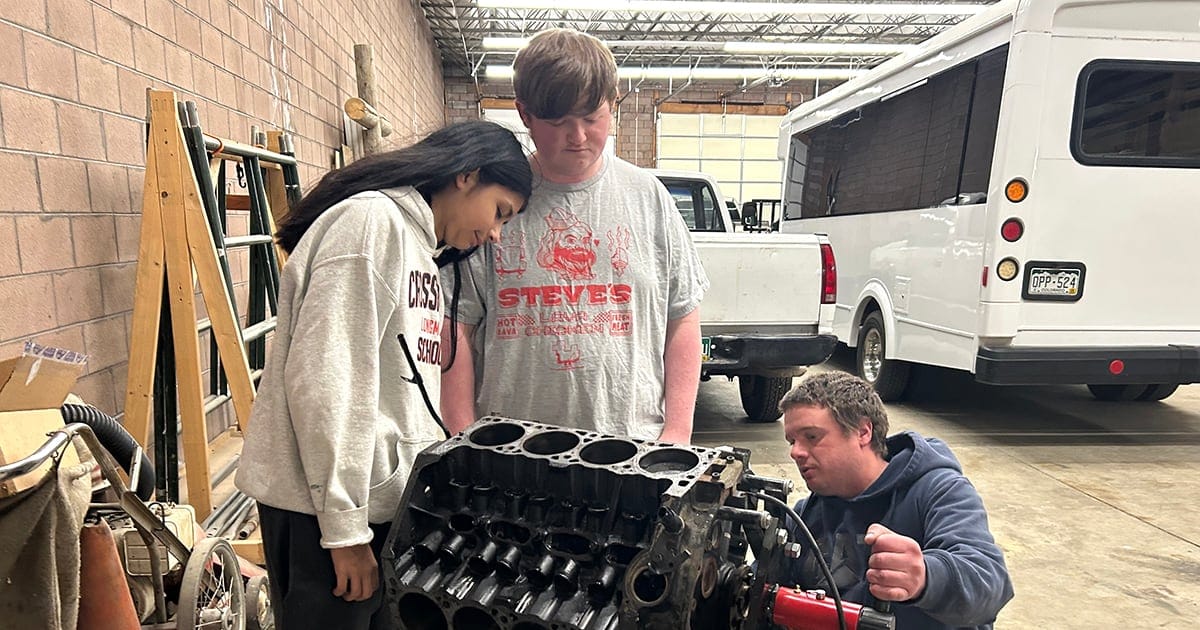
Barb Bulthuis runs Crossroads Workforce Readiness Program, a publicly funded homeschool enrichment program authorized by ERBOCES that serves about 30 high school students in Longmont. On Wednesday and Friday mornings, students take classes like future planning 101, basic automotive, basic carpentry, Spanish, and physical education.
On a recent morning, the automotive teacher and one other student looked on as ninth grader Jony Cano checked the air pressure of the tires on a silver Honda Odyssey parked inside a garage on the campus of FaithPoint Church. That’s where both the homeschool enrichment program and Crossroads School, a Christian school also led by Bulthuis, operate.
Cano, who hopes to become a diesel mechanic, said he used to get “straight Fs” at public school, but in seventh grade switched to Crossroads School where he is now earning As and Bs. This year, he joined the homeschool enrichment program.
Bulthuis said the enrichment program, which has a $144,000 budget, is not religious, is set up as a separate nonprofit from the school, and has a separate governing board. Some, but not all, students in the Crossroads Workforce Readiness Program attend Crossroads School.
Angie Jacklin’s 19-year-old son, a senior, only attends the workforce readiness program. Homeschooled until ninth grade, he joined the program last year as a junior after severe anxiety thwarted attempts to attend private schools in Loveland and Boulder. Before joining Crossroads, he took online classes.
“Our child was very excited that they could go one or two days a week and take a couple of classes and get used to being out among other people,” she said. “It helped us get from home to … a public place to learn, because they’re going to need that for college.”
ERBOCES has fueled growth
ERBOCES is expected to authorize 30 to 40 new homeschool enrichment programs by the end of this school year, according to a presentation Witt, the head of ERBOCES, gave last fall.
A dozen new programs were up for approval at just one ERBOCES board meeting in March. Nine more are up for approval Tuesday.
In addition to newly authorized enrichment programs, some of ERBOCES’ existing programs are expanding their footprints, either by enrolling more students or adding subcontractors. Altitude Performance Academy, a sports-focused program, is one of the programs that’s expanding, launching a six-hour-a-week gymnastics program next fall and an adventure program that includes ski lessons in 2027.
Eric Dinnel, the CEO of Altitude, is executive director of four other homeschool enrichment programs authorized by ERBOCES: Front Range Construction Academy, Renaissance Innovation Academy, Alpine International Prep Academy, and Colorado Agribusiness and Equine Sciences Academy.
Together, Dinnel’s five programs subcontract with more than two dozen groups around Colorado, according to their websites. Homeschooled students in the five programs also have access to tuition-free online classes through Shoreline Preparatory Academy, a school headed by Dinnel. It’s not clear where the funding for the online classes is coming from.
Dinnel did not respond to requests for comment.
Recent discussions among state lawmakers and education officials show that the state has little insight into or oversight of homeschool enrichment programs.
“There’s been an evolution of these models where just based on the number of times money is changing hands, it’s like people are trying to get into the business of providing homeschool enrollment,” Andrea Uhl, a legislative analyst, told the powerful Joint Budget Committee in March.
Sen. Judy Amabile, a Boulder Democrat, said at the meeting, “I was just shocked to see that there were all these private companies that were engaged in this work.”
Uhl said state audits of publicly funded homeschool enrichment programs have turned up concerning details, such as schedules that consist of one-time classes, sports on evenings and weekends, and private schools that merge homeschool enrichment time into their regular school days.
Funding cuts and new guardrails possible
Colorado officials are considering legislation and state rules that could cut homeschool enrichment funding and limit growth.
In March, the Joint Budget Committee ordered the drafting of a bill that would give a quarter of full-time funding to enrichment programs that operate the equivalent of one day a week. That means the state would pay about $3,000 on average per homeschool enrichment student instead of about $6,000.
That bill has not yet been introduced, and homeschool enrichment programs are lobbying for changes.
In addition, the State Board of Education last week approved a motion to push for a bill that would limit Boards of Cooperative Educational Services’ authorizing power so they could only approve schools and programs that would benefit students in their member school districts. The change would drastically curtail the reach of a co-op like ERBOCES, which has just two member districts.
Bulthuis, who runs Crossroad Workforce Readiness Program, is worried about funding cuts. Her homeschool enrichment program provides 90 to 100 hours of class time per semester.
“I have to do all of those same things for my program that a school does for a full-time program,” she said. “It’s not as much work as a full-time school, but it’s also not a quarter of the work.”
Bulthuis also said the estimated savings of up to $40 million from homeschool enrichment cuts is a drop in the bucket compared to Colorado’s public education budget, which is about $10 billion for K-12 schools this year.
But some lawmakers and public school advocates argue that even relatively small amounts of money matter at a time when public schools are laying off teachers and cutting programs.
Rep. Emily Sirota, the Democratic chair of the Joint Budget Committee, said state-funded homeschool enrichment programming “sounds very nice for the kids who are receiving it, but it seems very unfair to me … that we would continue to direct this vast sum of money to a program that is clearly being abused.”
Ann Schimke is a senior reporter at Chalkbeat. Contact Ann at aschimke@chalkbeat.org.
Ann Schimke 2026-04-14 23:55:35
Source link