
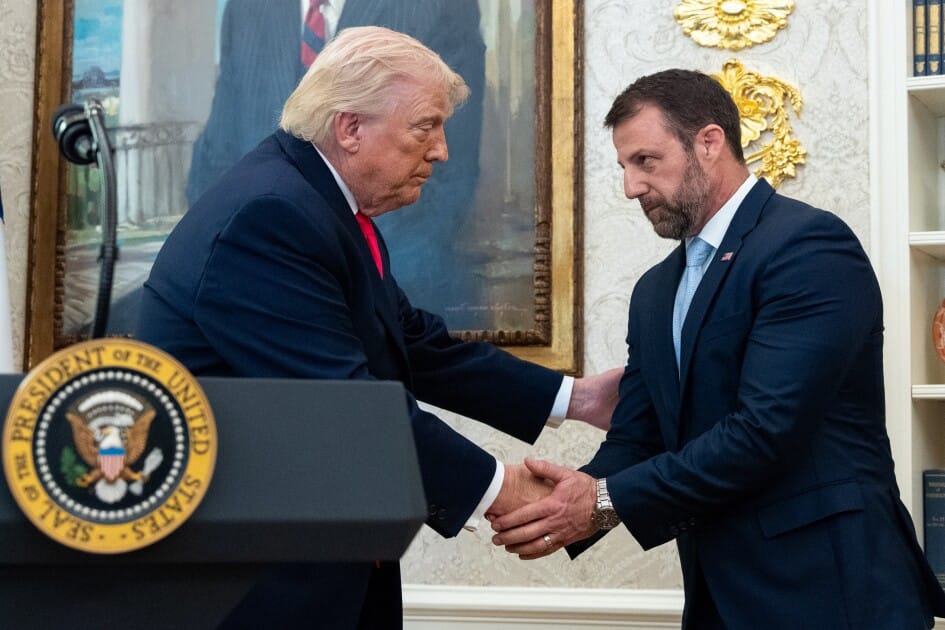
We, the board of directors of the National Academy of Education, sent a letter to Kristi Noem, the then-secretary of the U.S. Department of Homeland Security, and Todd Lyons, the acting director of U.S. Immigration and Customs Enforcement in February asking them to seriously consider the harms to students, families, teachers, and schools when making immigration enforcement decisions. We received no response. This week, former Republican senator Markwayne Mullin of Oklahoma was sworn in to replace Noem. We urge him to put in place protections against these harms.
Education has long been recognized as the backbone of our American democracy, and we have a strong legal and moral tradition of educating all children, regardless of their immigration status. Historically, schools have been protected spaces in our society designed to nurture healthy development and educate and socialize future generations to democratic values. Moreover, while approximately 6.3 million children under the age of 18 live with at least one unauthorized immigrant parent, all but about 1 million of those children are U.S. citizens. Research demonstrates, however, that the current immigration enforcement actions occurring across the country can have negative effects on all students in our schools.
Educators are reporting plummeting student attendance, decreased enrollments, emotional withdrawal, and fear and trauma associated with enforcement actions, regardless of the students’ immigration status. Research demonstrates that heightened immigration enforcement negatively affects student achievement, student attendance, and absenteeism. A recent study indicates that the January 2025 raids in California’s Central Valley coincided with a 22% increase in daily student absences, with particularly large increases among the youngest students. In addition to involuntary separations, persistent threats of separation have significant implications for the mental health of children and families, interfering with healthy development. For children, these mental health harms of forcible separation and the threat of separation include toxic stress, long-term risk for psychiatric disorders, chronic anticipatory anxiety, disengagement, and heightened emotional distress.
These enforcement actions harm not only students in immigrant families but also classmates and schools more broadly through disrupted learning environments; fear for themselves, friends, and classmates; strained student supports; and attendance-linked funding impacts in many states. As the research and news reports demonstrate, immigration enforcement actions in communities—regardless of where they occur—have a chilling effect on student attendance, harm students’ well-being, and impact the climate of the entire school.
In our letter to Noem and Lyons, first, we asked DHS and ICE to seriously consider these educational implications when making immigration enforcement decisions. Second, we urged them to restore and publicly reaffirm a clear policy that civil immigration enforcement actions will not occur at, or focus on, schools and school-related settings—except in the narrowest circumstances. For decades, DHS and its predecessor agencies recognized that schools occupy a special place in our civil society and that fear of enforcement in or near schools undermines access to education and harms children’s well-being (see, e.g., 1993 INS policy guidance and 2011 ICE policy guidance).
In 2021, DHS issued “Guidelines for Enforcement Actions in or Near Protected Areas,” restricting law enforcement activities “to the fullest extent possible” in or near “protected areas.” The directive indicated that it is a fundamental principle to refrain from law enforcement actions in or near locations that would “restrain people’s access to essential services or engagement in essential activities,” including but not limited to schools, child-care facilities, medical facilities, social services establishments, and places of worship. In addition to specifically identifying the examples of “[a] school, such as a pre-school, primary or secondary school, vocational or trade school, or college and university,” it also calls for protections for “[a] place where children gather, such as a playground, recreation center, childcare center, before- or after-school care center, foster care facility, group home for children, or school bus stop.”
In January 2025, DHS rescinded the 2021 guidelines, and ICE determined not to issue any specific rules, leaving discretion of where immigration laws could be exercised to the field offices.
Increased ICE enforcement actions, including at and near formerly protected areas, are reported daily in the media and confirmed by the Trump administration. We know that enforcement activities and the threat of such activities harm students’ learning and physical and mental health and have negative schooling implications. Further, research demonstrates that schools with “safe-zone policies”—similar to the federal policies adopted by DHS in 2021—can mitigate some of the harm, including reducing educational disruption, protecting academic progression, and supporting student well-being.
Taken together, this evidence supports a straightforward conclusion: When schools are perceived as enforcement-adjacent spaces, some families make decisions to avoid risk—regardless of their children’s immigration status—keeping children home, reducing engagement with educators, and disengaging from critical school-provided services. And when schools are sites of enforcement actions, students are traumatized. These actions harm not only students in immigrant families but also classmates and schools more broadly.
For these research-informed reasons, we requested in our letter that ICE:
- Reinstate and publicly publish a clear directive that civil immigration enforcement actions will not occur at or near schools, except under tightly defined exigent circumstances.
- Define “near” schools in operational terms (e.g., bus stops, drop-off/pick-up zones, school events, sidewalks, entrances, parking areas, and adjacent spaces commonly used by students and caregivers such as playgrounds), so families and school leaders can rely on the policy in practice, not just in principle.
- Require written, trackable supervisory approval for any proposed enforcement action implicating school settings, with prompt post-action reporting and meaningful accountability mechanisms.
- Issue training and implementation guidance for ICE personnel and relevant partners to ensure consistent compliance nationwide.
We understand that schools and educators will continue to confront the impact of enforcement actions in their communities when they enter their schools and classrooms. Implementing these policies, however, will allow educators the ability to focus on their important work and not have to prepare for potentially disruptive and traumatizing enforcement actions in schooling spaces.
We urge Secretary Mullin to consider the impact of enforcement activities on children, families, and schools, and to quickly implement these policy changes to better protect all children.
How to Submit
Education Week Opinion welcomes submissions from a range of perspectives within the K-12 education community. Regardless of your role in education, we want to hear from you.
2026-03-25 20:21:15
Source link