
Amid rapidly changing federal policy moves from the Trump administration on immigration this year, some conservative state leaders also made efforts to attack a landmark education-related U.S. Supreme Court case.
The 1982 decision in Plyler v. Doe granted undocumented students equal access to a free, public education. Attempts to undermine this have included proposals requesting families’ immigration status information at enrollment and charging tuition from undocumented families.
Following President Donald Trump’s election to a second term in 2024, an Education Week analysis found efforts taken in at least six states to challenge the Plyler decision. Five such attempts were paused or failed by the end of the year, while one effort remains in play until Dec. 31.
Meanwhile, at least two states, Illinois and Massachusetts, enshrined Plyler in state law instead.
Challenges to Plyler in years past have all failed. Nevertheless, in 2024, the Heritage Foundation, the conservative think tank behind the Project 2025 policy playbook driving much of Trump’s agenda, published a brief encouraging state leaders to challenge the decision with the long-term goal of getting the Supreme Court to overturn it.
Due to the rise in Plyler challenges in 2025, immigration advocates and legal experts remain vigilant in protecting its fate going into 2026, especially in the context of Trump’s mass deportation efforts.
“There’s nothing in the case law to suggest that [Plyler] is vulnerable or open to be challenged. What has changed is the political environment around these issues,” said Scott Levy, former chief policy counsel at FWD.us, a policy organization advocating to protect Plyler.
Where ‘Plyler’ attacks stand
Right now, Plyler remains the law of land. That means educators are advised not to ask students or families about their immigration status.
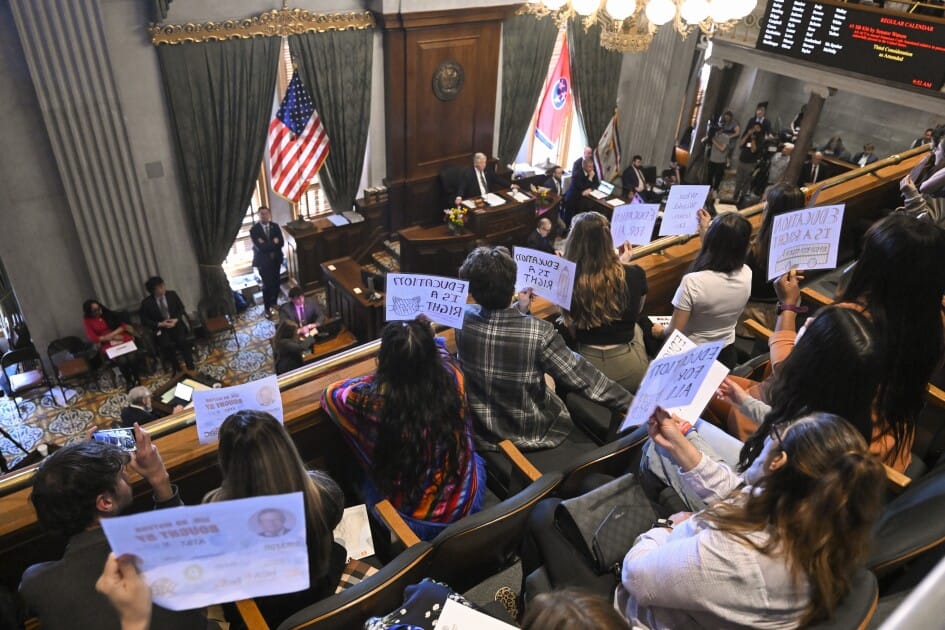
Still, those attuned to recent attacks against Plyler are keeping an eye on Tennessee, where Republican legislators introduced House Bill 793 and related Senate Bill 836 in February. Such legislation would require proof of citizenship or legal status to enroll in public schools, and would allow school districts and public charter schools to charge tuition to the families of undocumented students.
In April, House majority leader William Lamberth, a Republican, paused the legislation’s passage while it was moving through committees as he sought to confirm with the U.S. Department of Education whether it would jeopardize federal money for education in the state.
Immigrant student advocates in the state considered the pause a victory after months of protesting the bills.
In January when the new legislative session begins, the bill’s sponsor can put the legislation on notice to again be heard in the finance, ways, and means subcommittee. From there, the subcommittee can vote on the bill, roll the bill to a future meeting, or plan to take up the measure after the state budget has passed, said Krista Lee Carsner, the state’s director of the Office of Legislative Administration.
“There is nothing requiring the sponsor to put the bill on notice,” she added.
Lamberth did not respond to requests for comments regarding plans for the bill.
In New Jersey, a Republican legislator introduced Assembly Bill 5233 last January, which “requires students who are not U.S. citizens or legal immigrants to pay tuition to attend public schools.” The legislation made no progress this year and will fail Dec. 31.
Four other state efforts, in Idaho, Indiana, Oklahoma, and Texas, attacking Plyler this year failed.
Where leaders moved to protect ‘Plyler’
In Illinois, where the U.S. Department of Homeland Security launched massive immigration enforcement operations in Chicago communities this fall, Democratic Gov. JB Pritzker signed House Bill 3247 into law in August.
The new law codifies the right of undocumented students to receive a free, public education, and requires school districts to adopt clear policies protecting students from immigration enforcement activities in schools. While advocates cite immigration policies as critical resources for schools, a national EdWeek Research Center survey this year found that not all school districts report having such protocols in place. Of educators surveyed who work with immigrant families, 29% said their school or district has no immigration-related protocols in place.
Also in August, Massachusetts Gov. Maura Healey, a Democrat, signed Senate Bill 2575 into law which, among other provisions, amended state law to explicitly affirm the right to public education in the state for all children, regardless of disability or immigration status. In a press release, state Senate leaders said the move is an example of “strengthening state nondiscrimination law and aligning it with Plyler v. Doe.”
In December, the policy organization FWD.us published a report outlining the long-term benefits of Plyler since 1982.
The report, which was written by several researchers and was based on data from American Community Surveys from the U.S. Census Bureau, found that some 4.8 million people living in the United States have benefited from Plyler.
Beneficiaries of Plyler have also contributed via state and local income taxes over their lifetimes, with total contributions estimated to exceed the costs of educating them by over $633 billion, the report found.
Many of those who had access to free, public education due to Plyler finished high school and went on to college or university, granting them access to higher levels of income, and thus additional tax contributions to state and local coffers, said Phillip Conor, one of the report’s researchers from Princeton University.
Levy, formerly with FWD.us, hopes the organization’s report on the long-term economic benefits of educating undocumented children for free (as are all other children in the United States) will dissuade future attacks on Plyler.
2025-12-29 18:02:41
Source link