
Sign up for Chalkbeat Philadelphia’s free newsletter to keep up with news on the city’s public school system.
This story was published in collaboration with The New York Times.
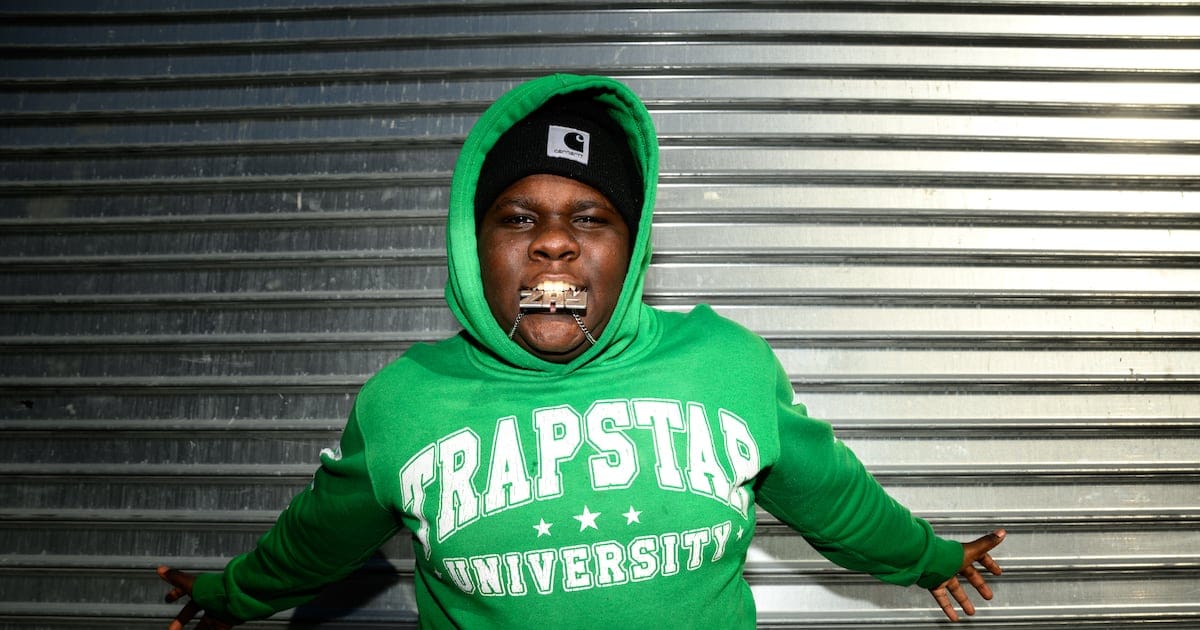
Zayvion Hamiel, also known as ZayMoney, sits at a DJ booth surrounded by speakers nearly as big as he is. He queues up a remix of Beyoncé’s “Run the World (Girls),” as a line of teens prepare to walk a makeshift runway.
This is Zay’s House. From the street, it looks like a nondescript building on a narrow block in North Philadelphia, one of the neighborhoods hardest hit by the city’s gun violence crisis. But inside is a community space where modeling practice, graphic design, and DJ-ing happen regularly, and where Hamiel, 13, his siblings and other aspiring creators spend some of their after-school time.
Teenagers in Philadelphia say music is key to helping them process the anger, grief, and loneliness that come with growing up around gunfire. Drill music, an aggressive subgenre of rap that has been accused of glorifying and inflaming violence, rose to prominence in the 2010s and has a hold on many teens. But a growing number of artists like Hamiel and programs in the city aim to harness music to deter violence.
“I started seeing these kids in the streets, and they’re fighting, they’re shooting each other, and I wanted them to stop,” Hamiel said. “That was when I was 6.”
That year, his cousin was shot. Hamiel soon started writing verses with his mother, who is also his music producer and manager and runs an anti-violence nonprofit. Their goal is to inspire young people to make and listen to rap that envisions a better Philadelphia.
Young, dying young trying to prove a point / Being Black in the hood and staying out of the joint.
— Zayvion Hamiel


Qidere Johnson, aka LGP Qua, rose to prominence as a young North Philadelphia artist pushing for a different kind of rap in the city.
Johnson, a father of two, filmed videos on porches and at community events, with lyrics touching on systemic inequities.
Then on Mother’s Day last year, he was shot in broad daylight in the city’s Kensington section. He was 30.
The community response to his death was swift and heartfelt. Government officials named a street corner after him. The Philadelphia rapper Meek Mill paid tribute on Instagram.
For many young rappers, like Honesty Dawkins, 16, Johnson modeled success in the face of intense social and industry pressure to make violent rap.
“For him to go against what everybody else is saying, being like, ‘Hey, yo, this isn’t cool — like, this is what we doing, and it’s not right,’ it was very brave of him,” she said.

Dawkins, who goes by the artist name Honimommi, lost a close friend to gun violence in January. While grief is part of her reality, her music focuses on confidence and success.
She started laying tracks in a closet-size recording studio at a violence prevention space not far from Zay’s House called As I Plant This Seed, where she still spends many evenings.
“I don’t talk about harming people and stuff like that,” she said of her lyrics. “I don’t want my kids to grow up thinking that Philly is just a bunch of gun violence and people who are rapping about gun violence.”
Resisting the lure of drill
A lot of commercial and social pressure pushes young artists to rap about gun violence. Drill rap, which originated in Chicago, is highly popular and notoriously heavy. Videos often feature rappers backed up by large groups of masked people holding guns.
“The drill scene really took off, especially in West Philadelphia, especially during the pandemic,” said the rapper Clinton Mills Jr., 25, who goes by CJ Da Prodigy. “If you a Philly rapper, people expect you to rap about killing and about selling drugs.”
The “virality of violence” on YouTube and other platforms makes producing music about it more alluring than addressing its root causes, said Christopher R. Rogers, a scholar of Black culture and an assistant professor at Haverford College near Philadelphia.
But drill music has caught the attention of prosecutors. “The district attorney has gotten involved,” said Vinte Clemons, who makes music as ARSIN and is one of the city’s first adult artists to explicitly push against violent rap. “A lot of people have got locked up. A lot of people have died over it.”
Bill Fritze, an assistant district attorney in Philadelphia, said his office’s investigations had diminished some groups, but he expected music celebrating bloodshed to continue as long as there was a profit motive.
Honesty Kearse, 19, said shifting music culture away from violence feels urgent. She lost a sibling to gun violence, and worries about the influence drill has on her younger brother and the teenagers he hangs out with. She is taking a rap writing class as a way to process the grief, and to try to get a message across to her peers.
“I just want a world where I don’t have to worry about if my siblings is gunned down just because they’re wearing black,” she said.
Kearse’s after-school program is one of many that youth mentors say help young people channel an interest in music making in a different direction.

When Jonathan Edwards started FamFrequency Productions four years ago, drill music “was all that,” he said, even among his students who weren’t actively involved in street crime. Today, he encourages them to tap into their authentic experiences instead.
“Reflect on your week; put this in a lyric,” Edwards said. “Now half the city who is 15 years old, who just broke up with their girlfriend can relate to that lyric.”
Cassidy Brown, 20, credits FamFrequency for helping him find his own voice.
“My brand started with a sort of Batman persona,” said Brown, who performs under the name c12. “It was dark. I was mad. I didn’t want anyone to know my face. I was kind of like a vigilante without the violence.”

After some time working with Edwards, he became more comfortable showing his face and rapping about subjects like race and gender identity.
“Tryna soften up a world that wants to see me as a brute. / Would my ancestors be proud to see how far I grew my roots?”
— Cassidy Brown
“As I progressed with my music I was like, I want everybody to know,” he said. “It feels amazing. It feels freeing. Because it’s a coping mechanism for me, just to dump all of that out there and get it off my mind.”
To make it in the music industry, Brown is broadening his mix of relevant skills. In addition to writing music, he is studying mechanical engineering at Temple University and interning at a local recording studio.


“Learning how to mix and match tracks and how to troubleshoot, learning how mics work,” he said. “That’s really where the money is at.”
Dancing to new beats
Close to 1,000 teenagers crowded the edges of a carpeted rectangular dance floor on a recent Wednesday, cheering and shouting as a three-on-three dance battle heated up.
“Tanging,” the Philadelphia-grown dance style that competitors perform, is fast-paced, athletic, and at times combative. It’s set to bouncy and explosive beats, a far cry from the heavy tones of drill rap.

When someone threw down especially hard, teenagers stormed the floor. An emcee kept it moving, and a row of judges perched on lifeguard chairs determined the winners.
At Level Up Philly, a West Philadelphia violence prevention initiative, teens and organizers say the dance scene lets young people burn energy while finding a sense of belonging they may otherwise seek from gangs.


“These are the ones who would just as easily be on the other side if we didn’t provide this,” said Aaron Campbell, the nonprofit’s founder and executive director.
On Campbell’s forearm, a tattooed line of seven stick figures marks every Level Up participant killed by a bullet from 2022 to 2025. Last summer, a dance battle emcee was shot and killed.
And then there are the injured children. Citywide, there have been more than 1,000 nonfatal shooting victims under 18 since 2020. Shootings have declined significantly since 2023. Campbell keeps gauze in the kitchen for changing bandages.
Dance is one way for young people to block out the negative, said Tacori Aaria Mateen. She’s 15, a rapper, athlete, and “kid influencer” with close to 600,000 Instagram followers. She’s known as the Philly Princess and also performs under the name T-Cori.
One of her most popular videos, “Hips,” features dozens of Philadelphia children goofing off with their friends, grooving in pajamas in their kitchens and dance-battling on their blocks.
“Dance like a butterfly, hips like a bee / Killin’ these moves like Muhammad Ali”
— Tacori Aaria Mateen
“The whole point is giving kids something to do than being out in the streets,” Mateen said. “Instead, you could go make a dance to this, or you could start making your own songs.”
Mateen performs at school assemblies, skating rinks, and pizza parties, sometimes with other youth influencers, including ZayMoney.


The violence prevention activist and music producer Tommy Blackwell said events where kids could express themselves were critical to deterring gun violence.
But sustaining those spaces is a challenge. An open mic Blackwell used to organize with a stipend for nonviolent rap performances has been on hold since November because a state grant dried up.
The challenge gains urgency as summer approaches, the prime season for block parties, music festivals and other opportunities for artists, and also when teenagers are out of school and shootings typically spike.
“There are thousands of LGP Quas in the city of Philadelphia,” Blackwell said. “We have to provide those platforms if we want to save lives.”
Visuals by Kriston Jae Bethel.
This article was published as part of a collaboration between The New York Times’s Headway Initiative and Chalkbeat Philadelphia, focused on gun violence in Philadelphia. This reporting is supported by the Stavros Niarchos Foundation (SNF), with the Local Media Foundation serving as a fiscal sponsor. Funders have no control over the selection, focus of stories or the editing process and do not review stories before publication. The Times retains full editorial control of the Headway initiative.
Sammy Caiola covers solutions to gun violence in and around Philadelphia schools. Have ideas for her? Get in touch at scaiola@chalkbeat.org.
Sammy Caiola 2026-04-12 10:00:00
Source link