
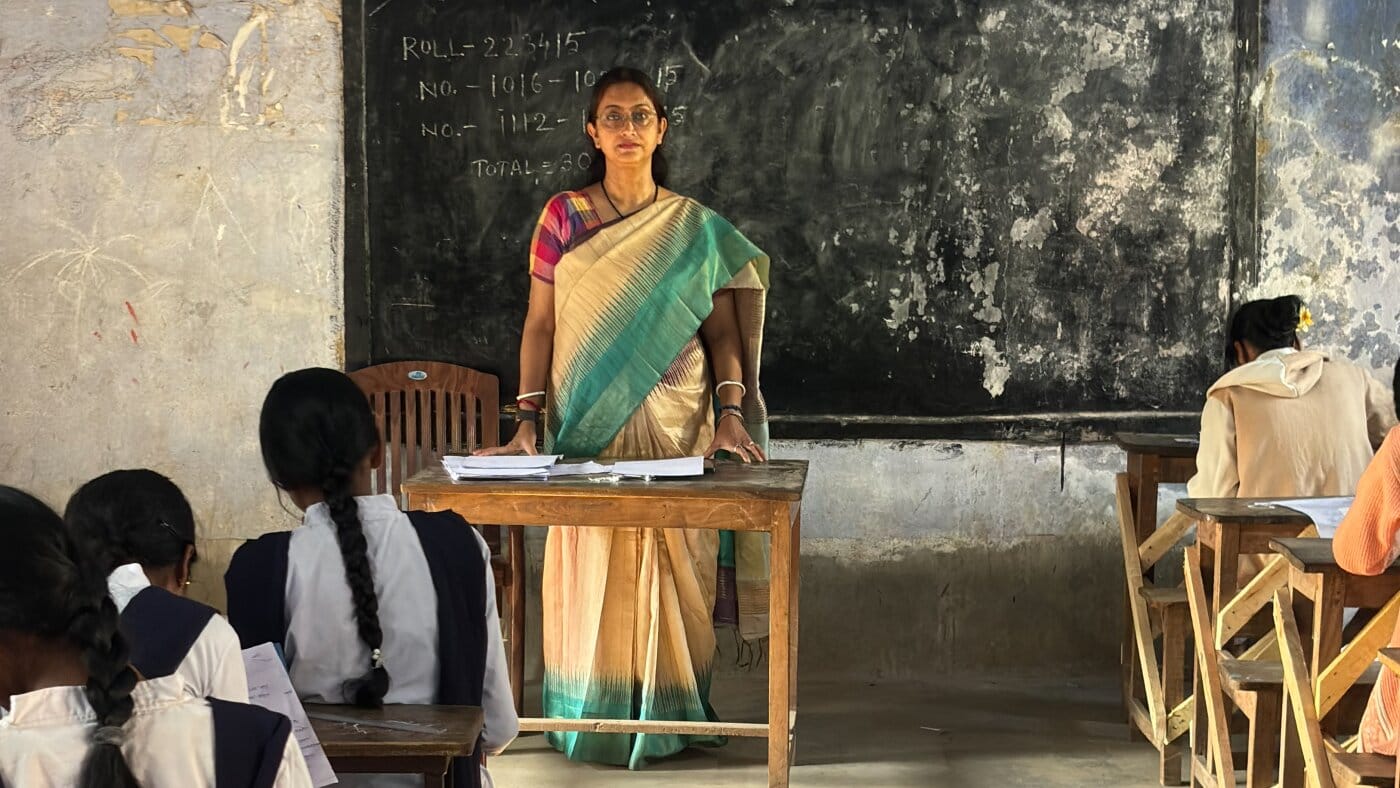
Joyeeta Banerjee in her classroom in India. She is an English teacher from Bankura, a district in a rural area of West Bengal, India. For 24 years she has taught first-generation learners — children who speak Bengali or Santali at home.
Anupam Gangopadhyay
hide caption
toggle caption
Anupam Gangopadhyay
When the letter from the Fulbright Distinguished Awards in Teaching Program arrived, it felt as though the sky had opened. I was going to America for four months to study how language learning could become more equitable. But almost instantly the joy was clouded by two questions from those around me:
“Who will look after your children?”
“What about your husband’s conjugal life?”
There were no questions about my research or how I hoped to use it to improve classrooms. Just these two questions — plain, practical and soaked in the belief that a woman’s dreams must not stray beyond her kitchen walls.
When a woman shares her success, it is never a full sentence. It always demands a footnote about duty and sacrifice.
I am an English teacher from Bankura, a district located in a rural area of West Bengal, India. For 24 years I have taught first-generation learners — children who speak Bengali or Santali at home. Their parents sign their names with trembling hands that carry the invisible weight of illiteracy. My classroom is small, the blackboard cracked, the ceiling fan slow. Yet within these modest walls burns a fierce desire to learn.
Now, during my fellowship term in Pennsylvania, I study and observe in schools that are modern and well equipped. Instructors are called “professionals,” not “lady teachers.” Students compose their essays on laptops instead of scraps of reused paper. Yet, even in these classrooms, I see female educators juggling motherhood, grading and exhaustion. Patriarchy, it seems, travels well; it only changes its tone.
Language has always been my chosen battlefield. In my classes back home, whether in school or the after-hours literacy classes in the slums, I tell my students, particularly the girls, that English is not a colonial badge. It is a tool to claim space, because in India, English is the language of opportunity, development and privilege.
But even as my students repeat words like freedom or choice, I know those words live precariously in their mouths. They can spell them but not always live them.
In India, nearly one in four young women are married before their 18th birthday. For girls who grow up without schooling, the number rises to almost half. When early marriage decides the course of a girl’s life, choice becomes a borrowed word — briefly held in school, then taken away at home.
Fulbright, for me, became a bridge between two selves — the teacher and the woman. The teacher analyzes syntax; the woman lives inside the syntax of social expectation. The research project I am developing here grew from that tension.

Joyeeta Bannerjee in her classroom in India. During a fellowship in Pennsylvania, she writes, “I study and observe in schools that are modern and well equipped. Instructors are called “professionals,” not “lady teachers.” Students compose their essays on laptops instead of scraps of reused paper. Yet, even in these classrooms, I see female educators juggling motherhood, grading and exhaustion. Patriarchy, it seems, travels well; it only changes its tone.
Anupam Gangopadhyay
hide caption
toggle caption
Anupam Gangopadhyay
The idea took shape when I discovered that Soma, a 15-year-old girl in my class, could flawlessly copy every English word from the blackboard, but when I asked her what those words meant, she folded the edges of her notebook and fell silent. My Dual Toolkit is for girls like her. It does something simple yet radical: It listens. It doesn’t test whether students can memorize; it asks whether they can understand. It uses the textbooks already in their hands as a doorway, and their home language as the light that helps them see meaning inside. If English is the gatekeeper of opportunity in India, then this Toolkit is my way of handing them the key.
First-generation learners and women like me, the first teacher from a government-sponsored school to be selected for this award, share something: We are both firsts, both trying to write sentences the world has not yet approved.
Sometimes, after school visits, I return to my dorm room — a room of my own — and think of the girls in my classroom or from the slums in Bankura, sitting on rough benches, their hair oiled and braided, their notebooks open like small windows. I wish they could see how much of what the world calls “advanced” still struggles with the same basic framework of gender.
When I go home, the questions will return.
“Who looked after your children?”
I will say, “They learned independence.”
“What about your husband’s conjugal life?”
I will answer, “He survived my absence and perhaps learned solitude.”
Every woman who crosses an ocean for her work carries rebellion in her suitcase. Mine is lined with lesson plans, stories of my girls from my school and the slums, and a stubborn belief that my worth does not depend on how well I maintain other people’s comfort. Education, after all, is an act of faith that minds can open, that even inherited questions can change.
I hope that one day, when another woman from a small town in India wins a fellowship abroad, someone will simply ask her:
“What will you discover?”
The author of this publication is a participant in Fulbright Teacher Exchanges, programs of the United States Department of State, administered by IREX, a nonprofit global and educational organization. The views and information presented are the grantee’s own and do not represent the views of the U.S. Department of State, the Fulbright Program, or IREX.
Joyeeta Banerjee 2026-03-01 13:36:43
Source link