
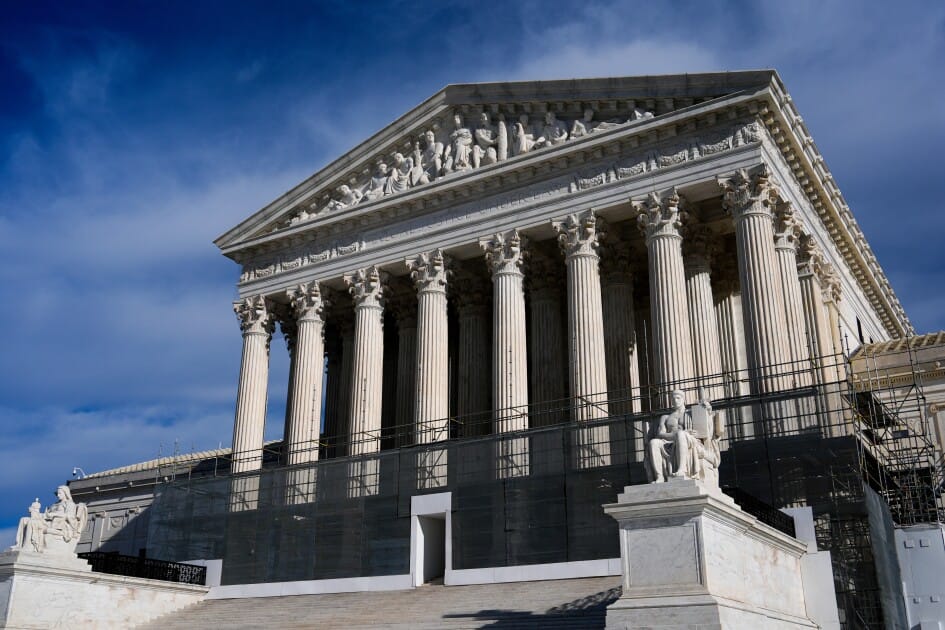
A group of California parents has asked the U.S. Supreme Court to reinstate a federal district court decision that said parents have a federal constitutional right to be informed by schools of any gender nonconformity and social transition by their children.
A federal appeals court earlier this month blocked the district court decision, calling it too “sweeping” and “ambiguous” and likely wrong on the merits.
The pause by a panel of the U.S. Court of Appeals for the 9th Circuit, in San Francisco, reinstated a mandate by the California Department of Education that restrains teachers and district staff members from informing parents about a child’s gender identity at school, unless the child consents.
“California is requiring public schools to hide children’s expressed transgender status at school from their own parents—including religious parents—and to actively facilitate those children’s ‘social transition’ over their parents’ express objections,” the challengers say in their Jan. 13 Supreme Court filing in Mirabelli v. Bonta.
The high court filing notes that the parents, who are represented by the conservative legal organization Thomas More Society, have also asked a larger panel of the 9th Circuit to review the pause.
“But California parents’ religious and fundamental parental rights—and the health and safety of their children—are too precious for them to delay seeking relief from this court,” the filing says.
Justice Elena Kagan, who handles emergency requests from the 9th Circuit, gave the state until Jan. 21 to reply. She could then rule on the emergency request herself or refer it to the full court.
A broad class action of California parents and teachers
U.S. District Judge Roger T. Benitez of San Diego said in his Dec. 22 decision that state and local “parental exclusion policies” are “designed to create a zone of secrecy around a school student who expresses gender incongruity.”
The district judge said the Supreme Court last year reaffirmed parental rights in education in its decision in Mahmoud v. Taylor, which held that parents have a First Amendment free exercise of religion right to exclude their children from public school lessons on gender identity and sexual orientation.
Benitez said parental-exclusion policies deprive parents of the opportunity to decide for themselves and their child whether to pursue “psychological counseling, psychiatric care, gender-affirming care, family acceptance, or something else.”
The judge separately ruled that teachers who raised objections to the parental exclusion policies have First Amendment free speech and free exercise of religion rights to notify parents about their students’ gender issues.
Benitez certified the challenge as a class action and allowed any parent or public school employee objecting to such policies on religious grounds to submit an opt-out form.
California Attorney General Rob Bonta, a Democrat, asked the 9th Circuit to block the judge’s decision, which the court did on Jan. 9. The panel said the certified class was too sweeping and that Benitez had failed to identify the specific policies he was blocking, since the state does not, in all circumstances, forbid disclosure of students’ gender-identity information to parents.
The Supreme Court filing by the challenging parents highlights the allegations of one challenging family, identified as the Poes. The parents say their middle school daughter was treated as a boy at school for most of a year, before they found out when the child attempted suicide. Even a new public school refused to communicate with the parents about the child’s gender identity, citing the state-mandated parental-exclusion policies, the filing says.
“To this day, the Poes continue to be left in the dark regarding their daughter’s gender presentation at school,” the filing says.
Lawyers for the challengers say the 9th Circuit panel wrongly viewed the Supreme Court’s Mahmoud decision allowing parental opt-outs based on religious beliefs as limited to curricular matters.
But “whether a policy applies in the school classroom, lunchroom, or restroom, it may still substantially interfere with parents’ rights to instill in their children the principles of their faith,” the filing states, quoting a judge from a similar case.
The filing notes that the Supreme Court is considering whether to take up other cases about schools’ interactions with parents over gender-identity issues, and it suggests the justices, “given the importance and urgency of the issues,” might want to grant full review of the California case at this early stage.
The court, at its private conference this Friday, will consider two pending appeals that raise similar issues. One is Foote v. Ludlow School Committee, involving a federal appeals court ruling that rejected a parental-rights challenge to a Massachusetts district’s gender-notification policy. The other is Littlejohn v. Leon County School Board, in which another federal appeals court ruled against parents who alleged their district aided their child’s “secret” gender transition.
A decision about whether to take up those cases could come as soon as Friday, but the court may not decide right away.
2026-01-14 21:27:42
Source link