
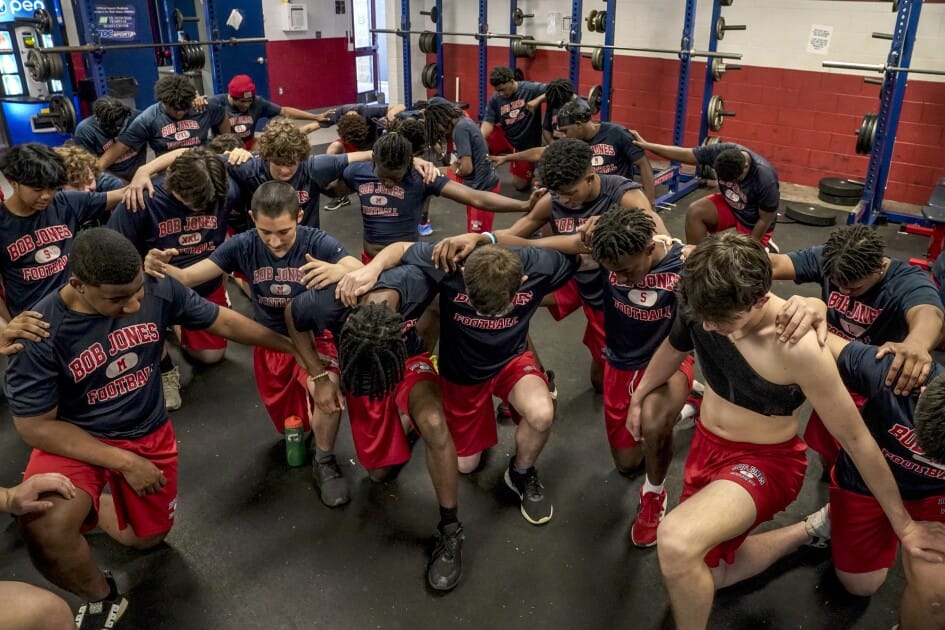
President Donald Trump last fall promised new legal guidance from the U.S. Department of Education that would ensure “total protection” for the right to pray in public schools.
That guidance is now out, and it makes clear that students and teachers can pray in school as long as it’s not disruptive to other students and school activities and that no one is coerced into praying. The guidance also says teachers and school staff can pray at school as long as they’re not doing so in their professional capacity and requiring students to participate—though it’s OK to pray with willing students.
In addition, schools are to protect students from religious harassment and make accommodations for students who need to pray at specific times. But schools cannot sponsor devotional activities, and they must treat religious student groups the way they would any other type of student club.
By and large, the rules and principles in the guidance document don’t mark a radical departure from the document it replaced, which the Biden administration developed in 2023. Periodic guidance on prayer in schools is required under the Every Student Succeeds Act.
Where the new guidance differs is in its emphasis on protecting the individual right to free religious exercise in school, particularly for educators, above maintaining school as a religiously neutral setting, said Suzanne Rosenblith, the dean of the Graduate School of Education at the University of Buffalo, who specializes in legal and political issues in education.
“I don’t envy an administrator that wants to really achieve substantive neutrality in schools from their professional staff, and they’re in an environment where you might be able to push those boundaries,” she said.
Both the Biden and new Trump versions of the prayer guidance acknowledge that teachers and administrators can pray during the school day as long as it’s not in their professional capacity and that they’re not coercing students into praying.
The Biden administration version outlined religious activities teachers could participate in before school or during lunch—such as prayer or Bible study with colleagues—and noted that teachers are free to pray during the workday just as they’d also be allowed to make a quick, personal phone call.
It also specifically said public schools can’t provide religious instruction, though they can teach about religion.
The new Trump administration guidance doesn’t include that same admonition against religious instruction (though it doesn’t endorse it), and it doesn’t include those examples delineating when a teacher is acting in a personal vs. professional capacity. It also says teachers are free to pray with students.
“A teacher may bow her head to say grace before lunch, and students may join her in grace, but she may not instruct her class to pray with her, pressure them to pray with her, or create an atmosphere in which students are favored if they pray with her,” the new guidance reads.
In effect, Rosenblith said, the guidance can “muddy the waters” and “give teachers more wiggle room to push some boundaries” between professional and personal conduct.
Guidance from the Education Department isn’t legally binding. Rather, it’s a statement from the agency on how it intends to enforce federal laws and evaluate civil rights complaints.
“Our Constitution safeguards the free exercise of religion as one of the guiding principles of our republic, and we will vigorously protect that right in America’s public schools,” Secretary of Education Linda McMahon said in a Feb. 5 statement announcing the new guidance.
Traditionally, courts have viewed school prayer through a lens of protecting students—considered a “captive audience” at school because they have to attend—from undue coercion, Rosenblith said.
But the latest guidance cites recent Supreme Court rulings that have increasingly favored religious accommodations in public schools and other settings to prioritize individual religious expression. One of those was the 2022 Kennedy v. Bremerton School District case, in which the court said a football coach’s post-game prayers at mid-field with students were a personal observance protected by the First Amendment. And the court last year said parents with religious concerns could opt their children out of lessons with LGBTQ+ content.
“What the administration is saying is, effectively, we have a sympathetic court, and so we can see these things through,” Rosenblith said.
2026-02-10 21:32:31
Source link