
by Terry Heick
Before the ideas, let me preface this by acknowledging that many of these–if not most–aren’t feasible in most classrooms and schools.
I taught for years and tried to shoehorn ideas like this into my teaching, and it was rewarding but exhausting and ultimately resulted in my becoming a pariah in my own school/district. I didn’t intend on ‘not being a team player,’ but that’s exactly how ideas like these look to–well, to some people. I’ll leave it at that. (See also Teaching Disruptively.)
Since I’m not going to explain how to accomplish these kinds of shifts (that’d be a book), though, I do refer to some of the posts I’ve created over the years that elaborate on some of these ideas. The purpose of this post, then, is to vaguely sketch the possible characteristics of an innovative classroom.
You may disagree strongly with every single one, and that’s okay. These are all opinions and when you, as an educator, attempt to help the students in your classroom grow, they may have needs that take precedence over these–basic reading skills, student organization skills, classroom management, etc. I get it. I only want to contribute to the conversation of how we might eventually replace classrooms where its ‘management’ is the primary concern.
See Also The Elements Of A Literacy-Rich Classroom Environment
The big idea? Moving the conversation from innovation for the sake of appearing innovative to innovation that is sustainable, centered around people and communities, at a scale that actually works.
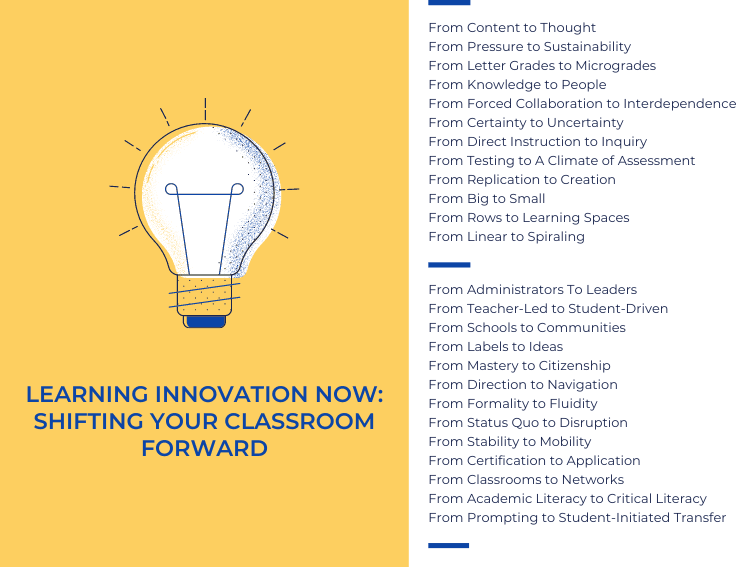
The Shifts And Characteristics Of An Innovative Classroom
From Content to Thought (see also Are You Teaching Content Or Are You Teaching Thought?)
From Pressure to Sustainability (See also the Agrarian Learning Model.)
From Letter Grades to Microgrades (See also How Gamification Can Uncover The Nuance Of The Learning Process.)
From Knowledge to People
From Forced Collaboration to Interdependence
From Certainty to Uncertainty (See also How To Teach For Knowledge Through Humility.)
From Direct Instruction to Inquiry (See also Alternatives To Lecturing In The Classroom.)
From Testing to A Climate of Assessment (See also 50 Formative Assessment Strategies.)
From Replication to Creation
From Big to Small
From Rows to Learning Spaces
From Linear to Spiraling (See also Learning Is Not Linear. Why Is Curriculum?
From Administrators To Leaders
From Teacher-Led to Student-Driven
From Schools to Communities (See also The Characteristics Of A Good School.)
From Labels to Ideas
From Mastery to Citizenship (See also Examples Of Digital Citizenship.)
From Direction to Navigation
From Formality to Fluidity
From Status Quo to Disruption (See also How Disruption Causes Lasting Change In Education.)
From Stability to Mobility (See also 12 Principles Of Mobile Learning.)
From Certification to Application
From Classrooms to Networks
From Academic Literacy to Critical Literacy (See also The Relationship Between Reading And Critical Literacy.)
From Prompting to Student-Initiated Transfer (See also Showing What They Know: Categories Of Cognitive Transfer.)
Terry Heick 2025-12-03 15:25:00
Source link