
Kim Freudenberg, a longtime teacher in San Francisco, knew that raising two boys meant a lot of hard conversations. She warned them about all the usual dangers: drugs, alcohol, sex, social media, riding a bike without a helmet.
“Never once did I even think that I needed to say ‘gambling,'” she recalls.
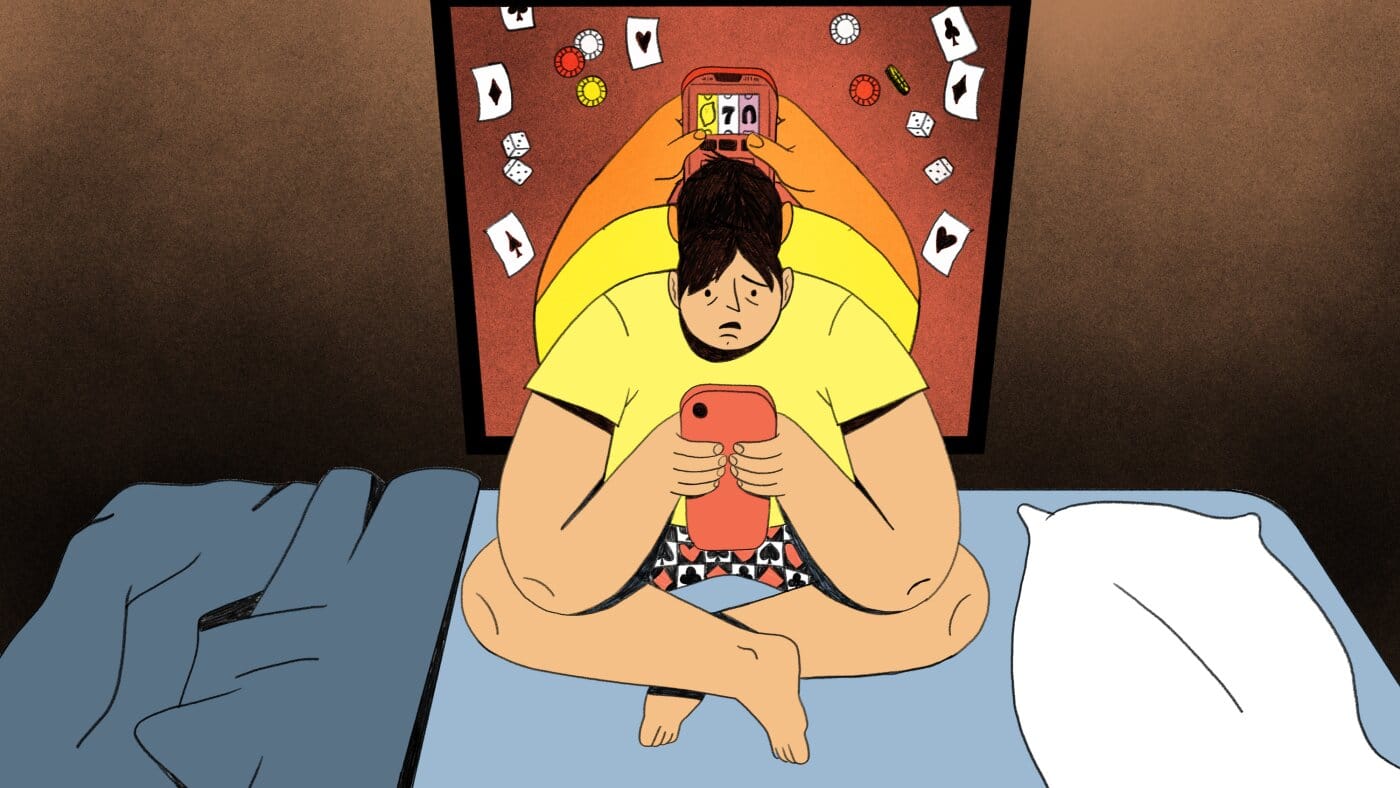
One day, when her oldest son was 11, he was watching someone play video games on a livestream and clicked on a link in the comments. It took him to an offshore online casino.

There, he got sucked in — to blackjack, poker, roulette. He could use items from the video game as money. Soon he got hooked, but the signs of his addiction were hard to spot.
“It’s not like he was just holed up in his room 24-7,” Freudenberg says. “He ran track. He played soccer. He was a great student.”
Until he dropped out of college at age 19. That’s when his mom found out that he had been gambling for nearly half his life.
He’d sold things from around the house to keep up with his debts, borrowed money from friends and, then, eventually, started stealing money from his parents.
It’s a problem that educators, researchers and parents like Freudenberg say is affecting a growing number of young people, most of them boys. A recent national survey from Common Sense Media found that 36% of boys age 11 to 17 in the U.S. have gambled in the past year.
“It’s a lot of kids,” says Michael Robb, the head of research at Common Sense Media, a nonprofit that promotes digital safety for kids. “A third of kids is a lot of kids.”
He notes that playing fantasy football with friends or making a March Madness bracket may be harmless. It could, for example, help strengthen male friend groups. But for a small subset of boys, Robb adds, things can get out of control: “They’re not all going to have problems. But given how much things have changed in the last couple of years, the way [some kids] are engaging in gambling behaviors is already flashing red signs.”
It’s not just teens. Gambling has soared in the U.S. since a key Supreme Court ruling in 2018 allowed states to legalize sports betting. That opened the floodgates, from one state back then to 38 in 2024.
Before that decision, Americans spent $4.9 billion annually on sports betting. By 2023, that figure had ballooned to $121 billion, according to The Journal of the American Medical Association (JAMA).
And those were just the legal bets. No one under 18 can gamble legally, but experts say the opportunities are everywhere.
“If I wanted to bet on the [Washington] Nationals,” says Matt Missar, an addiction counselor in Pittsburgh, “20 years ago, as a teenager, I’ll go find a bookie and I’ll place a bet. Nowadays, I can bet on every single pitch of a game.”
Much of the explosion in legalized gambling is happening on cellphones, Missar notes. “It is incredibly easy.”
He specializes in gambling and video game addictions and says the number of young adults he sees come through his practice has ticked higher in recent years.
“It’s not just that the problem arose when they’re 18,” he says. “It started when they were 13 or 14 … and slowly over those years it became more of a problem.”
Freudenberg wishes she had seen the warning signs. But often, she says, online gambling can look the same as texting a friend or watching a video.
She thinks removing the guardrails has created a slippery slope for kids: “If my kid had to get in a car, drive to a bank, take out money, drive to a casino, go into the casino, show an ID at the door — he probably wouldn’t be a gambling addict.”
After a few attempts at rehab, she says, her son is back at college and doing well. Freudenberg helped start a support group for parents of teen gamblers, and their numbers are growing.
She fears that, all over the country, there are lots more parents just like her.
“The tsunami is on the horizon,” she says. “And it’s gonna be really, really bad.”
Sequoia Carrillo 2026-04-05 09:00:00
Source link