
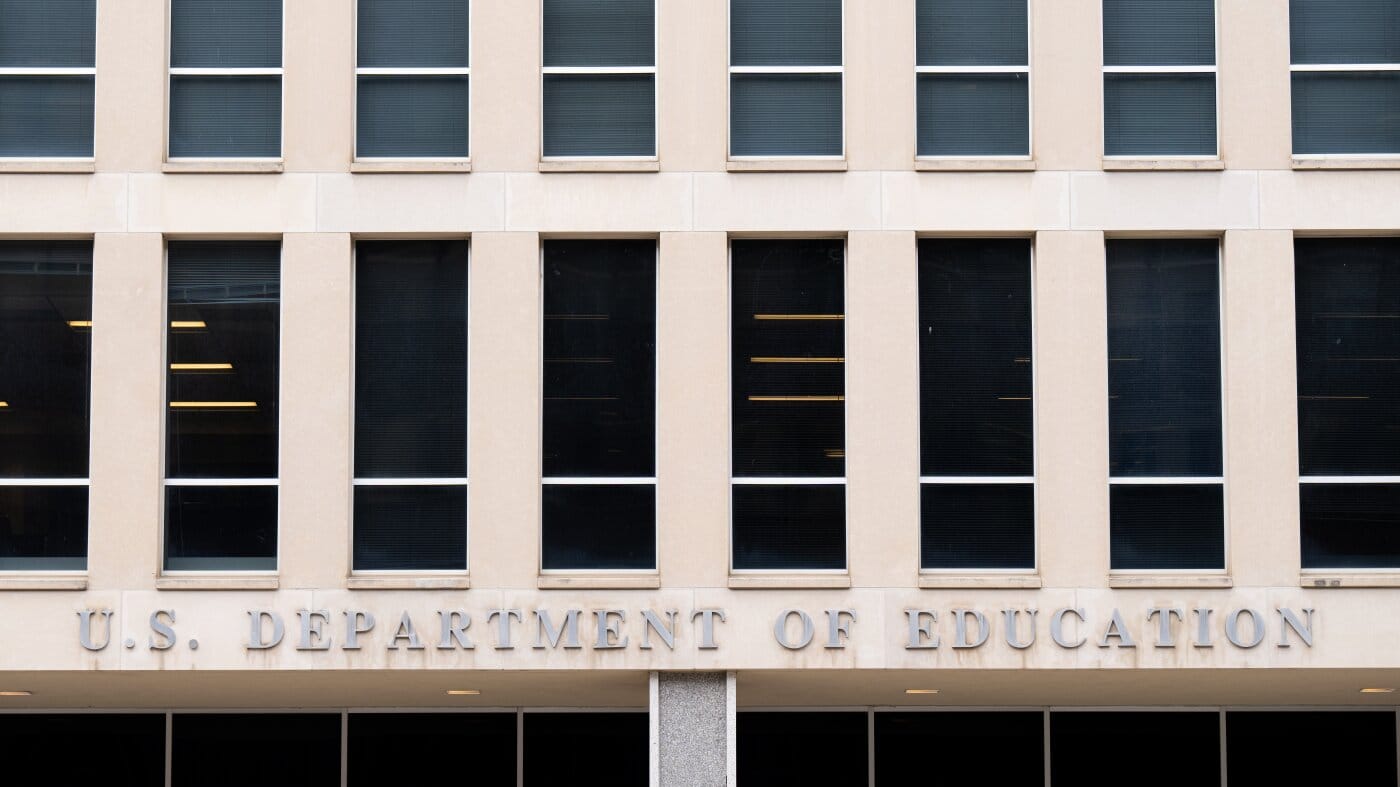
The Lyndon Baines Johnson Building, which houses the U.S. Department of Education, in Washington, D.C.
Bill Clark/Getty Images
hide caption
toggle caption
Bill Clark/Getty Images
A new report from a government watchdog suggests the Trump administration’s efforts to fire staff at the U.S. Department of Education cost taxpayers tens of millions of dollars.
The report, from the nonpartisan U.S. Government Accountability Office (GAO), focuses on the department’s Office for Civil Rights (OCR), which investigates complaints of discrimination in schools based on students’ sex, race, national origin, disability and more.
In March, the administration attempted to fire more than half of OCR’s civil rights attorneys and staff. At the time, Education Secretary Linda McMahon said the cuts reflected the department’s commitment to “efficiency” and “accountability.”

But, when that reduction-in-force (RIF) was blocked by the courts and the Education Department was forced to retain and continue paying these staff, the department prohibited them from returning to work.
For nearly nine months, from March 21 to mid-December, “there were 247 people on administrative leave from OCR who were being paid while not being allowed to work,” says Jackie Nowicki, lead investigator of K-12 issues at GAO, “and that decision came with a cost.”
A cost of between $28.5 million and $38 million, according to GAO.
Sign up for the NPR Education newsletter
How GAO came to these numbers
Nowicki says the Education Department did not share a complete accounting of the RIF’s costs and/or savings, leaving GAO investigators to arrive at their own rough calculation using workers’ salaries and benefits. The report recommends that the department do a full accounting now.

Kimberly Richey, who was appointed by President Trump to run OCR, rebuffed that suggestion in a written response to GAO’s report.
Richey argues, because the Education Department eventually rescinded its RIF notices to OCR staff and returned attorneys to active duty in December, the topic is “moot.” “We do not concur with the recommendation,” Richey writes.
The report points out the department was supposed to have done this math already. Guidance from the Office of Management and Budget (OMB) and the Office of Personnel Management required that the department document the full costs and savings of its staff cuts. GAO investigators write that the Education Department “could not demonstrate that it included all potential costs and savings” and that it had not documented its analysis.
Education officials told GAO they had done the analysis but relayed its results to OMB “orally,” according to the report.
The department is expected to report to Congress within 180 days on whether it agrees or disagrees with the recommendation. What to do beyond that will be up to lawmakers.
“Every child in America should be able to get a good education no matter where they live, what their religious beliefs are or whether they have a disability,” said Sen. Bernie Sanders (I-Vt.), who requested the GAO study. “Instead, the Trump administration fired half of those working to protect the civil rights of students and wasted as much as $38 million in taxpayer dollars by preventing investigators from doing their jobs. That is unacceptable.”
The department is dismissing many cases and issuing fewer resolution agreements
According to GAO, from March to September, OCR resolved more than 7,000 discrimination complaints, but about 90% were resolved by the department dismissing the complaint, meaning staff received information from complainants but did not proceed to investigate. Dismissals are not an immediate red flag and have long been a common tool at OCR. But how common?

GAO offers two points of comparison, based on available data: In the 2019-20 school year, during Trump’s first term as president, 81% of OCR complaints were resolved through dismissal; in 2010-11, the dismissal rate was 49% under the Obama administration. The GAO report did not provide data for other administrations.
Public data tells a more nuanced story of OCR’s work under the second Trump administration:
- After Trump’s 2025 inauguration OCR reached a resolution agreement in just two racial harassment cases the rest of the year. In 2017, the first year of the first Trump administration, it resolved more than 30.
- In 2017, the Trump-led OCR reached agreements in roughly ten times as many disability discrimination cases as it did in 2025.
- And finally, OCR resolved nearly 60 sexual harassment cases and 15 sexual assault cases in 2017. After Trump’s second inauguration, the office did not reach a resolution agreement in a single case of school-based sexual harassment or sexual assault for the rest of the year.
“I’m really befuddled by that,” says Beth Gellman-Beer of the sexual harassment and assault resolution numbers. She ran OCR’s Philadelphia office until it was closed in March and she received her RIF notice. Gellman-Beer spent 18 years at OCR and says preventing sexual assault and harassment “was a priority area under the first Trump administration.”
NPR reached out to the Education Department for comment on the 2025 resolution numbers and did not hear back.
According to GAO’s findings, which mirror previous reporting by NPR, if the Trump administration is ultimately allowed to cut every OCR staffer who originally received a RIF notice, 62 staff would remain – just 10% of the office’s size when the Trump administration began.
Cory Turner 2026-02-02 10:00:00
Source link