
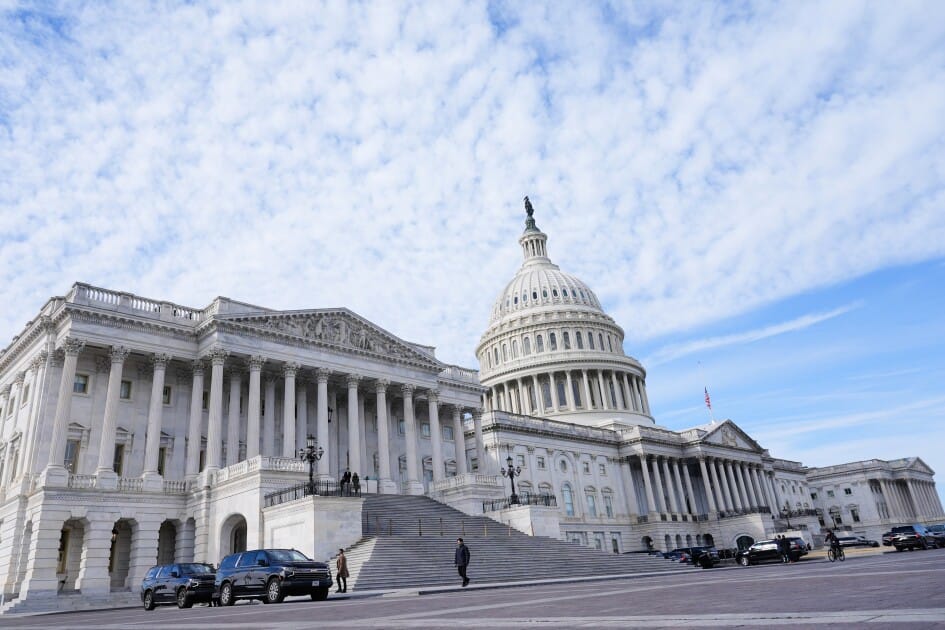
Parts of the federal government—including the U.S. Department of Education—could shut down again starting this weekend.
Since Congress ended the previous, longest-ever shutdown in November, lawmakers have approved and President Donald Trump has signed half of the annual slate of federal funding bills for the fiscal year that’s already close to one-third of the way over.
As recently as Friday, the House had approved fiscal 2026 funding bills for the remaining eight agencies, including the Education Department. The Senate appeared on track to do the same this week.
But that all changed on Saturday morning, when ongoing protests intensified after federal Homeland Security agents in Minneapolis fired at least 10 gunshots in five seconds and killed Alex Pretti, a 37-year-old intensive care nurse for the U.S. Department of Veterans Affairs.
As news and video footage of the shooting spread over the weekend, key Democratic senators who had gone against their party to support the deal ending the last shutdown condemned immigration agents’ conduct and came out against advancing the Homeland Security spending legislation.
The shooting, plus a snowstorm blanketing much of the country, has significantly raised the likelihood of a partial federal shutdown. Here’s what we know as of Jan. 26.
Senators are running out of time to pass spending bills
Senate Republicans need at least seven Democratic votes to meet the 60-vote threshold for approving appropriations bills. By the end of Sunday, in response to Pretti’s death as well as the broader escalation of violence in Minneapolis, Democratic senators had announced en masse they would not advance the funding bill for the Department of Homeland Security unless it’s rewritten to include restrictions on Immigrations and Customs Enforcement (ICE) operations.
That bill is part of the same legislative package that includes funding for seven other agencies: Defense; Education; Labor; Health and Human Services; Housing and Urban Development; Transportation; and the Treasury.
Even before Pretti’s killing, only seven Democrats had voted to approve the Homeland Security spending bill in the House while the measure including the Education budget garnered widespread support.
On Sunday night, Senate Minority Leader Chuck Schumer, D-N.Y., urged his Republican counterparts to advance the five non-Homeland Security funding bills in time to pass them by Jan. 30.
“If Leader Thune puts those five bills on the floor this week, we can pass them right away,” he said in a statement, referring to Senate Majority Leader John Thune, R-S.D.
That may be easier said than done.
Sen. Susan Collins, R-Maine, who chairs the appropriations committee, said Monday she’s “exploring all options” with Thune.
But Senate Republicans so far have not publicly indicated they’re willing to separate votes on the Homeland Security bill from the others. And due to the winter storm, senators won’t be back at work until Tuesday afternoon, leaving roughly 72 hours to resolve differences and finish the job.
The Education Department would shut down without an agreement
If Congress doesn’t approve the Education Department spending bill by the Jan. 30 deadline, that agency would shut down for the second time in three months.
More than 2,000 staffers would be furloughed, according to the shutdown plan Secretary Linda McMahon published last fall. And many of the department’s daily activities would come to a halt, including running new grant competitions and conducting civil rights investigations.
A short shutdown for the Education Department wouldn’t pose a major threat to schools’ federal funding. Most of the money schools get annually from the federal government arrives in their bank accounts over the summer.
But there are a few exceptions, including Impact Aid, the program that supplies monthly installments of funding to the more than 1,000 districts nationwide that have non-taxable, federally owned land within their borders.
Head Start providers of early-childhood education, which depend on monthly funding from the U.S. Department of Health and Human Services, could also face temporary fiscal pain if that agency shuts down for more than a few days.
A prolonged shutdown could delay department staffers’ efforts to prepare funding that schools expect to receive in the coming months.
School districts would have to wait even longer for clarity on federal funding
District leaders nationwide would also experience yet another delay in getting clarity on what to expect in federal funding for next school year.
When Congress follows the prescribed schedule for passing a federal budget, funding levels for education programs are in place nearly a year in advance.
Instead, many school districts have begun bracing in recent months for a dramatic reduction in federal funding through key formula programs. The Trump administration proposed reducing federal investment in K-12 schools by $7 billion a year, though lawmakers have since proposed several budget drafts with less dramatic cuts.
The bipartisan, bicameral spending deal that lawmakers unveiled earlier this month and that passed the House assuaged some of those concerns, proposing level funding or slight increases for virtually every existing Education Department program.
Federal employees would face a fresh round of uncertainty
Whether the federal government shuts down again or not, Education Department staffers may have more reasons to worry as January ends.
During the first week of the previous shutdown, the Education Department abruptly sent layoff notices to 465 employees, including nearly every staffer who works on federal grant programs that touch K-12 schools.
The legislative deal that ended the shutdown rescinded those layoff notices and blocked the agency from additional staff reductions—but only through Jan. 30.
In the months since, the Department of Education has signed a slew of “interagency agreements” shifting management of many of its programs to other agencies, including the departments of labor, state, and the interior.
An agency spokesperson didn’t answer questions Monday about whether staff members will remain in those jobs even after the layoff ban expires on Jan. 30.
2026-01-26 21:36:43
Source link