
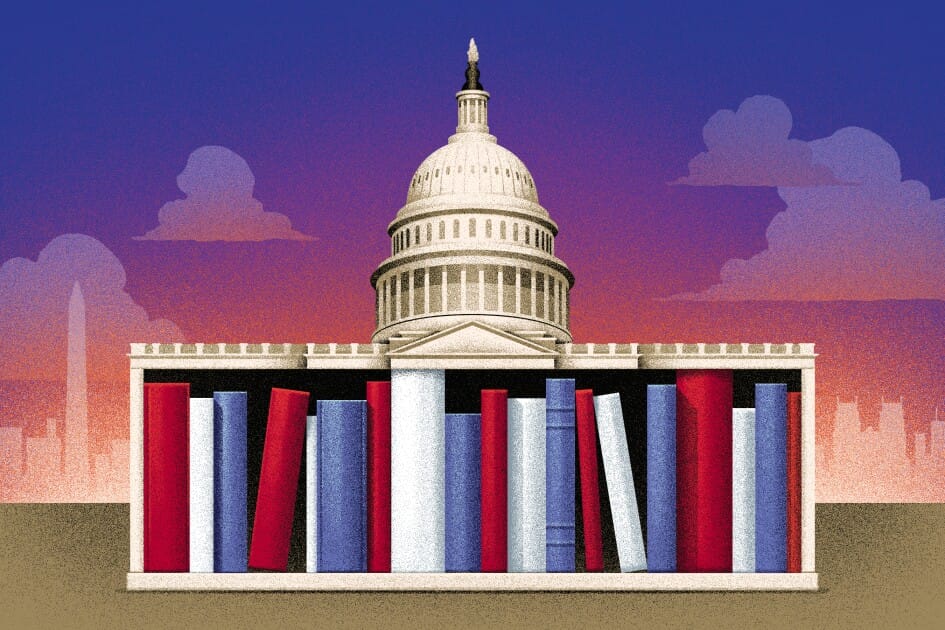
As we celebrate the 250th anniversary of the Declaration of Independence, it’s an especially good time to reflect on the civic mission of democratic schooling. Today, Ashley Berner, the director of the Johns Hopkins Institute for Education Policy, and I discuss what the erosion of civil society means for students, educators, and school leaders—and what we can do about it.
—Rick
Ashley: I’ve been thinking a lot about civil society’s role in sustaining democracy and what that means for schools. Democratic theorists talk about the twin threats of an overbearing state and the isolated individual; in other words, extreme collectivism and extreme individualism. What protects democracy against these equal and opposite forces, they suggest, is the voluntary sector: churches, synagogues, hospitals, libraries, Elks Clubs, and the bowling league. Unlike the state, civil society is noncoercive; you don’t have to join in. Unlike the family, civil society looks outward to the wider world. A healthy democracy relies on these communal places and activities.
What’s this got to do with education? For one thing, an educationally plural school system places civil society at the center of schooling. In the Netherlands, Poland, Alberta, Canada, and the Punjab, for instance, governments fund and regulate schools, and individual families can choose from among them, but civil society organizations are integral to the delivery system. Faith-based organizations, community-based organizations, and education trusts help by opening schools, placing and training teachers, and providing critical infrastructure. Because civil society helps mediate between the state and the individual, educational pluralism can help stabilize democratic life. We could view the growth of charters, private schools, micro-schools, and home-schooling co-ops in the United States in this light: as helpful additions to the civic infrastructure.
For another, in the lead-up to the 250th anniversary of the Declaration of Independence, I’m noticing the role of civil society in nurturing the civic capacities of students and the communities in which they live. My team is the research partner to the U.S. Chamber of Commerce Foundation’s National Civics Bee. The program is nationally devised but locally delivered, with local chambers hosting the competitions, recruiting participants from schools and youth organizations, attracting media attention, and bringing elected officials into the process. It’s a great opportunity for middle schoolers, to be sure, but the program also boosts local interactions and alliances. I find this deeply encouraging, and it’s only one strong example among many others.
This activation of civil society gives me hope that the rabid polarization dominating our public sphere won’t ultimately win. What do you think of all this, Rick?
Rick: What a timely topic. My mind immediately goes to Bob Putnam’s wildly influential volume Bowling Alone. The book came out in 2000, but Putnam was working on it while I was a doctoral student at Harvard in the 1990s. I still remember the seminar from 1995 or so when I first saw him present (with old-fashioned overhead transparencies) one graph after another showing that, since the 1960s, we’d seen plunging participation in Boy Scouts, churches, bowling leagues, political parties, and pretty much every other communal organization.
The “bowling alone” title referred to the striking fact that, while bowling leagues were disappearing, the total number of bowlers had actually increased over the prior 30 years. What was going on? People were bowling alone. Putnam understood this decline in civic organizations as hugely significant because he’d previously done a book on Italian political culture in which he’d found that northern Italy’s rich history of voluntary organizations had produced social capital and political trust, while southern Italy’s lack thereof had produced thin ties and political instability.
Few of us appreciated back then how prescient Putnam would prove to be. At the time, he noted that the Sony Walkman made it easier for us to tune people out. Well, it turns out that we were just getting started. Gaming, social media, cellphones, and personal chatbot companions make such concerns look positively quaint. I mean, we’re at a point where most 4-year-olds have tablets, teenagers are spending five or more hours a day on devices, and it’s a big deal when local kids casually get together to play ball.
I take your point about the possibilities of educational pluralism. But, for me, the big question is what (if anything) schools might do to help seed a resurgence of neighborly and civic engagement. Two centuries ago, in Democracy in America, Alexis de Tocqueville observed that voluntary organizations were vital to the genius of America. They allowed Americans of very different views and stations to come together for various purposes, with everyone having opportunities to lead, follow, and benefit. We’ve lost far too much of that, I fear. I’m wondering how we get it back. Ashley?
Ashley: You mentioned schools “seeding a resurgence of engagement.” That’s exactly right. Schools impact civil society in two primary ways—one immediate, one long term. First, in the short term, the very presence of new school models—from micro-schools to home-school co-ops—represents an expansion of civil society. My favorite example is Indianapolis, where neighborhood groups partner with hospitals to create new schools, universities design charters that connect students to entrepreneurs, and the magnificent Mind Trust nurtures school leaders and recruits national nonprofits to the city. I wrote a report a few years ago about the city called “Does Educational Pluralism Build Civil Society?” The answer is “Yes.”
Second, in the longer term, schools with clear missions and values do a much better job of producing community-engaged adults. There’s a large body of research here but one example: A report on data from the Panel Study of Income Dynamics found that “Catholic school graduates are over 50 per cent more likely than public school graduates to volunteer for organizations that fight poverty … [and] graduates of Evangelical Protestant and other non-Catholic religious schools are about 40 per cent more likely to volunteer in general as adults than their public school counterparts are.” District schools can achieve similar results when they develop clear identities and missions. Just look at the success of Michael Bloomberg’s small high school initiative, or Miami-Dade’s efforts under Alberto Carvalho. And schools of all types can require community service, which builds the habit of participation in the next generation.
Beyond the schoolhouse, though, educational philanthropies and civic-building nonprofits can intentionally strengthen the fabric of local communities. I already mentioned the U.S. Chamber of Commerce Foundation’s National Civics Bee, but there are others. For instance, the National Constitution Center is launching a play-based, family learning experience that invites youth and caregivers to discover together how big ideas and teamwork shaped America. The experience will be made available through local civil society organizations like libraries and YMCAs, deepening local connections and attachments. This is encouraging. May it continue.
Rick: I like where you’re going. These efforts strike me as worthy and promising. I’ve been peripherally supportive of one or two, would love to see more of them, and look forward to seeing how big of an impact they ultimately have. A big challenge, of course, is that we’re asking educators, schools, and these new initiatives to carry a lot of weight, since the nation around them is less and less prone to voluntary or civic engagement than it once was.
Americans have fewer friends, belong to fewer voluntary groups, spend less time interacting with friends and neighbors, are less likely to go to church or a neighborhood barbecue, and are instead spending a lot of time alone on their devices. Asking schools and these new initiatives to help do their part to address that is reasonable, but we should be clear that it’s asking a lot.
The obvious companion question is what citizens or civic leaders might do to flip the script. A number of years ago, the University of Southern California’s Pedro Noguera and I got into this topic in the course of our book, A Search for Common Ground. We noted that the muscles of civic engagement had atrophied, making it easier to see one another as two-dimensional caricatures and discouraging all of us from bothering to engage with people who disagree with us.
And it’s not just that we’re spending less time interacting. It’s also that people spend large swaths of the day online, interacting with digital simulacrums of their fellow citizens. They see disembodied memes, angry tweets, and agitprop videos. They encounter caricatures, while algorithms steer them toward like-minded influencers and provocative content. The distance and anonymity of online discourse have eroded the discipline of civility. I’m heartened, though, to see the appetite for something better. Polling by More in Common makes it all too clear that most people are tired of performative vitriol. But social media and contemporary politics are dominated by the 20 percent who thrive on it. The challenge is how to reenergize civil society to put the 80 percent back in the driver’s seat.
This conversation has been edited for length and clarity.
2026-02-10 11:00:00
Source link