
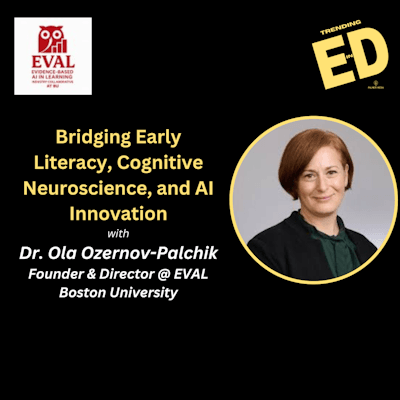
On this episode of Trending in Ed with Mike Palmer, unlock the secrets of the reading brain and the future of educational technology in this deep dive with Dr. Ola Ozernov-Palchik. A researcher at Boston University’s Wheelock College of Education and Human Development and MIT’s McGovern Institute for Brain Research, Dr. Ola sits at the cutting edge of cognitive neuroscience and the science of reading. 🧠
We explore why 70% of students in the U.S. are not reading proficiently and how early identification of dyslexia—starting as early as kindergarten—can change the trajectory of a child’s life. We also explore the “last infinite mile” of education: the gap between groundbreaking research and actual classroom practice. The devil is in the details.
Dr. Ola shares her journey from evaluating reading curricula to using fMRI and machine learning to predict learning difficulties. We also tackle the massive shift toward AI-driven tutoring and the evidence-based AI movement. Are we rushing into a multi-billion dollar tech bandwagon without proof of what actually works? Ola makes a compelling case for why we must demand rigorous evidence before putting new tools in the hands of students. Learn more about her work launching a Research-Based Accelerator here.📚
Whether you are a parent, educator, or an EdTech founder, this conversation is a must-listen to understand how we can leverage learning science, research, and emerging technology to ensure every child has the opportunity to thrive.
If you enjoyed this episode, subscribe wherever you get your podcasts so you never miss out on a conversation like this one. 🔔
Timestamps:
- 0:00 – Introduction to Dr. Ola Ozernov-Palchik
- 1:11 – Journey from Philosophy to Reading Research
- 2:22 – Looking “Under the Hood”: Transitioning to Neuroscience
- 3:33 – How the Brain Learns to Read and the Reality of Neuroplasticity
- 4:42 – Pivoting to Online Research and Global Scalability
- 6:45 – The Power of Peer Tutoring and Data-Driven Support
- 8:33 – The Science of Reading and the Implementation Gap
- 10:46 – Early Identification: Screening for Dyslexia in Kindergarten
- 13:59 – Breaking Down Phonological Awareness vs. Comprehension
- 19:11 – Explicit Instruction: Why Reading Isn’t a Natural Process
- 22:25 – Debunking Myths: Strength-Based Approaches vs. Literacy Support
- 27:32 – AI as the New Frontier: Promise and Pitfalls
- 31:30 – Building Speech-to-Speech Avatars for Early Learners
- 35:34 – The Evidence Crisis in Educational Technology
- 39:35 – BU’s Evidence-Based AI for Learning Initiative
- 44:12 – The Future of Literacy and Policy Guardrails
- 46:31 – Final Thoughts: Advocating for Science in Education
Palmer Media 2026-01-16 10:00:00
Source link