
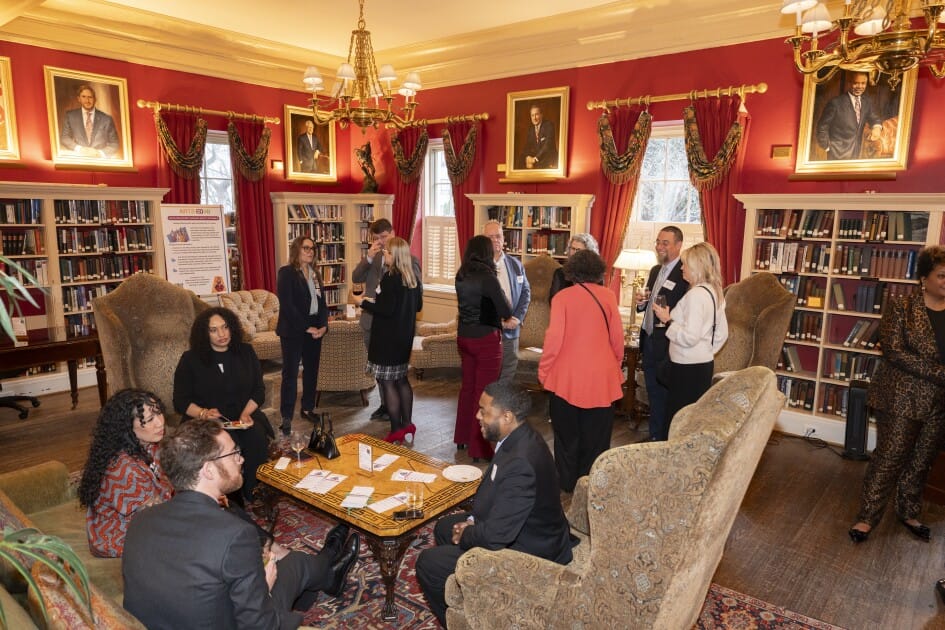
Arts educators and their advocates met Tuesday to lament what they view as the arts’ second-tier status in schools and talk about the arts’ potential to help schools address poor student mental health and boost engagement.
They also discussed how they could collaborate on their advocacy to ensure more students have access to classes in visual arts, music, theater, dance, and other arts disciplines.
The meeting, organized by the advocacy organization Arts Ed NJ, included representatives from a number of different arts education groups, including Americans for the Arts, the National Association for Music Education; state-level arts advocacy groups; and the Education Commission of the States, which tracks state education policies.
The nation’s primary K-12 law, the Every Student Succeeds Act, calls for students to have a “well-rounded education” and provides funding streams that can support arts education. But many teachers and arts education advocates have argued that the No Child Left Behind Act, ESSA’s predecessor, caused more prioritization of math and English/language arts—the primary subjects included in state tests.
As a result, states have allocated fewer resources and placed less importance on arts education, according to the Commission on the Arts at the American Academy of Arts and Sciences.
“Arts education is always put on the back burner,” said Daziha Brown, an Education Commission of the States policy analyst.
Arts don’t hold the same status as the core academic subjects, she said. “I’m seeing arts education being incorporated into [Career Technical Education] pathways, as options for high school students rather than being a requirement.”
While federal funds are not the primary funding source for arts education, the field hasn’t been immune from federal funding turbulence over the past year as President Donald Trump’s administration has terminated in-progress education grants, delayed the release of funds, and proposed eliminating dozens of federal K-12 programs.
Last September, the recipients of at least nine, multi-year Assistance for Arts Education grants received notices from the U.S. Department of Education telling them their five-year initiatives would end a year early, affecting nearly $7 million in funding, Education Week reported.
The administration also proposed to eliminate the National Endowment for the Arts, the largest funder of the arts in the country, and abruptly canceled hundreds of NEA grants.
Trump also proposed eliminating the Assistance for Arts Education program from his 2026 Education Department budget, as well as other funding streams schools can use to pay for arts education. However, Congress last month finalized a budget that maintains level funding for virtually all existing K-12 education programs in the fiscal budget, allocating roughly the same amount of money, including for arts education.
Most recently, the Education Department announced new rounds of awards for five competitive grant programs, including one for arts education.
“Arts education is not separate from the challenges that we see every day in our communities, in our schools—they are central to fixing those issues,” said Wendy Liscow, executive director of Arts Ed NJ.
Local efforts aim to boost arts education
Students of color and those from low-income households are most likely to lack access to robust arts education in school, research shows.
One organization focused on that inequity is Arts Ed Newark in Newark, N.J.
Its Arts Ambassador program trains parents to become arts education organizers in their communities and champions for increased arts education at their children’s schools.
“Parents are really the deciders, they’re the voters, and it’s their children that these programs are for,” said Lauren Meehan, the organization’s director.
In New Jersey and Pennsylvania, the nonprofit Young Audiences provides artist-led professional development to help educators incorporate more art into their teaching. The group also offers a program that allows students to work with an artist for several days, learning the culture and history of a specific art form, then showcasing their artwork.
“We’re looking at their confidence level. Do they feel better? Are they reporting that they feel happier?” said Michele Russo, Young Audiences’ president and CEO.
“There’s been research for years about the benefits of arts experiences,” she said. More educators are aware of this, “because there is a mental health crisis happening with students.”
2026-03-26 18:46:21
Source link