
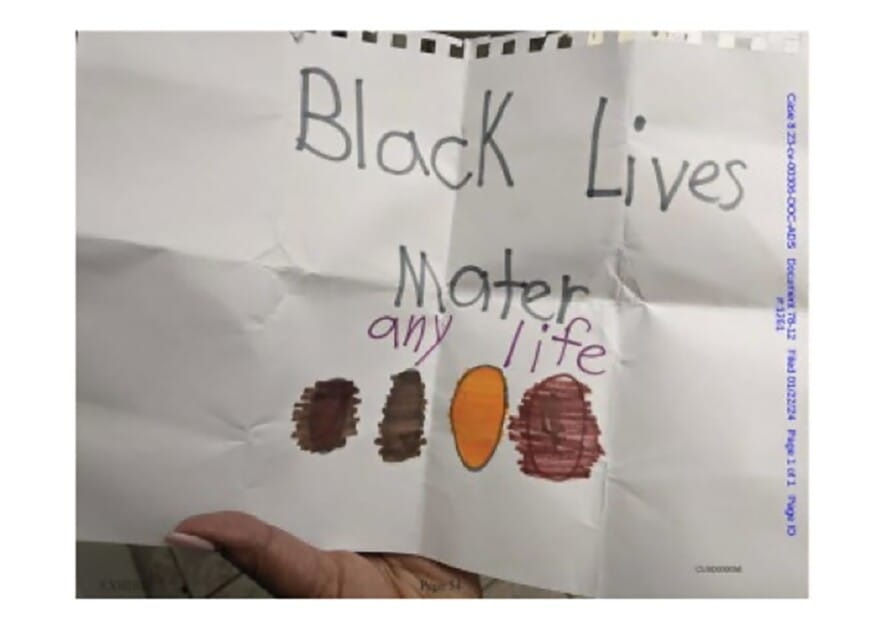
A federal appeals court has revived the First Amendment lawsuit of a California 1st grader who alleges she was punished for giving a drawing to a Black classmate with a message referencing Black Lives Matter and “any life.”
A unanimous three-judge panel of the U.S. Court of Appeals for the 9th Circuit, in San Francisco, ruled that elementary school students have First Amendment free-expression rights in schools. It thus joined four other federal appeals courts that have ruled that the U.S. Supreme Court’s landmark student-speech decision in Tinker v. Des Moines Independent Community Schools is not limited to secondary school students but also applies to elementary students.
“Elementary students’ speech is protected by the First Amendment, Tinker applies in the elementary student speech context, and elementary students’ young age is a relevant factor,” the 9th Circuit said in its March 10 opinion B.B. v. Capistrano Unified School District.
A dispute over whether student was punished
The lawsuit on behalf of the 1st grader identified as B.B. says that the episode began with a 2021 lesson on Martin Luther King Jr. that referenced the Black Lives Matter movement. According to the complaint, B.B. felt bad for her Black classmate identified as M.C. and gave her the drawing that said, “Black Lives Mater” (sic) and “any life.” The drawing also included four colored circles meant to represent four students holding hands.
M.C.’s mother found the drawing in her daughter’s backpack and contacted the school to express concern that M.C. was being singled out for her race. But court papers also say the mother believed that B.B. innocently drew the picture and did not want her punished.
What happened next remains in dispute. The lawsuit alleges that the school principal spoke to B.B. and told her the drawing was “not appropriate” and “racist.”
He made B.B. apologize to M.C., which B.B. did. The principal allegedly prohibited B.B. from drawing and giving pictures to classmates while at school. And teachers then barred B.B. from recess for two weeks, requiring her to sit on a bench while her classmates played, the suit alleges.
When B.B.’s mother learned of her daughter’s alleged punishment, she filed complaints with the district. In a statement included in a letter from the district concluding the investigation, the principal said, “I am confident that [B.B.] was not punished for her drawing nor would she be made to apologize for it. … I can say that she is a kind student and did not mean anything by it aside from wanting to give a friend a picture.”
B.B.’s mother sued the district and two school officials, alleging that they violated her daughter’s First Amendment free-speech rights by punishing and retaliating against her.
A federal district judge referred to the “all lives” message on B.B.’s drawing as being “similar to ‘All Lives Matter,’ a sentence with an inclusive denotation but one that is widely perceived as racially insensitive and belittling when directed at people of color.”
The judge went on to say that “Giving great weight to the fact that the students involved were in first grade, the court concludes that the drawing is not protected by the First Amendment.”
More proceedings to come
The 9th Circuit panel overruled the district judge.
“Age is relevant as younger students are more vulnerable than students who are approaching adulthood,” the court said in an unsigned opinion. “But, as all students, including elementary school students, have First Amendment rights, the school has the burden, under the Tinker balancing test, of showing that its actions were reasonably undertaken to protect the safety and well-being of its students.”
The other federal appeals courts that have ruled that Tinker applies to elementary school students include cases such as a 3rd grader wearing a gun-rights hat, a 5th grader who sought to distribute invitations to a church Christmas party, and a 3rd grader who wanted to distribute religious candy canes to his classmates. No other federal appeals court has apparently ruled otherwise, but some school districts continue to make the argument that Tinker should not apply at the elementary level.
B.B.’s drawing did not disrupt school and did not appear to be meant to intimidate or harass her classmate, the 9th Circuit panel said. And there was no evidence that B.B.’s reference to “any life” was connected to the phrase “All Lives Matter.”
The court said there were so many facts in dispute that the lower court should not have granted summary judgment to the defendants. It appears B.B.’s alleged ban from recess was not documented by the district, but such a ban would constitute punishment under California law, the court said.
But if further proceedings determine that B.B. was not actually punished for her drawing, “her First Amendment claim will fail,” the court said.
2026-03-11 20:20:01
Source link