
Louisiana will receive modest new authority over how its districts manage federal funding under a waiver from the Every Student Succeeds Act approved by U.S. Secretary of Education Linda McMahon on Feb. 25.
The waiver—at least the second approved on ESSA funding flexibility in President Donald Trump’s second term—comes nearly a year after Trump issued an executive order calling on McMahon to dismantle the U.S. Department of Education and “return authority over education to the states and local communities.”
In recent months, the Education Department has been encouraging states to ask for waivers from different provisions of ESSA—the nation’s primary K-12 law—and several state requests are pending. In early January, McMahon announced that Iowa’s waiver request had been approved, allowing the state to combine the state portion of four federal funds into a single block grant subject to fewer restrictions.
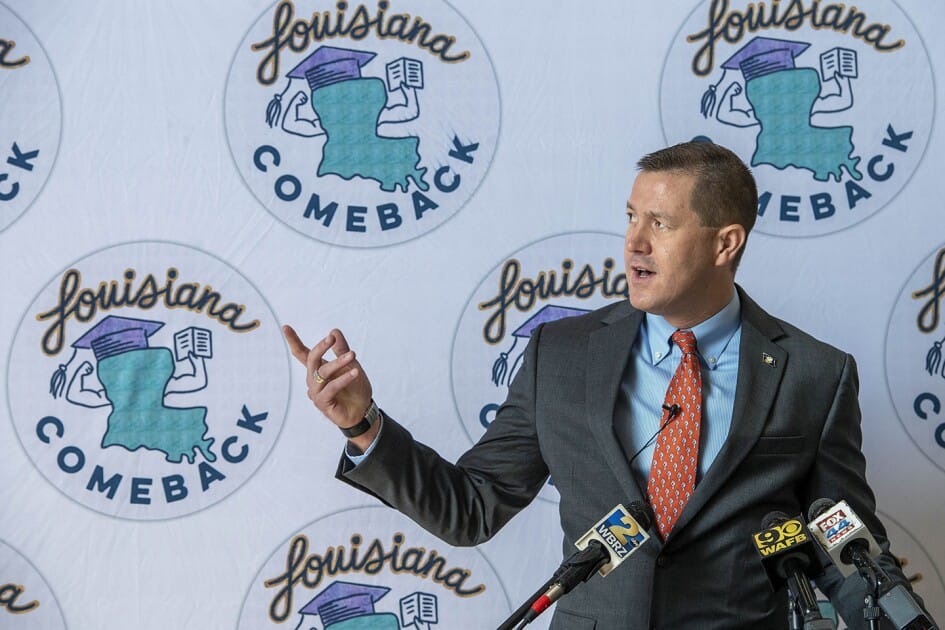
The waiver approved for Louisiana on Feb. 25 represents a small, but notable, step toward greater state autonomy, said Cade Brumley, the state’s superintendent of public instruction.
But the approved flexibility—coupled with a second Louisiana ask for ESSA funding leeway the state filed with the department this month—does not represent a total reimagining of the federal-state relationship in K-12, he explained.
“These waivers do make our jobs a little bit easier, and it does help us save a little bit of money that we can further push into the classroom,” Brumley said in an interview. “I don’t want to oversell what these are. I do want to indicate that they are important, and they do help us out, and they do help us cut some bureaucracy and save some dollars.”
He added, “I do think that that these particular waivers are probably just a component of Secretary McMahon and ED’s broader attempt to return education to the states as much as possible.”
Latest waiver gives Louisiana more flexibility with Title I and Title IV formula funds
Under the new flexibility, the Pelican State can give its districts the go-ahead to carry over more than 15 percent of Title I funds for disadvantaged students from one year to the next. In the past, Louisiana and other state agencies had to ask the department to approve individual districts’ requests to save more than the maximum percentage of Title I funding for a subsequent school year.
The department also OK’d Louisiana’s request to allow its districts to spend a greater share of their Title IV-A grant funding on technology than is specified under the law. Title IV-A is a wide-ranging federal formula fund for student support and enrichment activities.
Under ESSA, districts that receive at least $30,000 in Title IV-A money must spend at least 20 percent of those funds on some activity aimed at giving students a well-rounded education (think world-language instruction, college counseling, or music class). Another 20 percent must be directed toward improving student health and wellness (for instance, a suicide-prevention program or a school violence-prevention strategy).
Districts must also direct some portion of funding to effective technology use—say, teacher professional development on ed-tech tools. But no more than 15 percent can be spent on technology infrastructure, such as laptops or tablets.
But the Louisiana education department can now approve requests from its districts to go beyond that technology spending cap.
Louisiana also wants Iowa-like funding flexibility
This isn’t the only ESSA waiver request the Pelican State is pursuing. Louisiana also wants to be able to combine the state portion of the funding it receives from eight federal funding streams under ESSA into a single pot of money that can be used for statewide school improvement activities. The state portion of those funds typically amounts to up to 5%. Louisiana received more than $500 million total from those funds in 2024, according to Education Department documents, so 5% would work out to more than $25 million.
The state has posted a request for public comment on this waiver on its website and submitted it to federal officials Feb. 25.
If approved, the change wouldn’t affect how much money districts receive or how federal dollars are spent at the district level, said Lexi Pritchard, the state department’s director of operations.
But it would allow the state to direct its portion of the funds to what Louisiana officials decide is the greatest area of need.
The state could choose to use the money for a new literacy initiative or a tutoring program for students performing below grade level, she suggested.
That waiver request—if approved by the federal department—is similar to the funding flexibility Iowa received last month.
Louisiana’s funding flexibility ask has raised alarm bells among advocacy groups that worry it could steer resources away from vulnerable populations, including low-income students, rural students, English learners, and students in juvenile-justice facilities, and weaken transparency around how the state is serving those students.
“This request brushes aside far too many of the vital safeguards Congress placed in [federal law] that have ensured access and equal opportunity for all students for the past 60 years,” wrote All4Ed, EdTrust, EdTrust-Louisiana, and the National Center for Learning Disabilities in a joint public comment on the state’s request.
Brumley believes the change would give the state the flexibility to focus on programs that it believes will deliver the best results for Pelican State students.
“We do really good work for children and communities,” he said. “We push ourselves hard every day. We’re just trying to turn better academic outcomes for kids.”
2026-02-25 22:27:42
Source link