
Sign up for Chalkbeat Chicago’s free daily newsletter to keep up with the latest education news.
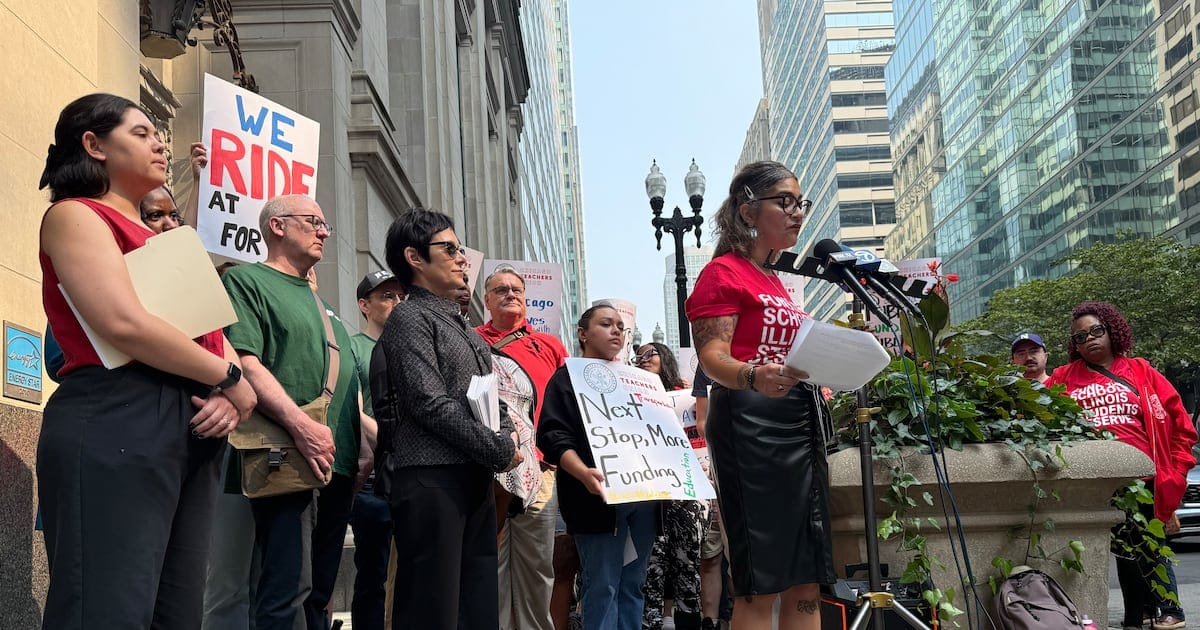
More than a dozen teachers and their union pushed the Chicago Board of Education Monday to reject the district’s $9.88 billion budget proposal that includes all-staff furloughs and a spending freeze in the middle of this upcoming school year.
During one of two required budget hearings, teachers discussed how the district’s proposed budget — which also includes staff cuts to help close a $732.5 million deficit — would hurt them and their schools and would exacerbate problems that educators are already facing due to recent budget woes.
For example, a teacher in the Austin neighborhood said Monday that teachers across four grades at her school have already received layoff notices, meaning each of those grades would have just one teacher, and at least one class could have as many as 47 kids, based on current enrollment estimates, she said. That figure would violate the Chicago Teachers Union’s contract with the district.
Another teacher at Funston Elementary School in Logan Square said her school couldn’t get more custodial or pest control help as it dealt with a rodent infestation.
The comments during Monday’s hearing signal sharp tensions over a budget proposal that CPS revealed last week and wants its board to approve in ten days.
The Chicago Teachers Union estimates that the proposed furloughs, which would happen on staff professional development days, would mean a 2.3% pay cut for its members. The union has made two key demands: The state should hold a special legislative session and raise revenue for schools, and CPS should sue Cook County Treasurer Maria Pappas for repeatedly late tax bills, which has meant late revenue that CPS and other school districts rely on.
In an interview with Chalkbeat Monday, CPS CEO Macquline King described her budget plan as “very painful.” Proposing furloughs was the hardest decision she and her team made, in part because they would happen on days meant for educators to improve their work with students, she said. King added that she hopes elected officials in a position to help CPS will consider the impact of furloughs when making decisions.
“What I do believe is really important is that there is a sense of urgency in order for Chicago Public Schools to make payroll in the fall,” King said to Chalkbeat. “We really need the budget to pass because ultimately we do not want to disrupt services to our students.”
Emila Zoko, acting CPS budget director, said furloughs and the mid-year spending freeze are “options of last resort” and avoidable if the district gets an additional $200 million in revenue, such as from special taxing district dollars from the city known as tax increment financing — or TIF — surplus. CPS is already assuming it will receive $200 million in TIF surplus in its budget proposal.
The district is already laying off more than 760 teachers and 800 paraprofessionals, most of whom the district expects to rehire at other schools with openings. Overall, the district, which employs about 37,000 people in schools, would cut a net total of 164 school-based employees. The district, where enrollment has declined, also laid off 162 central office and citywide employees earlier this month.
Still, the layoffs mean the neediest students may lose contact with an adult they have come to trust, staffers said during the hearing.
“Think about how this impacts our [unhoused] students — what happens when those people in their lives are not there to make sure they feel safe, secure, and thriving?” said Tiwanda Parker, a college and career coach who said she was laid off.
Board members legally have until the end of August to pass a budget, but district leaders want the board to adopt a plan by July 30. That’s because, in order to make up for late Cook County property tax revenue, CPS needs a few weeks to take out a short-term loan to pay for daily operations, including payroll, at the start of the school year, according to Wally Stock, acting chief financial officer. That process will require CPS to have an approved budget, Stock previously told the board.
CPS says it’s owed at least $250 million from the last round of late tax payments alone. Pappas’ office told the Chicago Tribune the figure is closer to $70 million or $80 million.
The district does not have cash to provide a cushion as it waits for the tax dollars, and in the last year, borrowing to fill the tax-revenue gap has cost CPS about $40 million in interest, Stock has said. On Monday, Stock said he is talking to the county on possibly getting access to an interest-free bridge loan that typically isn’t available to CPS, but even that wouldn’t be large enough to get the district through its bills from September to October.
Board of Education members focused on ways to raise more funding but diverged on how to get there.
For example, Che “Rhymefest” Smith, an elected board member, focused his questions during the hearing on how much more TIF dollars City Council and Mayor Brandon Johnson could send to CPS to avoid furloughs and a midyear spending freeze. Elected member Jitu Brown, however, said it’s not realistic to expect more TIF after receiving a record amount last year, and said the district should instead build in the possibility for more state funding.
Budget officials said their numbers are rooted in historical projections. CPS has received at least $200 million in TIF surplus dollars every year since 2023.
The budget proposal wouldn’t implement a spending freeze and furloughs until January, providing CPS leaders “a window of time” to attempt securing more revenue, Stock said.
CPS held a second budget hearing Monday evening. People can view it on the district’s YouTube channel.
Mila Koumpilova contributed.
Reema Amin is a reporter covering Chicago Public Schools. Contact Reema at ramin@chalkbeat.org.
Reema Amin 2026-07-20 23:02:09
Source link