
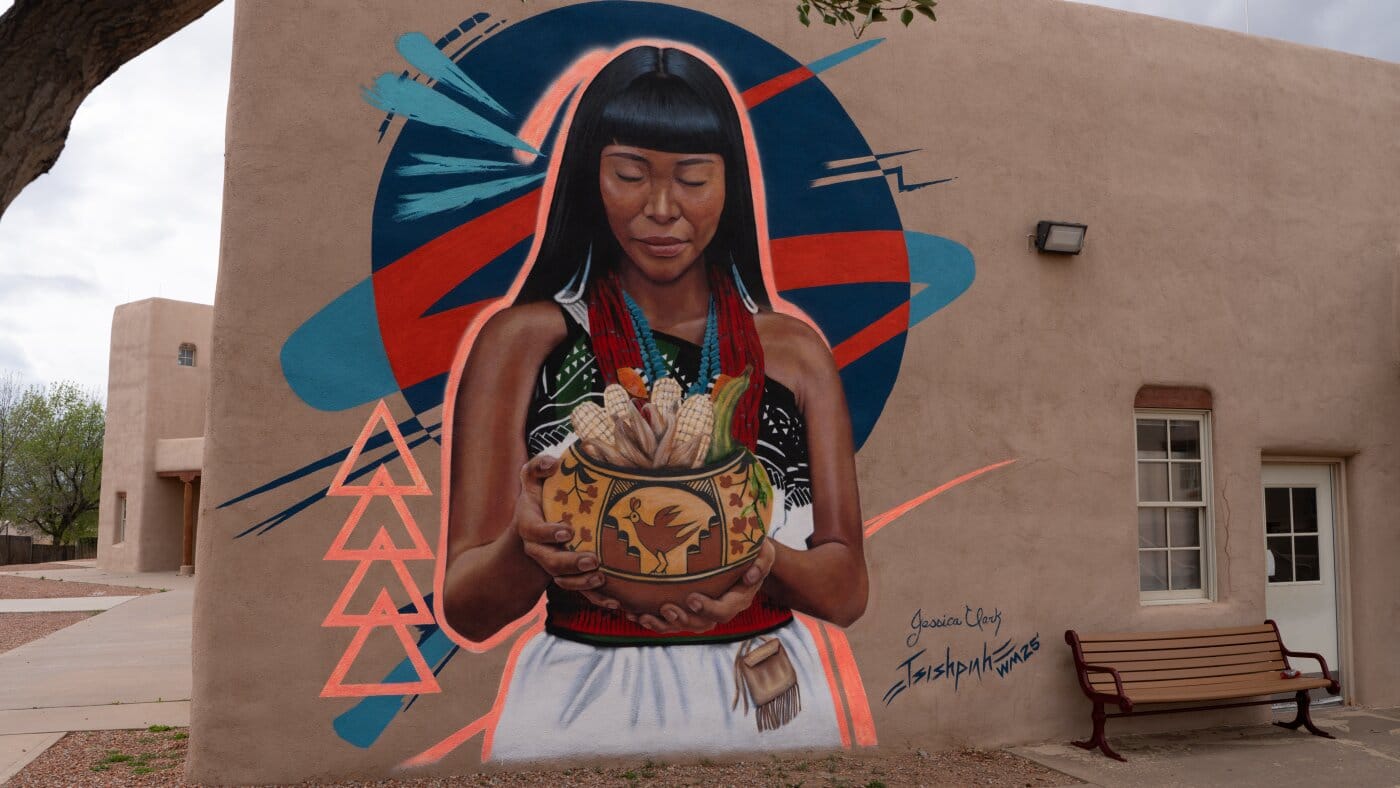
Mural by Warren Montoya, on the wall of Santa Fe Indian School.
Esha Chiocchio for NPR
hide caption
toggle caption
Esha Chiocchio for NPR
The Santa Fe Indian School sits off a short road in the middle of the New Mexico city. Its half dozen stucco buildings blend into the flat, dusty landscape around it.
“We were established in 1890 as a Native American boarding school,” Kyle Shutiva, a junior at the school, says. “It’s still a boarding school, but not how people would expect.”
For more than a century federal Indian boarding schools worked to break tribal bonds by isolating children from their families and forbidding traditional practices.
SFIS’s campus, like many boarding schools of its kind, has a painful history. There are stories of forced assimilation and harsh punishment for students speaking their Native languages from its earliest days – but this school developed differently.

The Santa Fe Indian School was established in the late 1800s by the Bureau of Indian Affairs (BIA) as a federal, off-reservation boarding school with the primary goal of assimilating Native Americans.
Photo provided by the Santa Fe Indian School
hide caption
toggle caption
Photo provided by the Santa Fe Indian School
Now, in between classes students walk around the campus in school sweatshirts with moccasins or traditional jewelry like bow guards. Inside the library, students gather surrounded by murals and photos of alumni going back to the early 20th century.
“This area right here is our Native American section,” Shutiva says, pointing to a few shelves in a sun-lit portion of the library. Under the Dewey Decimal System Native American materials are categorized under 970 or “History of North America.” Students like Shutiva are helping to re-categorize the library.

Kyle Shutiva is a student at SFIS.
Esha Chiocchio for NPR
hide caption
toggle caption
Esha Chiocchio for NPR
“We’re just trying to decolonize this area,” he says. “Because [the] 970s show that Native Americans are history, but we’re still here, truly.”
A different path
Located in the middle of Santa Fe, SFIS wasn’t quite as isolated as other federal boarding schools. The school became a training ground for many Native artists as early as the 1930s, after New Deal-era public works money flowed into the surrounding area.
“Santa Fe Indian School was lucky because there was a culture here in Northern New Mexico,” says Christie Abeyta, the school’s superintendent. “Highlighting art, craftsmanship, carpentry and architecture.”
Famous artists like Georgia O’Keeffe and Dorothy Dunn took an interest in Native art and the Institute of American Indian Art was founded nearby. Some of those instructors also taught at the boarding school.

Students and artists painted murals on the walls of the schools.
Photo provided by the Santa Fe Indian School
hide caption
toggle caption
Photo provided by the Santa Fe Indian School
For the last 50 years it has also been completely independent from the federal government.
“When we became tribally controlled,” Lisa Longeteig, the school’s librarian says. “That was a key piece.”
Now, local tribes set the curriculum – a complete reversal from the school’s founding purpose.
“Since then, we’ve seen a dramatic increase, even in my time here, in language offerings,” she says. “So more students are able to study their language here on campus than we had before.”

Antique murals are framed in the sunlit library at SFIS.
Esha Chiocchio for NPR
hide caption
toggle caption
Esha Chiocchio for NPR
Longeteig has been at the school for 25 years and knows every inch of the place.
It’s hard in a library as full as this, of books yes, but the real commodity is the wall space: entire murals are mounted and hung up behind glass.
“So this is all we have left of these murals,” Longeteig says of the paintings from older school buildings on the campus. “These are very famous artists and many of the ancestors of our students.”
A family history
Shutiva points out a section with a book on his great grandmother, Lucy Lewis. She’s a famous Acoma potter known for fine line work and traditional black on white ceramic designs. Feeling a connection to family is one reason Kyle left public school a few years ago and enrolled here.
“I felt out of touch with my native heritage,” he says. “But when I came here, I was surprised, there’s so many kids wearing moccasins without feeling judgement.”
Alivia Armijo, a middle schooler in her first year at the school, had a similar thought process.

Clarissa Quintana, Alivia Armijo, and Addison Tenorio, are students at SFIS.
Esha Chiocchio for NPR
hide caption
toggle caption
Esha Chiocchio for NPR
“My mom went to school here,” she says. She chose to come to this school all the way from Ohio. “It focuses on tradition and culture and [at] my other school I was like the only Native kid there.”
Here, surrounded by other Native students, she’s excited about what she’s learned, like buffalo dances and making Pueblo art. It’s all part of going to school at SFIS.
Tasha Pino is a language teacher at the school, specializing in San Felipe Keresan, a dialect of Keres spoken by some of the students.
It’s not the easiest job, some students are fluent, others complete beginners, but it’s personal for her. She went to school here too and sees herself in the kids.

Tasha Pino is a language teacher at SFIS.
Esha Chiocchio for NPR
hide caption
toggle caption
Esha Chiocchio for NPR
“It’s a huge passion for me,” she says. “Being able to give back to my community and to my students. This is the way I can do that.”
A legacy in the making
The school now offers around 11 languages – no easy feat to get teachers from so many different pueblos – or tribal settlements scattered around the southwestern U.S.
Mark Lee Moquino oversees the language program. He’s a new hire with big ideas that include incorporating culture throughout the curriculum, for example combining lessons on math and art with native traditions. “Math [is] used in counting numbers of fibers when weaving a belt or blanket,” he says.
He hopes to expand not only the number of languages they offer, but also the way they teach them: “There’s ways to incorporate any aspect of our culture into the western education system.”
Sequoia Carrillo 2026-06-21 12:06:04
Source link