
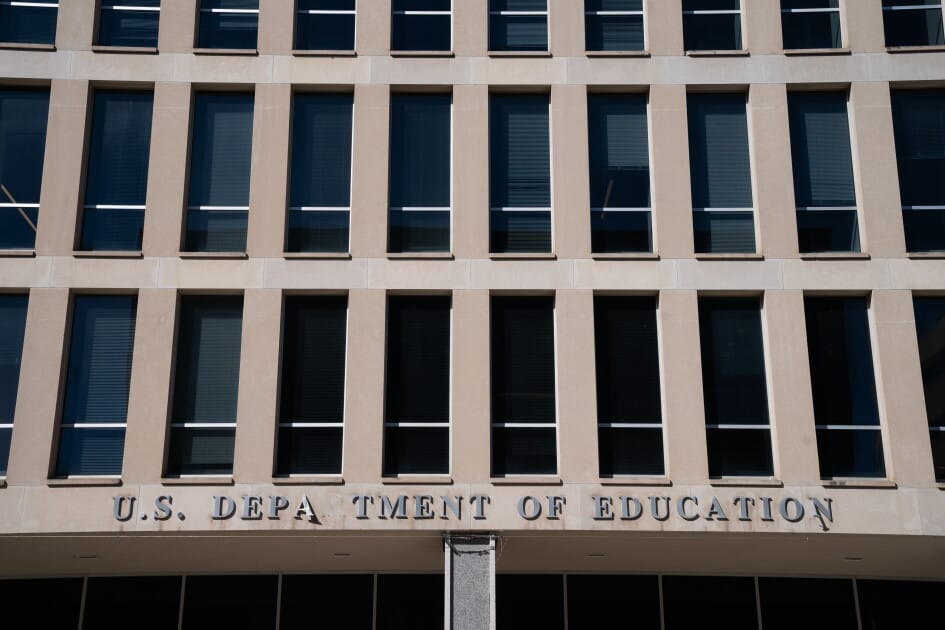
The Trump administration last week advanced its ongoing push to close the U.S. Department of Education, announcing that two major agency functions—special education and civil rights enforcement—will move to other agencies.
They join more than 100 other K-12 and higher education programs that have already begun moving. All told, six federal agencies—Health and Human Services, Interior, Justice, Labor, State, and Treasury—are set to oversee Department of Education programs.
Republican presidents have advocated closing the Department of Education since its inception in 1979. But only Congress can shutter a Cabinet-level agency.
Secretary of Education Linda McMahon has pitched the program moves—many of which are spelled out in the conservative policy playbook Project 2025—as test cases to sway skeptical lawmakers toward her position that the agency is redundant and its programs can be managed more efficiently elsewhere in the federal government.
But the transitions haven’t been entirely smooth. Plaintiffs in an ongoing lawsuit challenging efforts to shutter the Education Department amended their complaint to argue that the interagency agreements represent illegal overreach. Congress passed a bipartisan budget law questioning the legality and value of the changes.
Meanwhile, the Education Department told states this spring that it plans to send an expected July delivery of formula funds for K-12 schools through the same grant portal it’s used in previous years, rather than pushing to move the funds into a separate grant portal used by the Department of Labor, where most K-12 programs have moved. An earlier effort to transfer Education Department funds for career-technical-education programs to the Labor Department system caused major delays for some states last fall.
Education Week continues to keep tabs on the Education Department programs on the move and the Cabinet secretaries tasked with overseeing education programs. In the meantime, here’s what we know—and still don’t—about the latest changes, drawing on conversations with experts and advocates.
How will students be affected?
They won’t be—at least that’s what Trump administration officials, including McMahon, have said.
But in a joint letter last week, dozens of education and disability advocacy groups raised concerns that the separation of special education (in HHS) from other K-12 programs (largely in the Department of Labor) “weakens the coordination necessary to ensure students with disabilities are fully included in general education.”
Similarly, the groups said, separating special education programs from the civil rights office (which is moving to the Justice Department) could make it harder for federal staffers to ensure that schools are following the laws meant to meet the needs of the nation’s more than 7 million K-12 students with disabilities.
As of January 2025, disability-based discrimination cases represented the largest category of the Education Department’s outstanding civil rights cases, accounting for nearly half of the 12,000 unresolved cases at that time. (The department hasn’t updated its count of unresolved cases since then.)
More broadly, civil rights advocates and former agency staffers say DOJ, a law enforcement agency, lacks the education-specific expertise to prudently adjudicate civil rights cases centered on schools and colleges. Administration officials said last week they’re still working out the new approach to staffing for civil rights enforcement.
Has funding for students with disabilities and civil rights enforcement been cut?
No. Congress in February allocated more than $15 billion for special education programs. Most of that money will begin flowing next month to states for distribution to school districts for direct services to students.
Administration officials have repeatedly said that congressionally approved funding for special education will continue to flow and that the changes will all center around which agency distributes the dollars. The federal laws underlying funding for K-12 students with disabilities remain intact, and Trump has proposed a modest increase in annual funding for special education for 2027.
Lawmakers in February also supplied level year-over-year funding—$140 million—for the Education Department’s office for civil rights. President Donald Trump had proposed a $49 million cut. The move to DOJ does not affect the program’s funding level.
What role will RFK Jr. play?
HHS Secretary Robert F. Kennedy Jr. has spent much of his career—including his current tenure in the government—spreading misinformation about the effectiveness of vaccines and asserting without evidence that vaccine use and autism are linked.
Kennedy’s sister-in-law, Rebecca Hines, leads the Administration on Disabilities, the office within HHS where special education staffers will move. Hines’ AOD deputy, Diana Diaz-Harrison, is currently serving as Kennedy’s appointed coordinator of national policy on autism after a short stint overseeing special education in the Education Department.
Beyond those connections, it’s not clear whether or how Kennedy will get directly involved in special education policy or program administration.
Will Congress intervene?
Congress has yet to pass legislation that cancels or prohibits the Trump administration’s efforts to move Department of Education programs.
Sen. Bill Cassidy, R-La., who chairs his chamber’s education committee, said last week he’ll commit to holding a vote on Democrat-led legislation to block the transfer of special education to HHS. If special education must move out of the Education Department, he said, he’d prefer to see it move to Labor.
If Cassidy follows through, that would mark the first time a Republican lawmaker has formally opposed one of the Trump administration’s efforts to dismantle the U.S. Department of Education. Cassidy last year said he supported closing down the agency and would introduce legislation to do so. But he now may be feeling emboldened to oppose Trump after losing his primary bid for reelection earlier this year to a Trump-backed challenger.
Other Republicans in Congress are far less likely to buck the president, which means Cassidy’s legislation faces a steep uphill climb to passage.
What have department staff been told about the latest program transfers?
Not much.
As with previous interagency agreements, communications to agency staff in the immediate aftermath of the announcement have been scant, according to people familiar with the situation who spoke with Education Week on the condition of anonymity due to fears of retaliation.
Employees don’t know whether and when they’ll move to different buildings or how their programs will be affected by the announced changes.
Is there anything left in the Department of Education?
Yes. Some of the programs affected by previous interagency agreements haven’t begun moving to other agencies yet. And some program staff have remained in the Department of Education even as their colleagues on the same program have moved elsewhere.
Meanwhile, some Education Department functions have yet to be formally transferred. Most notably, the Institute of Education Sciences, the department’s research arm, hasn’t yet been the subject of an interagency agreement.
2026-06-22 19:57:39
Source link