
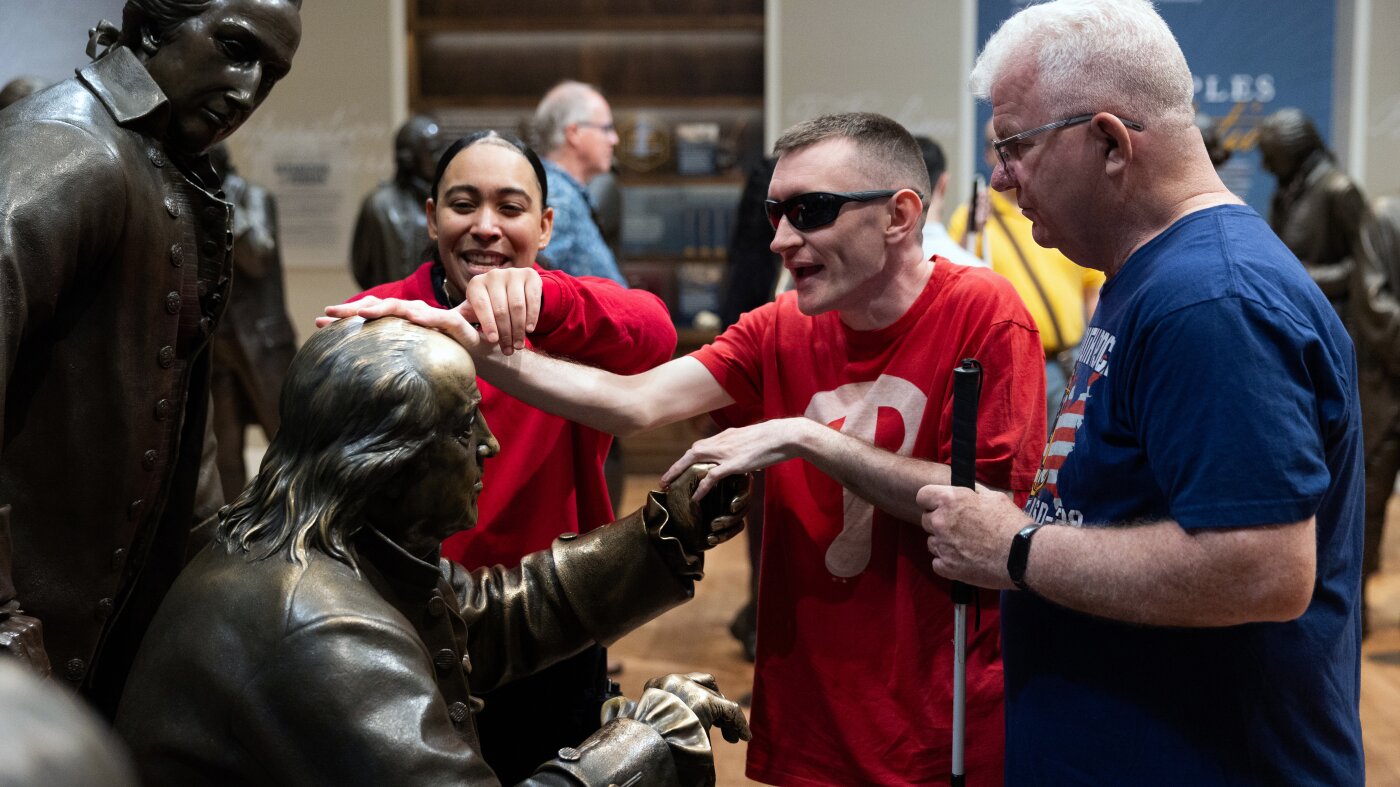
The National Constitution Center in Philadelphia offers guided tactile tours aimed at blind and low vision visitors in a gallery called Signers’ Hall. Museum educator Sydney Wharton traces visitor Tim Kelly’s Jr. hands over the statue of Benjamin Franklin as she leads him and his father, Tim Kelly Sr., through the gallery.
Rachel Wisniewski for NPR
hide caption
toggle caption
Rachel Wisniewski for NPR
Press the “Listen” button below to hear the story text, read by reporter Jonaki Mehta.
PHILADELPHIA — About a dozen visitors pause at the entrance to a gallery filled with statues of 42 men who had gathered here more than two centuries ago for the signing of the U.S. Constitution. The statues appear to be in motion, in conversation or deep in thought.

Standing among and touching their life-size figures, hands and faces drops visitors into that consequential historic moment.
“They feel like real people,” Grace Engle, a museum educator at the National Constitution Center (NCC), says to the tour group. “Except they might let you touch them a little more than your average individual might on a first meeting.”
As America recognizes 250 years of existence, this museum in the nation’s founding city has begun offering guided tactile tours aimed at blind and low vision visitors in a gallery called “Signers’ Hall.”

Left: Simon Bonenfant works with the organization Philly Touch Tours and helped train the museum educators leading the tours.
Right: Bonefant engages with George Washington’s face and head.
Rachel Wisniewski for NPR
hide caption
toggle caption
Rachel Wisniewski for NPR
The Americans with Disabilities Act (ADA) of 1990 required most public institutions like museums to make buildings themselves accessible, but access to exhibits inside is often still limited. The NCC joins a growing number of museums nationwide that have, in recent years, incorporated accessibility options like sensory-friendly days into their programming, though “touch tours” are less common.
Visitor Tim Kelly Jr. runs his fingers over Benjamin Franklin’s figure. “Everything feels so distinct on him,” he says. “He’s seated. I could also feel the wrinkles on his face because he was 81 years old at the time of the convention.”
Kelly says it’s refreshing to experience a tour tailored to the way he learns: The museum’s guides provide detailed descriptions of what can be seen and felt, while weaving in a history lesson. Pointing to Eldbridge Gerry in one corner of the room, Grace Engle says, “He is who you have to blame or thank for the beauty of gerrymandering,” explaining that Gerry had once redrawn a district in the shape of a salamander. “And so then a cartoonist deems it gerrymandering.”

The National Constitution Center in Philadelphia is participating in the nation’s 250th anniversary, in part, by expanding access to their exhibits to visitors with disabilities.
Rachel Wisniewski for NPR
hide caption
toggle caption
Rachel Wisniewski for NPR
At other moments, museum staff trace visitors’ hands over the expressive faces, clothing and hands of the statues, all while guiding them safely through the crowded space.
Kristina Marinello, senior director of museum experience, says this gallery has long invited touching. “Ben Franklin’s hands are super shiny because people have kind of always touched him no matter what. Kids like to sit on his lap.” But the center only began offering these tours officially in April, after staff trained with Philly Touch Tours, an organization that works with museums far and wide to make them more accessible.

Left: Replicas of artifacts are available as part of the tactile friendly tours the NCC now offers.
Right: Jeff and Sharon Clark touch the replica of an antique fabric. They have been to the NCC before it offered tactile tours and say the experience now is much improved.
Rachel Wisniewski for NPR
hide caption
toggle caption
Rachel Wisniewski for NPR
Trish Maunder, one of the group’s founders, says “Our mantra is ‘seeing may be believing, but when you touch, you know.'” Maunder, whose daughter is blind, calls touch the “mother sense,” one she thinks people lose connection with as they get older. She hopes tours like this become more prevalent and will help sighted and blind people alike reconnect with that sense. “Your body holds on to that sort of muscle memory, so now you carry that with you.”
Over the last two decades, museums around the country have incorporated accessibility into their programming, says Heather Pressman, who teaches courses on museums and accessibility at Johns Hopkins University. She says meeting ADA accessibility requirements “is the bare minimum.” Ensuring the artifacts in a museum are accessible takes more work, but it doesn’t have to cost much, she says. “Something super simple for people who have low vision is just creating large print labels.” Pressman says exhibits with calming sensory experiences for neurodivergent visitors are another cheap option that’s becoming more widespread. For museums with valuable, ancient artifacts, creating replicas that can be held is also a step toward accessibility.

Left: In addition to touch tours, the museum regularly holds “sensory-friendly” days for neurodivergent visitors with dimly lit rooms and sensory toys. They’re also often intended to be kid-friendly experiences.
Right: The theater in the Constitution Center is often reserved as a quiet room on sensory-friendly days.
Rachel Wisniewski for NPR
hide caption
toggle caption
Rachel Wisniewski for NPR
While accessibility programming is never complete, Pressman says it tends to open their doors to more people than museum staff may realize. “How many of us are now wearing glasses in our 40s? People can also temporarily have a disability, like you break your leg,” for example, she says. In fact, nearly a third of the U.S. population has disabilities.
Kristina Marinello says she has been working on expanding accessibility at the NCC in many ways, including through sensory-friendly days that include features like dimly lit, silent rooms. “Those first three words of the Constitution — ‘we the people’ — we want to stand by that and make sure everybody feels that,” she says.

Left: Akosua “Kosi” Asabere has been on a touch tour at the NCC once before. She says, for once, she doesn’t feel like an afterthought in a museum-going experience.
Right: Asabere feels the cuff of George Washington’s sleeve.
Rachel Wisniewski for NPR
hide caption
toggle caption
Rachel Wisniewski for NPR
As the Constitution Center’s most recent tactile tour comes to a close, second-time visitor Akosua “Kosi” Asabere shares some reflections. “Standing in Signers’ Hall and running my fingers over those bronze statues, I felt this profound sense of reverence, but I also felt deeply conflicted,” she says. Asabere is a software engineer who works on digital accessibility and says she can’t help but think about the nation’s founding document through that lens.
“It was a brilliant document, but it had massive systemic bugs. Women were left out. Black people were left out. Disabled people were left out.”
At the same time, she’s encouraged by places like the National Constitution Center, which she says are taking steps to ensure historically marginalized people, including those with disabilities, are no longer an afterthought.
Edited by: Nirvi Shah
Visual design and development by: LA Johnson
Jonaki Mehta 2026-06-18 09:00:00
Source link