
Indiana on Tuesday secured the broadest state waiver yet from federal school funding and accountability requirements, as the Trump administration aims to give state and local leaders more control over K-12 decision-making.
It’s the third state to receive such a waiver from the U.S. Department of Education, following Iowa in January and Louisiana last month.
But Indiana’s waiver goes further than the other two, marking the first time a state will be allowed to change how it rates school performance for federal accountability and the first to give school districts more leeway in how they spend certain federal education funds.
Under the waiver:
- Indiana can combine the state portion of five federal formula funds to pursue statewide initiatives of its choosing—similar to authority the Education Department granted Iowa and Louisiana.
- It can let up to 15% of its school districts combine money from two federal accounts, rather than be required to spend each on their federally designated purposes, a move federal and state education officials said would reduce districts’ administrative burden.
- Notably, the waiver relaxes part of the Every Student Succeeds Act’s accountability requirements for high schools—the first such waiver granted by this administration to do so. (In President Donald Trump’s first term, some requirements were paused during the COVID-19 pandemic.)
Since the start of the second Trump administration last year, the Education Department has invited states to seek waivers from funding and other requirements outlined in the Every Student Succeeds Act, the nation’s primary K-12 law.
ESSA authorizes various funding streams to states for services for disadvantaged students, professional development for teachers, services for English learners, before- and after-school programs, and more, and sets benchmarks for school performance.
The waiver allows Indiana to redirect the state portion—typically 5%—of five of those funding streams toward statewide initiatives, rather than spend each separately. Those five grants pay for professional development, state assessments, before- and after-school programs, supplemental services for English learners, and student support and enrichment.
Indiana received more than $99 million from those five funds in 2024, according to Education Department budget documents. The Trump administration has twice proposed to eliminate all five through the federal budget process. Lawmakers rejected those cuts in the 2026 budget, but those same reductions are on the table again as Congress works on spending bills for 2027.
Iowa’s and Louisiana’s waivers also allowed them to combine the state portions of federal formula funds for state-level initiatives.
Waiver lets Indiana start a pilot project on local districts’ federal funding
One part of Indiana’s waiver is a provision letting the state pilot a project in which up to 15% of its school districts can consolidate the federal funds they receive for professional development (Title II-A) and student support and academic enrichment (Title IV-A).
The state will have to update the federal government on how participating districts are using those federal funds with the new flexibility and their academic progress.
Indiana received $41.2 million under Title II in 2024 and $20.7 million under Title IV-A, which is spread among school districts.
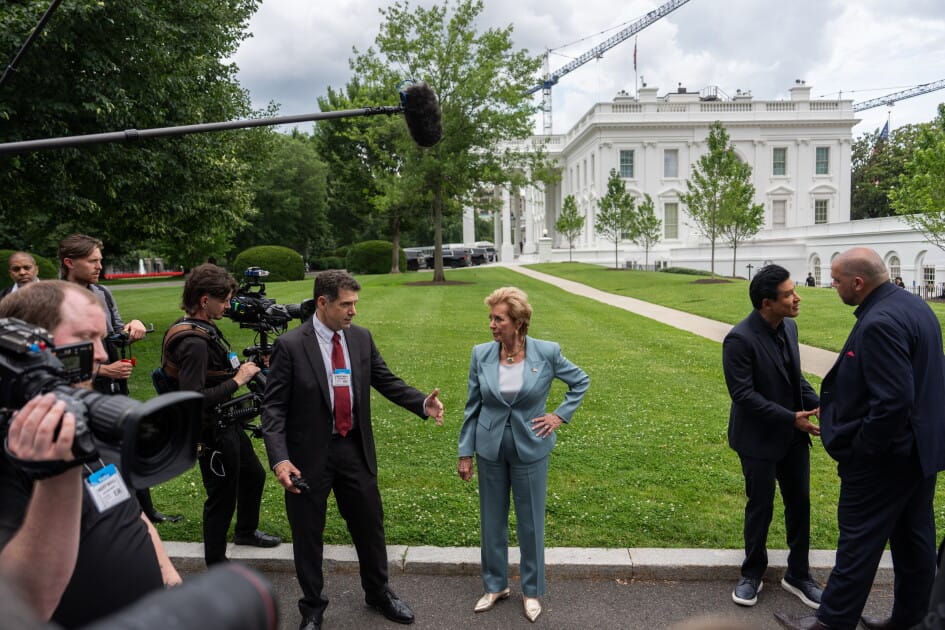
At a news conference in Plainfield, Ind., announcing the waiver, U.S. Secretary of Education Linda McMahon and Indiana Secretary of Education Katie Jenner touted the pilot project as one that would reduce red tape.
“Now, the money will specifically be able to be deployed exactly how they need it in a timely manner,” Jenner said of local school districts. “The goal is to reduce some of the bureaucracy, paperwork that our locals spend hours on.”
Indiana is among at least a half dozen states so far that have requested flexibility from federal requirements since the Trump administration invited them to. But every state so far that’s secured a waiver initially made a much broader request than what the administration granted.
Kirsten Baesler, the assistant secretary of elementary and secondary education, has said states won’t be granted unlimited flexibility. Education Department staff have worked with state leaders to refine their requests so they’re allowable under ESSA, she has said.
“Everything is within the law and within the intent of Congress,” Baesler said at Tuesday’s news conference.
The waiver’s accountability provisions apply only to high school performance
The accountability flexibility is relatively narrow, applying only to Indiana’s high schools. But it is the first signal that the Trump administration is willing to waive significant portions of the ESSA law on how states weigh and grade school performance.
Indiana will no longer have to weigh the academic indicators spelled out in ESSA—graduation rates and math and reading test scores—as heavily as other factors when grading its high schools and designating schools in need of improvement.
Instead, the state can use its own school accountability system, approved by the state board of education in March, for high schools in place of the system the state uses to comply with ESSA.
Under that new system, the state said it would rate high schools the following way: 10% based on graduation rates; 10% on standardized test results, including the SAT; and 80% on other factors, which might include AP courses, ACT scores, completion of courses for the state’s “honors enrollment” seal, end-of-course tests in biology and U.S. government, and obtaining workforce credentials.
That system takes full effect in the 2026-27 school year and will rate schools on an A-F scale.
The Education Trust, a strong proponent of federal school accountability requirements, said the waiver undermines ESSA’s insistence on using the same measures for all students and keeping math and reading at the center of states’ efforts. The organization said the move could also lessen the incentives for schools to get all students to graduate.
“Most concerning, Indiana’s plan appears to vary standards across student groups in a way that will allow the state to say, ‘Everyone is doing just fine,’” said Denise Forte, the organization’s president and CEO, in a statement.
In approving the waiver, McMahon noted that many of Indiana’s additional indicators do reflect academic performance. They also better align with the state’s aspirations to prepare students broadly for what’s next, whether college or careers, she said.
“Ensuring that students graduate prepared for success in life is central to academic achievement,” the secretary said in the waiver letter, “and Indiana’s request supports holding schools accountable for equipping students with the knowledge, skills, and training needed to meet the demands of higher education and the workforce.”
Dale Chu, an independent education consultant who formerly worked in Indiana’s education department, said the waiver raises an interesting policy question: Should the feds encourage the inclusion of additional student performance measures in high school, or limit them to tried-and-true academic signals?
“The real test is how it plays out in practice once the A-F ratings are released this fall. That’s where we’ll get a clearer read on whether it functions as broader measurement, or de facto compensation” for low performance, he said.
2026-06-16 20:22:03
Source link