
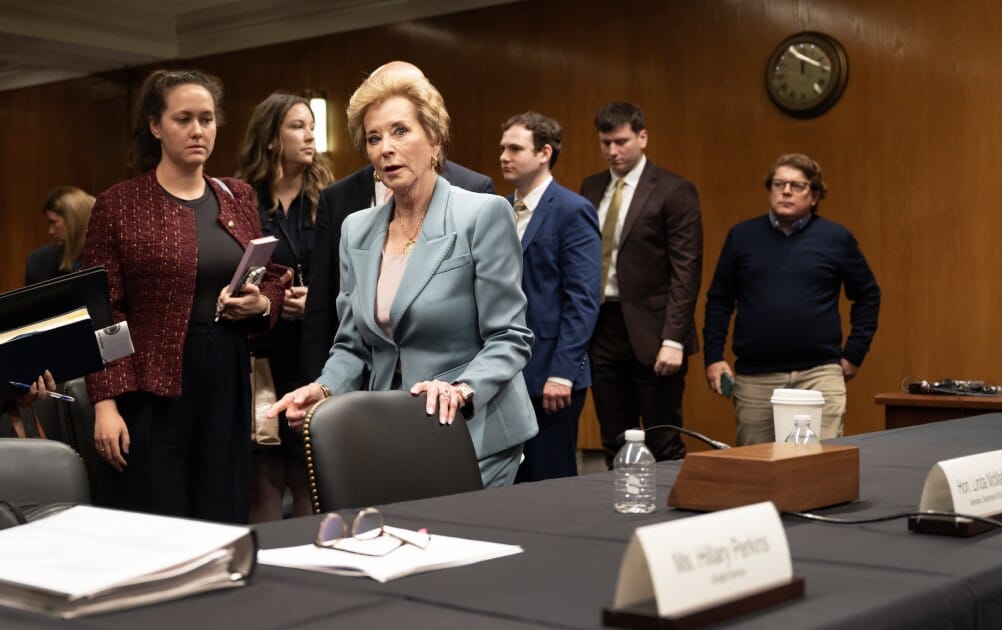
More than a year after signaling major changes to federal programs for students with disabilities, the Trump administration continues to weigh shifting pieces of the U.S. Department of Education’s special education office to the departments of Labor or Health and Human Services, Education Secretary Linda McMahon said Tuesday.
“Currently we are still evaluating where those programs would best be located,” McMahon testified during a Senate appropriations subcommittee hearing Tuesday to review the Trump administration’s fiscal 2027 budget proposal. “We have not made that determination yet.”
The same is true, McMahon said, for whether and where to move the Impact Aid program, which supports school districts near non-taxable federal land. That program remains fully within the Education Department for now.
Throughout the hearing, McMahon vigorously defended her agency’s efforts to shift more than 100 other programs to five other federal agencies, including moving most programs for K-12 schools to the Department of Labor.
Agency staff who work on those programs will continue to do so from their posts at new agencies, McMahon said. Still, educators and advocates have decried the moves as disruptive and unnecessary.
“When you bring two factions together, do you believe in the end they’re going to be better serving the population you are looking to serve?” McMahon said. “There’s some hiccups along the way in the beginning, but in the end this is a program that will help our students as they go from K-12 and higher education be prepared for the workforce of today.”
McMahon’s appearance on Capitol Hill marked her first public testimony before lawmakers since she briefed House lawmakers on her agency’s priorities last June. She faced questions from Democrats and Republicans alike about her agency’s efforts to make changes to existing programs, transfer agency responsibilities, and propose billions of dollars in funding cuts and grant consolidations.
She also added to her growing repertoire of verbal gaffes—three times, she referred to the widely known Title I program for low-income students, and the largest Education Department line item, as “Title A.”
Here’s a recap of a few highlights from the hearing.
Lawmakers from both parties question TRIO changes
The Education Department line item that got the largest spotlight by far during Tuesday’s hearing was its proposal to eliminate TRIO, a $1.2 billion collection of eight grant programs that support low-income middle and high schoolers in their pursuit of affordable higher education options.
Twelve U.S. senators—six Democrats and six Republicans—recently wrote to McMahon urging the agency to revise its newly published TRIO application notices, which emphasize initiatives like workforce development and apprenticeships that differ from TRIO’s historic emphasis on college.
Lawmakers from both parties reiterated those concerns during the hearing. Day-to-day management of the program has also moved to the Department of Labor, though Education Department staff are still working on it.
“The partnership with [the Labor Department] negatively affects these competitions, and current grantees in my state … are going to be hurt by the change in focus,” said Sen. Susan Collins, R-Maine, who chairs her chamber’s appropriations committee.
McMahon defended the changes and didn’t signal a willingness to revise the published competition notices. She also said the agency has invested $2 million in research to determine which aspects of the program could benefit from further changes. “It was worth taking an opportunity of reform to show that there might be alternatives to higher education, given that we do have a lack of a skilled workforce,” McMahon said.
Civil rights enforcement will rev back up, McMahon says
Several Democratic senators grilled McMahon on staffing upheaval at the department’s office for civil rights, which appears to have dramatically scaled back its enforcement of federal civil rights laws in schools, even as it’s ramped up scrutiny of school districts and higher education institutions with policies around gender and race that differ from Trump administration priorities.
The department didn’t resolve any cases in 2025 that centered on sexual harassment or assault, school discipline, racial discrimination, or seclusion and restraint, according to a report published Tuesday by the office of Sen. Bernie Sanders, I-Vt.
McMahon framed her agency’s moves—including complying with a court order to restore dozens of laid-off staffers, and appointing the assistant secretary who ran the civil rights office during Trump’s first term—as a “full-on attack” to shrink a mounting backlog. “We are moving to resolve as many cases as we can,” she said.
Later, McMahon characterized the administration’s fiscal 2027 budget proposal as “a budget of increasing dollars for civil rights.” In response, Sen. Chris Murphy, D-Conn., pointed out the proposal as written would dock nearly a third of the office’s annual budget, from $140 million to $91 million.
Rhetoric quietly shifts toward Ed. Dept. evolution and away from closure
In a subtle departure from her typical rhetoric, McMahon during the hearing did not reference her mission of closing the Department of Education, or her desire for the interagency agreements to help convince lawmakers to eliminate the agency altogether.
Instead, she focused on what she sees as overlap between the missions of her agency and others that are now assuming day-to-day responsibilities for administering key programs.
“As we look at how education should be viewed in our country, clearly there are many aspects of education,” McMahon said while defending program shifts to the Department of Labor. “It’s enrichment of minds, it’s development of thought, but it is also to provide an opportunity once they have finished their education to enter into the workforce.”
McMahon dodged a question from Sen. Shelley Moore Capito, R-W.Va., about the metrics the agency is using to determine whether the agency transfers are working. She didn’t specify any particular metrics, though she did assert that the inaugural interagency agreement, shifting career-technical education programs to Labor, was successful, even as some states struggled for months to access funding for those programs.
“I’m really satisfied now with how this is working,” McMahon said.

Lawmakers question whether McMahon oversteps her authority
At times, senators questioned McMahon’s grasp on the separation of powers.
She justified the department’s crackdown on phrases like “DEI” by saying those terms are “against the statutes we’ve put in place.” In response, Sen. Jack Reed, D-R.I., pointed out that only lawmakers have the authority to create statutes. McMahon was likely referring to Trump’s anti-DEI executive orders, which lack the force of law.
McMahon also said the U.S. Department of Justice has determined that several higher education grant programs under the Minority-Serving Institutions banner are unconstitutional and as a result, “We won’t be funding those.” The Justice Department issued a legal opinion disputing the constitutionality of that program, but no court has yet issued a ruling.
In the meantime, Congress in February appropriated hundreds of millions of dollars for those programs. It remains unclear whether the Education Department will redirect those funds to other priorities, or let them expire. The latter move would violate federal law.
2026-04-28 19:07:53
Source link