
Sign up for Chalkbeat New York’s free daily newsletter to get essential news about NYC’s public schools delivered to your inbox.
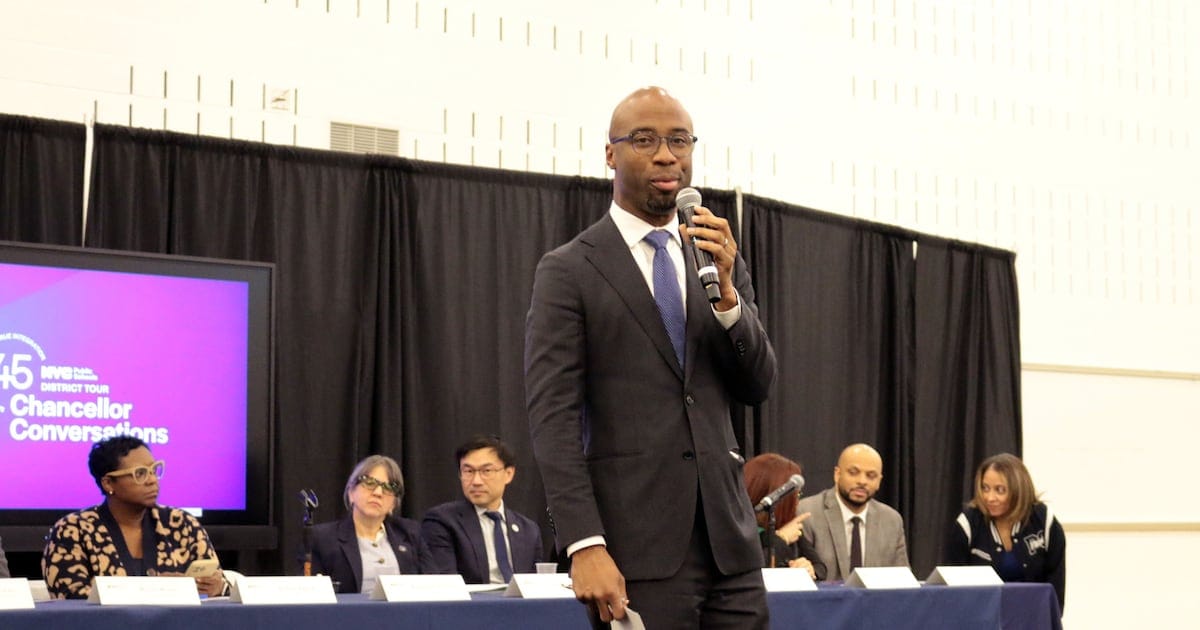
In a major reversal, New York City schools Chancellor Kamar Samuels is withdrawing controversial proposals to open the city’s first artificial intelligence-focused high school, close two middle schools, and relocate another.
The plan to open Next Generation Technology High School as a selective school in downtown Manhattan drew fierce community opposition in recent months. The city also saw intense backlash to its proposals for a slew of Upper West Side schools: to close the middle schools of P.S. 191 and Manhattan School for Children, and to relocate The Center School.
All four proposals were scheduled for a vote Wednesday in front of the city’s Panel for Educational Policy, or PEP. Withdrawing the proposals makes it nearly impossible for them to take effect next school year.
Samuels, who’s entering his fourth month as chancellor under Mayor Zohran Mamdani, said he believes all of the proposals “met multiple goals” but decided it wasn’t fair to advance them so quickly after a major leadership transition. Instead, he hopes to revisit the proposals later on, with a stronger plan for hearing community feedback.
“These proposals were always ambitious,” Samuels told Chalkbeat in an interview Sunday. “I think when you have a transition and you’re hearing simultaneously that families want more time, I want to be a chancellor who listens and engages and understands the complexity of all of the issues.”
The proposals represented an early and personal challenge for the chancellor, who previously served as superintendent of Manhattan’s District 3, where he helped get the ball rolling for the Upper West Side school proposals. As superintendent, Samuels developed a reputation for shepherding complicated school merger proposals to the finish line.
Multiple PEP members expressed serious concerns about the proposals directly to Samuels in recent days, according to several panel members. Chairperson Greg Faulkner penned a letter asking Samuels to withdraw the proposal for Next Generation High School, according to a copy obtained by Chalkbeat. The panel’s main criticism was over the school’s designation as a “screened” school, raising concerns about equity and access.
Samuels said he didn’t withdraw the proposals because of concerns they would not clear the panel’s vote. But losing a high-profile vote could have complicated Mamdani’s campaign pledge to run the school system in a more democratic fashion, especially while pushing to retain control of the school system.
Mamdani is lobbying state lawmakers for a four-year renewal of mayoral control, which expires in June, and an extension of the city’s deadline for complying with the class size law — arguments that hinge in part on his ability to convince them he will be responsive to community needs. (An agreement on mayoral control could be included in the state budget, which is overdue and expected to be finalized soon.)
The Upper West Side proposals were meant to help stabilize flagging enrollment while clearing out space for an overcrowded school to meet the class size requirements, city officials said. But parents and community members from all three schools decried the plans, arguing officials didn’t do enough to engage parents and that the moves would undermine critical support for vulnerable students. Several elected officials planned to hold a press conference Monday morning to oppose the plans.
Meanwhile, the proposal for Next Generation Technology High School, often called “Next Gen,” generated pushback from some families concerned about the role of AI in schools — tapping into a larger debate roiling the city and country.
Education Department officials recently introduced a draft AI playbook that largely sidestepped thorny questions about how to regulate student AI use and drew intense criticism from some parents who feared it encouraged schools to embrace untested technology. Samuels said he wants to focus on finishing that guidance before crafting proposals for schools like Next Gen.
“We have to ensure that any future proposal of a model like Next Gen high school fits the needs of the broader community and aligns with our AI guidance,” he said.
Officials had already solicited applications from eighth graders to Next Gen, though they hadn’t yet offered admission.
Next Gen raises questions about AI, equity
Officials had been moving swiftly to open Next Gen, a selective Lower Manhattan school geared toward preparing students for jobs in cyber security, computer science, robotics, and math. It would also teach students to be “builders as well as ethical users of AI and other modern technologies,” according to the city’s proposal for the school.
Supporters of selective schools, which typically admit students based on their middle school course grades, said the program would allow students to explore an emerging technology and help prepare them for competitive tech jobs.
But critics argued the school’s planning process was rushed, its mission was unclear, and it could enable companies like Google and OpenAI to influence how AI is used in city classrooms. Both companies were part of the school’s planning team, and Manhattan High Schools Superintendent Gary Beidleman said his experience as a Google Education Innovation Fellow in 2024 inspired his decision to push for the new program.
Some panel members raised concerns that the school was slated to admit students based on their academic records rather than being open to anyone and pressed officials about why the campus was planned for Lower Manhattan as opposed to higher-need areas of the city.
“If they’re talking about this technology really being something that is going to become more global … why would we be exclusive in who can have access?” said Faulkner, the chair.
Panel members raised the idea of introducing an AI literacy course that could be used across multiple schools, rather than concentrating on a single standalone school.
Faulkner added that he worries about opening more screened schools “that have historically segregated” students.
Samuels said he believes the city’s current system for deciding admission to selective schools, which groups students into five tiers based on their seventh grade marks, is working.
“I’m not necessarily looking to make major changes to screens in high school,” he said.
Panel members were also frustrated with how top officials handled public discussions about the school. Several pointed out that district officials’ communication about the school seemed to suggest it was already approved, even though it hadn’t yet cleared a panel vote.
Under the city’s original proposal, Next Generation would have taken the place of the Urban Assembly School of Business for Young Women, which currently enrolls just 91 students. The city is still moving forward with plans to close that school.
Families at a middle school on the same campus, Lower Manhattan Community School, had also raised concerns about Next Generation because they have long pushed for space in the building to make the school a program for grades 6-12 rather than 6-8.
District 3 proposals test city’s commitment to parent engagement
The move to withdraw three controversial proposals in District 3 came after months of outcry from families and educators in the district. They argued the process felt rushed and the timing of the decision would force families who planned to enroll in the two middle school programs slated for closure, P.S. 191 and the Manhattan School for Children, to scramble to find new schools for this fall.
Some families at P.S. 191 felt the school, which enrolled many asylum-seeking children, had not been properly supported by the city’s Education Department. The Manhattan School for Children developed a reputation for including students with disabilities in classes alongside their general education peers. Families feared they would not be able to find similarly welcoming campuses elsewhere.
Meanwhile, city officials contended that the middle schools were too small to be sustainable and offer solid academic programming. P.S. 191’s middle school currently enrolls 126 students, while the Manhattan School for Children has about 130, according to state data.
Yet the pushback put Samuels in an awkward position because Mamdani came into office promising to give families and educators a voice in the policy process.
For his part, Samuels said he wanted to give the acting superintendent of District 3, Reginald Higgins, time to develop his own strategy and build public support.
“He and all the superintendents around the city have to engage locally to collectively come up with proposals that will benefit everyone — and I think I want to give him a chance to do that,” Samuels said.
The administration has shown a willingness to back away from controversial proposals — including a fourth one for the district.
Last month, the city withdrew plans to close the Community Action School after a Center School mom made a racist remark caught on a hot mic while a Community Action Student was testifying at a public meeting. That episode drew international attention and prompted Samuels to promise an expansion of the Education Department’s Black studies curriculum and new parent training.
Michael Elsen-Rooney is a reporter for Chalkbeat New York, covering NYC public schools. Contact Michael at melsen-rooney@chalkbeat.org
Alex Zimmerman is a senior reporter for Chalkbeat New York, covering NYC public schools. Contact Alex at azimmerman@chalkbeat.org.
Michael Elsen-Rooney, Alex Zimmerman 2026-04-27 10:30:00
Source link