
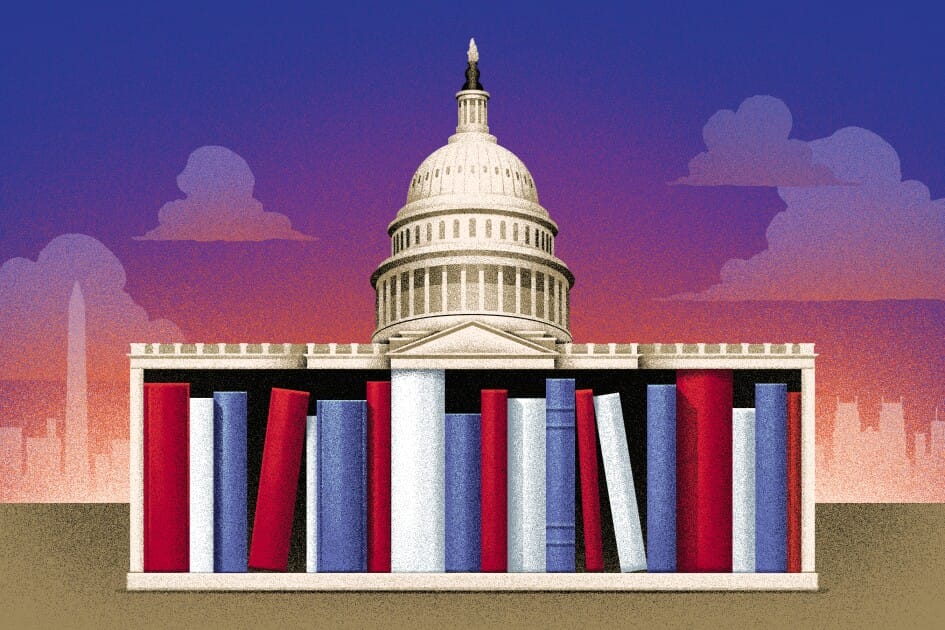
School choice has exploded in recent years. Is this development as novel as our heated debates suggest? Neal McCluskey, the former director of the Cato Institute’s Center for Educational Freedom, is out with a new edited volume that seeks to bring some historical perspective to our current clashes over tax-credit scholarships, education savings accounts, vouchers, and charter schools. In Fighting for the Freedom to Learn: Examining America’s Centuries-Old School Choice Movement, he and James Shuls of the Institute for Governance and Civics at Florida State, have assembled a collection of essays that trace the history of school choice back to the colonial era. I recently had the chance to chat with Neal about the book and what it means for today’s debates. Here’s what he had to say.
—Rick
Rick: You’ve got a new book out on school choice, Fighting for the Freedom to Learn. What’s it about?
Neal: The book traces the treatment of pluralism in American education—what we often call “school choice”—from the country’s colonial period to the “universal” programs of the last few years. Our most immediate goal was to get beyond the myopic focus on the 1950s. School choice opponents often claim the movement began as an effort to evade school desegregation following Brown v. Board of Education, while advocates suggest it started with Milton Friedman’s 1955 essay, “The Role of Government in Education.” Both episodes are part of school choice history but are nowhere close to the beginning. Americans have wanted plural options from the colonial period and the days of the early republic, when government funding of diverse options, such as different Christian denominational schools, sometimes occurred; to the 1870s as Catholics grew in number and became a political force seeking funding for their own schools; to the 1950s as not just desegregation but also worries about religious liberty motivated choice efforts; to the 1960s through the 1990s, when people sought to empower poor and minority families marginalized by public schooling; to today’s universal choice drive. The fundamental message of the book is that, in the United States, the desire for multiple education options has been driven by the populace’s differing values and needs.
Rick: What you’ve just described isn’t the history of schooling with which readers may be familiar. Why is that?
Neal: There’s a lot at play, including that many people just don’t encounter much American history, especially of education. The American history they do know might be only what they remember from high school. Moreover, many people might assume that education has always been as they experienced it—in public schools. I also worry that many journalists who cover education and, especially school choice, do not consult enough diverse voices to learn about this oft-ignored history. Randi Weingarten has claimed in interviews that the choice movement is based in segregation and that fascists oppose public schools. Folks like me—those without big, establishment platforms who would discuss a richer and more nuanced history—are not represented as frequently in traditional news venues.
Rick: Several contributors discuss Horace Mann and the common school. Why does that loom so large here?
Neal: The common school movement, spearheaded by Horace Mann in the mid-19th century, was an effort to publicly fund uniform, government-run schools in every community. This introduced the idea that the government should supply uniform schools for all. Without this development, the need for school choice would have made little sense. That is one reason we don’t see a school choice movement for much of American history or even a distinction between “public” and “private” schools. Education slowly evolved, state by state, to a system dominated by local government schools. Understanding the downsides of common schooling—which morphed into much more centralized systems—highlights the need for choice.
Rick: I’m struck that the chapters on the common school are mostly critical, despite Mann’s handiwork frequently being depicted as a democratic triumph. What do you make of that?
Neal: The biggest objection to the common school movement is that it attempted to standardize the education of children in a diverse society. This approach is more consistent with a totalitarian country than a free one, imposing one view of “right” education on everyone. It’s also important to look objectively at what we mean by “democracy.” To the extent it means that the people, either directly or through representatives, make political decisions, democracy is obviously preferable to a monarchy or oligarchy. And to make good decisions, people need some level of education. But government does not need to provide schools for education to be widespread.
Rick: Are there any chapters that you suspect readers may find especially provocative?
Neal: I think the two that will surprise people most are the chapters by Cheryl Fields-Smith and Ron Matus. Cheryl writes about the African American experience, including the extensive degree to which Black people, including under slavery, educated themselves and later sought alternatives to public schools. The chapter highlights the ability of people to empower themselves in pursuit of education and the inequality of public schooling in the antebellum and Reconstruction South. Ron’s chapter tackles a history that might surprise many people: progressive efforts to expand choice from roughly the mid-1960s to the mid-1980s. Several progressives, such as the sociologist Christopher Jencks and law professor Jack Coons, advocated choice to empower members of poor and minority communities that had insufficient political clout to make the public schools work for them. Indeed, the 1972 Democratic Party platform had planks about supporting private options. This flies in the face of the prevailing notion about school choice: It is exclusively a conservative idea.
Rick: In your telling, when did school choice first enter American education?
Neal: If school choice is defined as government funding going to a multiplicity of schools, that existed in many places from the colonial period to the 1850s. If we mean public money following kids, like a voucher, the first known example occurred in 1802 in Pennsylvania. We also had “town-tuitioning” in Vermont and Maine starting around 1870, by which towns not large enough to support public schools would give families money to choose private institutions. The modern choice period started in 1990 with the Milwaukee voucher program to empower low-income families.
Rick: So the mid-1800s!?
Neal: Yep.
Rick: Are there national policies that have made a big difference for school choice, or is this more a state and local story?
Neal: Until the creation of the new federal scholarship tax credit in the One Big Beautiful Bill, nearly all of the important school choice policies have been at the state level. There’s one notable exception: the District of Columbia voucher program. Created in 2004, it was one of the earlier modern school choice programs. Because it was created through federal law, it is in a sense national, but it only applies to D.C., over which the Constitution gives the federal government jurisdiction. But because it was an early modern choice program, the debate over it received significant national attention. Otherwise, school choice is a story of state action.
Rick: Last summer, as you just noted, Congress enacted the new Federal Scholarship Tax Credit program. How big a deal is this?
Neal: This policy, which allows taxpayers to claim up to a $1,700 tax credit for donating to a scholarship-granting organization (SGO), is a big deal because it could mean a lot of money going to school choice if many taxpayers claim the credit. It gives a nod to federalism by requiring that states opt in to the program, though taxpayers in any state can donate to SGOs nationwide and claim the credit. They won’t, however, have any eligible options in their own states if their state hasn’t opted in. That puts pressure on blue states to participate, which is not in the spirit of federalism. But federal scope and pressure will likely significantly expand choice funding. Hopefully, it won’t also increase federal regulation of private schools.
Rick: The Trump administration has been a vocal champion of school choice. How has that mattered?
Neal: School choice should not be a federal concern, but it is nonetheless generally a good thing to have a supportive president because he has a big pulpit and can exert influence over voters. In the specific case of President Donald Trump, however, he is pretty polarizing, which might have a net negative effect on efforts to build ideological bridges and compromise to get choice passed or expanded in some states.
Rick: Some educators view school choice as an attack on public education. Do you think they’ve got a point?
Neal: I understand that some people may see it that way, but school choice is not an attack on “public education”—it’s a challenge to the idea that the government must be the provider of schools as some claim. As long as the government funds education and enforces compulsory education laws, school choice does not change whether the public gets educated. It just gives the public options. The primary goal of choice is not to attack public schooling. It is to let people who need or want something different to pursue it without having to give up public funding, including their own tax dollars.
Rick: In your book’s final chapter, Jason Bedrick of the Heritage Foundation looks at the political history of school choice and suggests that it’s a mistake for advocates to adopt a bipartisan strategy. What do you make of his advice?
Neal: I’m not sure he is saying to never have a bipartisan strategy—I think he would love to have blue states in the school choice fold. His point is that you need a strategy that will work in any given state. The states most open to choice in the last several years have been red ones. They have responded to a message that resonates with conservative voters: The public schools have dismissed you and tried to impose “woke” ideas on your children, and you need the ability to choose something else. There are many choice advocates trying to think of ways to reach blue state voters, but it is a challenge because progressives are more inclined to prefer government-led solutions.
Rick: If you’ve one piece of advice for educators when it comes to thinking about educational choice, what would it be?
Neal: In a society in which people have diverse—and sometimes fundamentally conflicting—values, needs, and desires, it is better for everyone, including educators, that we have choice. That minimizes conflict, avoids lowest-common-denominator curricula, and reduces educator fear of making someone angry. It allows educators to focus on teaching what they think is best. Parents will have freely chosen them, likely because they agree with what their school stands for. That is a recipe for peace, curricular coherence, and good teaching.
This conversation has been edited for length and clarity.
2026-04-21 10:00:00
Source link