
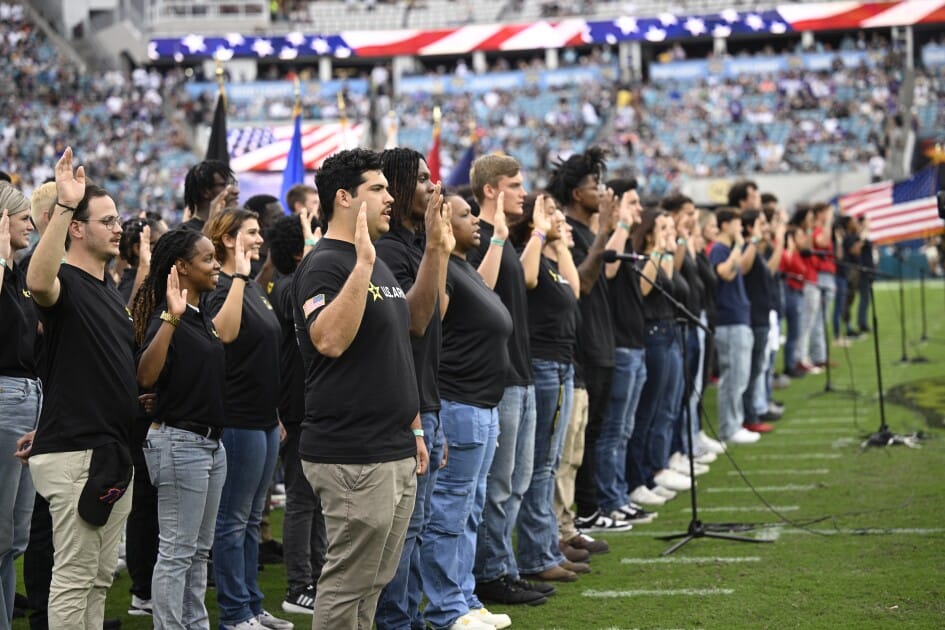
As states seek to align their education and workforce strategies, they lack data on students who move on to serve in the military—creating a big gap in their ability to measure the academic paths that lead to success after high school graduation.
Arkansas, Kansas, Ohio, Tennessee, and Washington state hope to change that by piloting a new data-sharing agreement with the U.S. Department of Defense that will allow them to securely access data on which students enlist, which branches they choose, and how long they serve, announced the Council of Chief State School Officers, which will lead the effort. After a year, the cohort hopes to use feedback from the pilots to refine the agreements and expand to additional states.
Sixteen states try to include military enlistment data in their school accountability models, according to the Data Quality Campaign, an organization that advocates for longitudinal data systems. And at least 33 states track postsecondary data.
The effort, which launches in the fall, aims to address an issue that has vexed state and district education leaders. Different branches of the military have no clear, uniform process for states to access enlistment data, forcing many states to go without it, said Dean Folkers, senior director of education data and technology for CCSSO. About 70,000 people enlist in the armed forces every year, and about half are recent high school graduates.
“For a lot of years, states have relied on what we would characterize as inconsistent data,” Folkers said. “They had to rely on post-school surveys that they would send out and get a small percentage back. Those post-school outcomes are an incredibly important accountability metric for states.”
States lack access to data on students’ military service
The gap comes as states seek to improve longitudinal data systems, which track students’ data points over time related to academic participation, achievement, and postsecondary pathways.
Analyses of that data allow insights into what grades, courses, and other choices are linked with enrollment in higher education, being hired for full-time jobs, and enlisting in the military. And it is crucial as schools grapple with disruption created by artificial intelligence and changing workforce needs, state leaders say.
But without a clear, consistent way to track that information, schools have opted not to report it or taken on the time-consuming task of verifying military services with graduates one-by-one.
“Let us be clear, our priority is to ensure that all high school graduates in our states are ready for college and career success,” 29 state education chiefs wrote in a 2023 letter to the Pentagon. “When students decide to pursue a career in the military, we hope that—and would like to know if—they are succeeding in that career choice. Our efforts as a state education system are only improved when we know how our students are doing.”
Five states will share data with the Pentagon
The new pilot agreements in the five states result from an effort called Military Enlistment Data Access to Lift Student Success, or MEDALS. Launched by CCSSO in 2024, MEDALS brought together a coalition of state education leaders, data experts, and Pentagon officials to explore ways to cut through the red tape.
The participating states will securely share military enlistment and persistence data with the Defense Department, but will not share it with other states or third parties, Folkers said. To get to this point, the working group had to identify an agreement that would address state and federal laws and protect data privacy. They also had to identify a technical process for states to access that data.
The Defense Department, known as the Department of War by President Donald Trump’s administration, “is pleased to partner with CCSSO to increase American students’ awareness of exciting military career options and to help them prepare to meet the Department’s high standards,” said Tim Dill, the agency’s assistant secretary for manpower and reserve affairs.
Using lessons learned from the pilot states, the MEDALS group will refine agreement language and the process for accessing data before expanding the effort.
The MEDALS working group expects to offer data-sharing agreements to additional states in the 2026-2027 academic year. Leaders are still working to determine how many will be included in the next cohort, Folkers said.
2026-03-18 21:08:14
Source link