
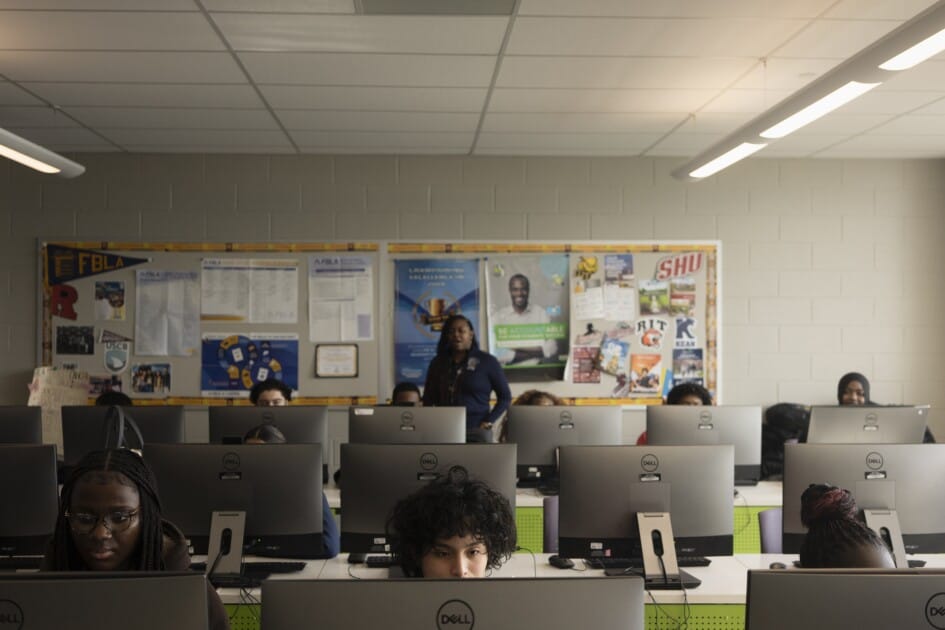
Victor Cifuentes wants to be an engineer.
If all goes according to plan, he’ll be a first-generation college student. His parents encourage him to attend college, but “I don’t get much advice from them [about] my career field,” said Victor, 16, a junior at Donald M. Payne Sr. School of Technology, a public high school in Newark, N.J.
Instead, Victor has had crucial college and career preparation as one of 43 students in the federally funded Career-Connected High Schools program in the Essex County Schools of Technology district.
Through the program, Victor, who’s studying carpentry, enrolled in a writing class, attended financial literacy workshops, and toured Princeton University to get a better sense of what college would be like.
“I’ve met many people in the career field I’m looking at,” Victor said. “They have told me about their experiences, and they have made me lock in that I really want to become an engineer.”
On paper, the program that supports Victor and his peers aligns neatly with priorities of the Trump administration. After President Donald Trump nominated Linda McMahon to serve as education secretary, McMahon published a policy platform that endorsed “workforce development programs that equip students with real-world skills for high-paying jobs in trades and industries and investing in apprenticeship programs with measurable results.”
But students in the grades behind Victor won’t have as many of the opportunities he was afforded. Last summer, the U.S. Department of Education told the Essex County district its Career-Connected High Schools grant would sunset early, with two years’ worth of expected funding cut off.
In fact, all 19 projects initially funded in 2024 through the federal Career-Connected High Schools program—part of the Perkins Innovation and Modernization program—have had to scale back programming and renege on financial support for students after the department told them in July that it had discontinued their grants because they were “not in the best interest of the federal government.”
Their fate is similar to that of more than 700 other Education Department grants the second Trump administration has revoked across dozens of programs. CCHS grantees collectively lost awards worth $48.6 million that they had initially expected to receive in 2025 and 2026. Some were even expecting additional rounds in 2027 and 2028. And some had left-over money from the initial funding round they ended up having to give back.
All of the CCHS grantees are still listed on the Department of Education website, where the agency boasts that 11 of the 19 projects are “primarily serving rural communities.”
Spokespeople for the agency didn’t answer requests for comment in time for publication. The agency has defended other grant terminations, saying it’s “no longer allowing taxpayer dollars to go out the door on autopilot” and that it’s “evaluating every federal grant to ensure they are in line with the administration’s policy of prioritizing merit, fairness, and excellence in education.”
Losing the federal grant won’t bring all the Essex County programming to a halt, but it will make certain investments—such as paying for field trips to college campuses and helping students enroll in pre-college summer programs—more difficult, if not impossible, project leaders said.
Discontinued grants
- Allen County Schools, Kentucky
- Arkansas Department of Education, Arkansas
- Blue Lake Rancheria, California
- Chemeketa Community College, Oregon
- Clayton County Public Schools, Georgia
- District of Columbia Office of the State Superintendent of Education
- Educational School District 105, Washington state
- Essex County Vocational Technical Schools, New Jersey
- Illinois Central College, Illinois
- Mexico School District 59, Missouri
- Miami Dade College, Florida
- Montgomery County Schools, North Carolina
- Pike County Board of Education, Alabama
- Region One Education Service Center, Texas
- Rockcastle County Board of Education, Kentucky
- San Antonio Independent School District (SAISD), Texas
- South Bend Community School Corporation, Indiana
- Wisconsin Department of Public Instruction, Wisconsin
- Yuma/La Paz Counties Community College District, Arizona
The cuts hit projects in Democrat- and Republican-led states alike. Alabama’s Pike County school district leaders, for instance, had planned to use the CCHS money—$2.6 million over three years—to establish two new career pathways for students (cosmetology and plumbing) and expand two existing ones (mechatronics and medical assisting technology), transport students to dual-enrollment programs, and hire work-based learning coordinators and success coaches.
When leaders in the 2,100-student district started encountering funding troubles, they decided to forgo providing the transportation and hiring work-based learning coordinators and success coaches.
Now that the grant has been discontinued, the district’s community and industry partners are sharing the costs, Knox said.

Previous administrations championed school-industry partnerships
These grants were awarded during the Biden administration—but they have their origins in the first Trump administration.
The Education Department opened applications for its first competition of “Innovation and Modernization” grants in 2019 under the banner of Perkins, the formula funding program that supports career-and-technical education nationwide. Nine projects for increasing student participation in computer science, STEM, and CTE programs collectively received $4.4 million over the next three years.
Biden administration officials decided to revamp the next iteration of the program to have a stronger focus on connecting districts and local industries.
They secured $25 million in Congress’ fiscal 2023 budget and received a flood of applications—161 in total from 43 states and the District of Columbia, collectively requesting $860 million.

The agency awarded $25 million in three-year PIM grants—now under the label of Career-Connected High Schools—to 19 projects, including in Essex and Pike counties, in early January 2024. The investment was small, but advocates were excited anyway.
“The policy behind it to us was more significant than the money,” said Phillip Lovell, associate executive director of All4Ed, a nonprofit advocate for preparing students for post-secondary opportunities. “We’re not just going to give money to school districts—we’re going to give money to partnerships between school districts, institutions of higher ed and employers.”
CCHS grantees started experiencing funding uncertainty almost immediately, well before Trump took office for his second term.
In March 2024, just a month after the Career-Connected High Schools grantees got their first set of funds, Congress approved an annual federal budget that included only $6 million for CCHS—less than one-third of the original allocation, and a far cry from the $200 million Biden had proposed for the program’s second year. That meant the grant recipients could now expect much smaller-than-expected awards for their second and third years of funding.
Ultimately, those smaller awards never arrived.

Funding officially disappears after months of uncertainty
Grantees’ second year of funding was due to begin Feb. 1, 2025—but the Trump administration had taken office days earlier and almost immediately threw federal spending into chaos.
For nearly six months into Trump’s second term, Career-Connected High Schools grant recipients weren’t sure their second year of funding would ever arrive, let alone their third.
In Wisconsin, the state education agency was using CCHS funding to help school districts that were struggling to implement dual-enrollment, workforce-learning, and professional credential-attainment programs learn from districts where those programs were working well.
But with the funding cuts and delays, project leaders had to scale back professional development opportunities for participating district leaders. The state also encouraged districts to stretch their first-year awards to cover two school years’ worth of expenses.
“It’s hard to oversee a grant program and keep it moving forward when you don’t even know until the last minute what things are going to look like,” said Karin Smith, who oversaw the Wisconsin education department’s CCHS-funded project.
Some CCHS grantees were momentarily encouraged in April 2025, when Trump signed an executive order urging increased federal investment in registered apprenticeships and other workforce development initiatives—exactly what the CCHS grantees were doing.

That optimism was short-lived, though. On July 29, 2025, all 19 received letters from the Education Department announcing that the agency had discontinued their grant awards.
As with hundreds of similar notices Education Department grant recipients received in 2025, the letters, signed by Trump appointee Murray Bessette, stated the projects were “not in the best interest of the federal government” and that the department was “exercising discretion to reallocate available funding towards projects more aligned with the current priorities of the administration.”
The agency didn’t allege the grantees had violated rules or laws, or specify which aspects of the programs clashed with administration goals.
It did allow grantees to appeal the decision by Aug. 12. But by late August, all programs that submitted appeals received virtually identical rejection letters.
The rejection letters bore the signature of Lindsey Burke, the department’s deputy chief of staff for policy and programs. Burke wrote the education section of the conservative policy agenda Project 2025, which includes a recommendation to eliminate competitive federal education grants altogether.

Ambitious plans didn’t end up coming to fruition
Grantees launched into their grant-funded work with big plans.
The Newark Youth Career Pathways nonprofit has had a long relationship with the Essex County Schools of Technology district, hosting workshops on financial literacy, resume writing, and planning for college.
When Kaleena Berryman, the nonprofit’s executive director, saw the opportunity for a federal grant that could help expand that partnership, she rushed to email Cathleen DelaPaz, the school district’s CTE director.
DelaPaz had seen it, too. They applied within a week, and became one of only five CCHS grantees on the East Coast.
The original plan was to establish two cohorts, each with 50 high school students taking classes that follow one of eight career pathways, participating in support and enrichment programming during and after school, enrolling in Rutgers University courses for up to 12 college credits, and even getting financial support from the district for child care, transportation, or technology access after they graduate.
“It would make sure that those 100 students were truly supported to remove any barriers to success,” Berryman said.

In Oregon, two community colleges partnered with five school districts and aimed to spend $4.2 million in CCHS funds helping rural students receive college credits, work-based learning experiences, and internships, said Sara Hastings, the dean of high school partnerships for Chemeketa Community College and project director for its CCHS grant.
The plan was to support 420 students with college credits, 150 students with internships, 400 students with career planning, and health care and agriculture career exposure for 600 students, Hastings said. It also included training for high school teachers to be able to teach dual-enrollment classes.
“It would have increased high school graduation rates, college matriculation, college and career completion by over 10%,” Hastings said. “It would have had a significant educational and economic impact on our region.”
Some CCHS programs had already begun to collect encouraging data on the success of their efforts.
Among the 15 districts that ended up sticking with the Wisconsin project, the percentage of enrolled students participating in dual-enrollment programs jumped from 3.9% to 18.6% from one year to the next, said Smith, the state’s CCHS project director. Participation in credential attainment saw a similar jump, from 6.9% to 25.1%. Work-based learning participation exploded from 4.4% percent to 45.2% percent.
“We were just on the precipice of seeing some really amazing things,” Smith said.

A new—and different—funding opportunity has emerged
For the current fiscal year, Congress last month allocated another $12.4 million for Perkins “national activities,” where the Innovation and Modernization and Career-Connected High Schools programs lie.
But the Trump administration hasn’t launched a new competition for PIM or CCHS grants—even as it continues to talk up initiatives with similar goals.
The pipeline for America’s workforce begins by training the next generation of skilled workers and making sure postsecondary education leads to well-paying careers that match workforce needs.
— Secretary Linda McMahon (@EDSecMcMahon) February 6, 2026
The department in December instead announced a new initiative that shares many core features of the CCHS program—but it’s structured as a “challenge” rather than a competitive grant program.
The Connecting Talent to Opportunity (CTO) Challenge calls on applicants looking to “strengthen the connections between learners, education and training providers, and employers by fostering the development of integrated Talent Marketplaces.”
The CCHS grant program was open to a wide range of applicants, including school districts colleges, and state education agencies. For the challenge, agencies and organizations can work together, but state governors must apply on their behalf.
Applications are due April 30. The $15 million competition will then fund a maximum of 10 projects, with money doled out in three increments: an initial prize of $100,000 before work begins, a planning round with a $400,000 award at the end, and a final round of implementation with a $1 million award at the end.
The challenge application materials emphasize that “the cash prize is not awarded with specific terms and conditions like a traditional federal education grant.” Participants will receive money after completing the project requirements, not before.
“It allows them to continue to support workforce development stuff, but it allows them to do that without continuing a program that started under the Biden administration, and with far fewer strings,” said Lovell from All4Ed.
The department didn’t answer questions about why it launched the challenge after discontinuing the similarly focused grants.
Meanwhile, CCHS grant recipients are still trying to build on their early successes.
The Pike County district in Alabama had partnered with community colleges to provide dual-enrollment opportunities for high school students. It also used federal grant funds to hire teachers who work on the school site rather than at the community colleges because transportation is a major barrier for the students, Knox said.
Enrollment in the four career pathways Pike County focused on has grown, which shows that the funding has really helped, Knox said. The plumbing program went from having eight students during the program’s first year to 25 in the second.

Enterprise State Community College is paying for the teachers for the mechatronics (technology allowing for automated manufacturing) and cosmetology classes; the plumbing program is funded through a state grant; and the district is partnering with the city of Troy and the Troy Regional Medical Center to continue the medical assisting program.
The CCHS grant funding “allowed us to create some of these big partnerships,” Knox said. “While I hate that the funding is gone, it positioned us to be able to be where we are today.”
With the CCHS funding that the Oregon Coast and Chemeketa community colleges received, Hastings said they were able to provide work-based learning experiences, dual-enrollment classes, and industry certifications for high school students during the 2024-25 school year—albeit to fewer students than planned.
“There were so many wonderful things that we could be doing for our students, especially for our rural students,” Hastings said. “To not be able to fulfill those promises to our students, it’s a hard thing.”
2026-02-26 22:13:01
Source link