
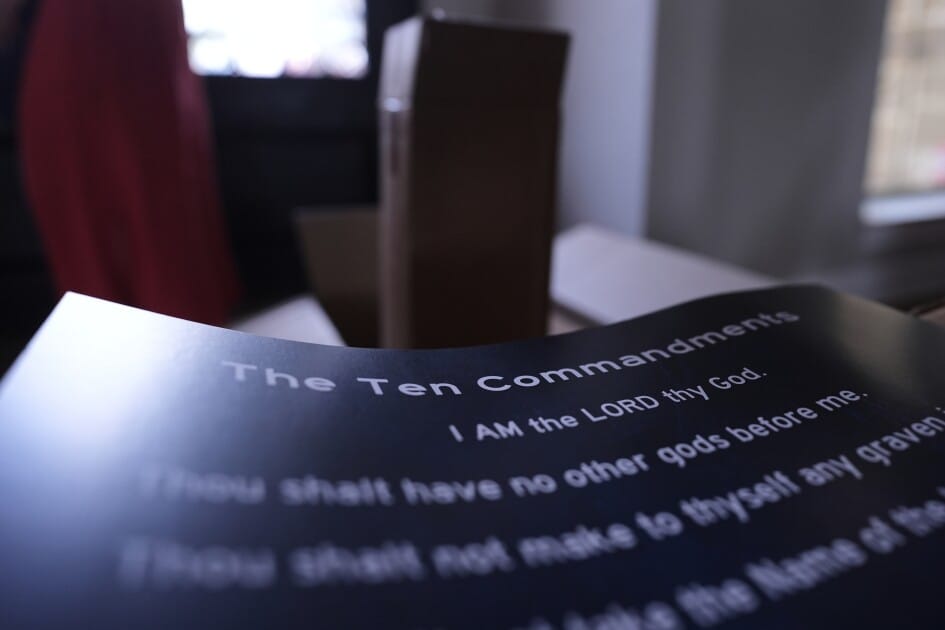
A federal appeals court appeared receptive to allowing Louisiana and Texas laws requiring displays of the Ten Commandments in public school classrooms to take effect, signaling a potentially significant shift in how courts view long-standing precedents governing the presence of religion in schools.
The full U.S. Court of Appeals for the 5th Circuit, in New Orleans, heard more than 90 minutes of arguments on Jan. 20 over the two similar laws that federal district judges in Louisiana and Texas have blocked at least as to some districts as likely violations of the First Amendment’s prohibition against government establishment of religion.
A three-judge panel of the 5th Circuit upheld the ruling against the Louisiana law last June, but that decision was set aside after all 17 active judges on the court took up both states’ laws in the fast-moving and lively argument. Whatever the appeals court’s decision, many legal observers expect the cases to reach the U.S. Supreme Court.
“What the Texas legislature has determined is that this is a historical document, … a foundational document that plays an important role in American heritage,” Texas Solicitor General William R. Peterson said about his state’s law, which was due to take effect last September before it was blocked.
Both Louisiana and Texas laws mandate specific size and font requirements for the classroom posters, and require a Protestant version of the Commandments.
Louisiana Solicitor General J. Benjamin Aguiñaga said that just because his state’s law requires a version of the Commandments that is associated with Christianity, it “doesn’t mean it is expressing hostility to other religions.”
Jonathan K. Youngwood, a New York City lawyer representing the families challenging the laws in both states—backed by the American Civil Liberties Union, Americans United for Separation of Church and State, and the Freedom From Religion Foundation—said the states “seek coercively to impose scripture on [the plaintiffs’] children.”
“From kindergarten to senior year,” he added, “a student in public school will face an unavoidable constant: government-mandated religious dictates in every single classroom.”
Youngwood argued that Ten Commandments displays are unconstitutional under the Supreme Court’s 1980 decision in Stone v. Graham, which struck down a Kentucky law similar to the recent wave of state statutes.
He faced pushback from some of the court’s more conservative members.
Judge James C. Ho, who was appointed in 2018 by President Donald Trump, asked whether the court would also have to bar traditional classroom recitations of the Pledge of Allegiance, with its 1954 addition of the words “under God.”
“If you have a polytheistic view, the pledge is anathema to that,” Ho said.
Other judges asked Youngwood about teaching President Abraham Lincoln’s second inaugural address, which includes Bible references, and Martin Luther King Jr.’s “Letter From Birmingham Jail,” which also has faith-based references.
“It’s about as religious as you can get,” said that judge. (The court livestreamed audio of the argument, and it wasn’t always possible for remote listeners to identify which judge was speaking.)
The pledge and those other documents were “far less egregious” than posting the Ten Commandments, Youngwood said. “These are commandments. This is many steps too far.”
A few tough questions for the states
Some judges seemed to agree with the two states’ arguments that the Supreme Court’s 1980 Stone decision was effectively overruled when the high court made clear in its 2022 decision upholding a high school football coach’s right to pray on the field that it had overruled a key 1973 decision on the separation of church and state.
That decision, Lemon v. Kurtzman, set a multi-part test for evaluating the constitutionality of government action regarding religion. The Stone decision was rooted in one of the prongs of the so-called Lemon test.
“Stone is Lemon, Lemon, Lemon,” said one judge. “It’s Lemon all the way down. So if you take away Lemon, there’s nothing left in Stone.”
Youngwood disagreed, saying “Stone is unquestionably still good law.”
Some judges did have tough questions for the two states’ lawyers. One asked lawyers about “limiting principles” for the display laws.
“Could the school start each day by reading the Ten Commandments?” the judge said. “Could [a teacher] answer students’ questions [or] proselytize? Where on the spectrum do we begin to say no?”
Aguiñaga said, “I think you can leave those cases for another day. … All we’re talking about here is the passive display of religious symbols.”
Peterson, the lawyer for Texas, said, “This is the display of the Ten Commandments in schools. This is not instruction about the Ten Commandments.”
Another judge asked Aguiñaga, “Can you think of any rabbinical authority that accepts the Protestant translation” of Commandments “over the Torah’s?”
Aguiñaga, as the state’s merits brief had, cited a positive reference to the Ten Commandments that the late Justice Ruth Bader Ginsburg, who was Jewish but not a rabbi, made in an essay she wrote when she was in 8th grade.
“Since the beginning of time, the world has known four great documents, great because of all the benefits to humanity which came about as a result of their fine ideals and principles,” Ginsburg had written in reference to the Commandments, Magna Carta, the 1689 English Bill of Rights, and the Declaration of Independence.
“Today people of almost every religion respect and accept [the Commandments] as a code of ethics and a standard of behavior,” Ginsburg wrote in her 1946 essay for the student newspaper at Public School 238 in Brooklyn.
(The Louisiana state education department had recommended in its guidance to schools about how the Commandments should be displayed that they might also display Ginsburg’s comment, among other suggestions.)
Youngwood took a jab at the state’s reliance on the Ginsburg quote to support its legal position. “This is the place they need to go,” he said of Louisiana. “They need to find an 8th grader’s essay.”
2026-01-21 20:18:17
Source link