
The U.S. Supreme Court on Tuesday appeared inclined to uphold two state laws that prohibit transgender girls and women from female sports.
The justices engaged in more than three hours of measured and generally respectful consideration of cases from Idaho and West Virginia, which are among the 27 states that have laws designating boys’ and girls’ athletic teams based on individuals’ sex assigned at birth.
“Given that half the states are … allowing transgender girls and women to participate, about half are not, why would we at this point … jump in and try to constitutionalize a rule for the whole country while there’s still … uncertainty and debate?” Justice Brett M. Kavanaugh said.
That comment came during arguments in Little v. Hecox, the case involving Idaho’s 2020 law, which was challenged by a prospective college athlete, Lindsay Hecox. A federal appeals court in 2024 blocked the law on the basis of the 14th Amendment’s equal-protection clause.
Idaho Solicitor General Alan M. Hurst told the justices that his state’s law “classifies on the basis of sex because sex is what matters in sports. It correlates strongly with countless athletic advantages, like size, muscle mass, bone mass, and heart and lung capacity. Tragically but not surprisingly, male athletes have even injured female athletes in many sports.”
Justice Samuel A. Alito Jr., a conservative who has expressed concerns about transgender girls’ participation, voiced the view of some cisgender girls who have been outspoken against competing against transgender girls.
“Looking to the broader issue that a lot of people are interested in, there are an awful lot of female athletes who are strongly opposed to participation by trans athletes in competitions with them,” Alito said. “Are they bigots? Are they deluded in thinking that they are subjected to unfair competition?”
Kathleen R. Hartnett, the lawyer representing Hecox, replied, “I would never call anyone that,” suggesting that Idaho’s law was an irrational response to a misguided perception that women’s sports were being “fully overrun by an outbreak of a huge new number of transgender people.”
A focus on two potential swing justices
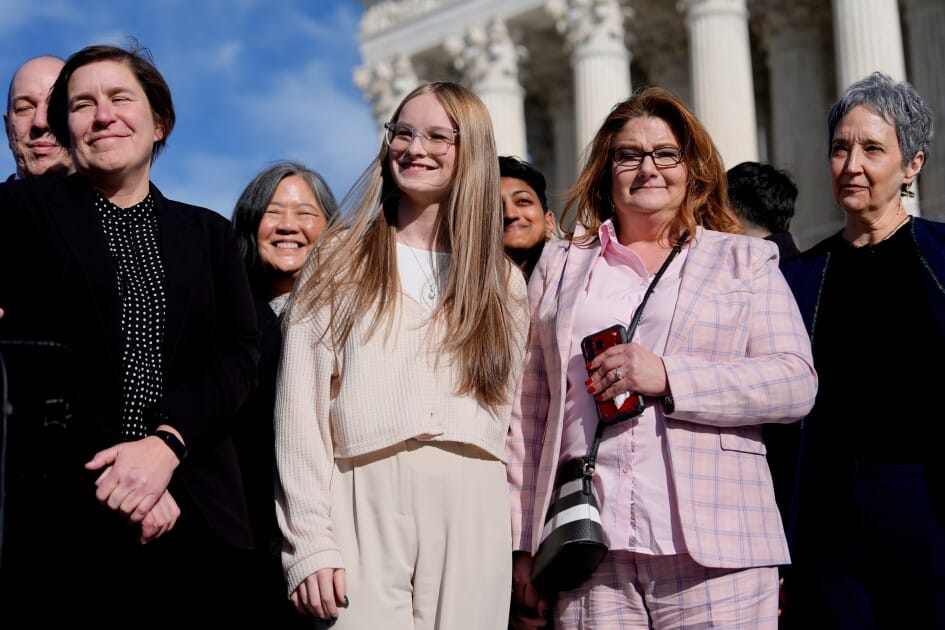
The court also weighed West Virginia v. B.P.J., involving that state’s 2021 law that was challenged by now-15-year-old Becky Pepper-Jackson, who won an injunction to participate in school cross-country and track and field, and has continued to compete. Pepper-Jackson and her mother, Heather Jackson, were in the courtroom on Tuesday.
The West Virginia law was blocked as to Pepper-Jackson by a federal appeals court based on Title IX, the 1972 federal law that bars sex discrimination in federally funded schools. So arguments in the West Virginia case focused a little more on Title IX.
“Title IX permits sex-separated teams,” West Virginia Solicitor General Michael R. Williams told the justices. “It does so because biological sex matters in athletics in ways both obvious and undeniable.”
Joshua A. Block, the American Civil Liberties Union lawyer representing Pepper-Jackson, referred to her initials used in court papers in saying that “West Virginia’s law treats B.P.J. differently from other girls on the basis of sex, and it treats her worse in a way that harms her.”
There was special scrutiny on the questions of two conservative justices—Chief Justice John G. Roberts Jr. and Justice Neil M. Gorsuch—who joined their liberal colleagues in 2020 to hold that Title VII of the Civil Rights Act of 1964 protects employees on the basis of sexual orientation and gender identity.
Gorsuch, who wrote the opinion in Bostock v. Clayton County, appeared more cautious on Tuesday to agree that Title IX and its protections in education “based on sex” necessarily protected transgender girls in sports.
Gorsuch focused on a 1974 act of Congress, known as the Javits Amendment, that gave schools and colleges greater flexibility to apply Title IX in athletics, as well as U.S. Department of Education regulations from the 1970s that combined to ensure there could be sex-separate teams.
“Javits changed Title IX, and it said, you know, sports are different,” Gorsuch said. “And we’ve got these regulations that have been out there for 50-plus years. … Why doesn’t that make this case very different than Title VII?”
Block replied that Title IX rules, even under the Javits Amendment and those early regulations, “still require equal athletic opportunity. It’s not a complete exception for sex-separated teams.”
Roberts suggested that while Bostock held that transgender status met the definition of discrimination on the basis of sex, the earlier case may not resolve “the question here” of “whether or not a sex-based classification is necessarily a transgender classification.”
Alito pressed Block on the definition of “sex” in the federal statute.
“Title IX prohibits discrimination on the basis of sex,” Alito said. “It’s a statutory term. It must mean something. You’re arguing that, here, there’s discrimination on the basis of sex. And how can we decide that question without knowing what sex means in Title IX? I mean, it could mean biological sex. It could mean gender identity. It could mean whatever a state wants to define it to mean, but it has to mean something.”
Block declined to offer a strict definition but said, “I think there are a whole range of sex-based characteristics that can give rise to discrimination.”
Questions about Trump administration Title IX enforcement
The Trump administration is supporting the two states, with Principal Deputy U.S. Solicitor General Hashim M. Mooppan arguing in both cases.
“Denying a special accommodation to trans-identifying individuals does not discriminate on the basis of sex or gender identity or deny equal protection,” he said.
Mooppan was pressed repeatedly on whether Title IX or the equal-protection clause would give cisgender girls the right to challenge a state that allowed transgender girls to participate in sports.
President Donald Trump, in his Feb. 5 executive order on “Keeping Men Out of Women’s Sports,” asserts that Title IX does prohibit trans girls from participating, and his Education Department is pressing that case against a handful of states.
“We are actively litigating in lower courts, and we are saying that they are violating Title IX,” Mooppan said, adding that it is a different question than the ones in the two cases before the court. “We would urge this court to make clear it’s not resolving that question one way or the other by what it says in this case.”
Justices Clarence Thomas and Amy Coney Barrett also asked questions that appeared more supportive of the states.
The court’s more liberal justices—Sonia Sotomayor, Elena Kagan, and Ketanji Brown Jackson—sounded supportive of transgender girls, but they were reserved in their questions, with a focus on allowing such girls to challenge their exclusion from sports under such laws if, for example, they have taken puberty blockers and female hormones.
Jackson wondered why there would not be a valid claim for a transgender girl “who does not have, because of the medical interventions and the things that have been done, who does not have the same threat to physical competition and safety and all of the reasons that the state puts forward.”
The justices seemed open to the effort by Hecox to dismiss her case because she has not made the track or cross country teams at her Idaho university and has said in court papers that she is suffering from the attention of being the plaintiff. Idaho argued against dismissing her case as moot.
The West Virginia case could still be the basis for a ruling under equal protection or Title IX. (The federal appeals court in that case, while blocking the law under Title IX, had sent the equal-protection issue back to the trial court for further development of the facts.) That still presents the Supreme Court with both issues.
A comment late in the argument by Kavanaugh, a father of two girls who have played multiple competitive sports, seemed to sum up the complexity of the issue, while again showing that he’s leaning in favor of the states.
“I hate that a kid who wants to play sports might not be able to play sports,” he said, referring to the transgender females challenging the state laws. “I hate that. But … it’s kind of a zero-sum game for a lot of teams. And someone who tries out and makes it, who is a transgender girl, will bump [another student] from the starting lineup, from playing time, from the team, … and those things matter to people big time.”
He continued: “It’s not like, ‘oh, just add another person to the team.’ That’s not how sports works.”
A decision in the case is expected by late June.
2026-01-13 23:34:57
Source link