
Sharie Lewis, chief financial officer for the suburban Parkrose school district in Oregon, always anxiously anticipates the outcome of her state’s annual legislative session. But this year she’s especially on edge.
The state is bracing for a revenue shortfall of potentially hundreds of millions of dollars, and has asked every agency—including the state education department—to prepare for budget cuts that could range from .5 percent to 5 percent and take effect for the school year that’s currently underway.
Mid-year cuts of that magnitude—the first of their kind since Lewis joined the 2,800-student district a decade ago—would translate to Parkrose schools losing $250,000 to $2 million. With union contracts already in place, cutting staff pay in the waning months of the school year would be an uphill battle—but Parkrose might not have other options.
“When you only have $41 million in the general fund, that’s quite sizable,” Lewis said.
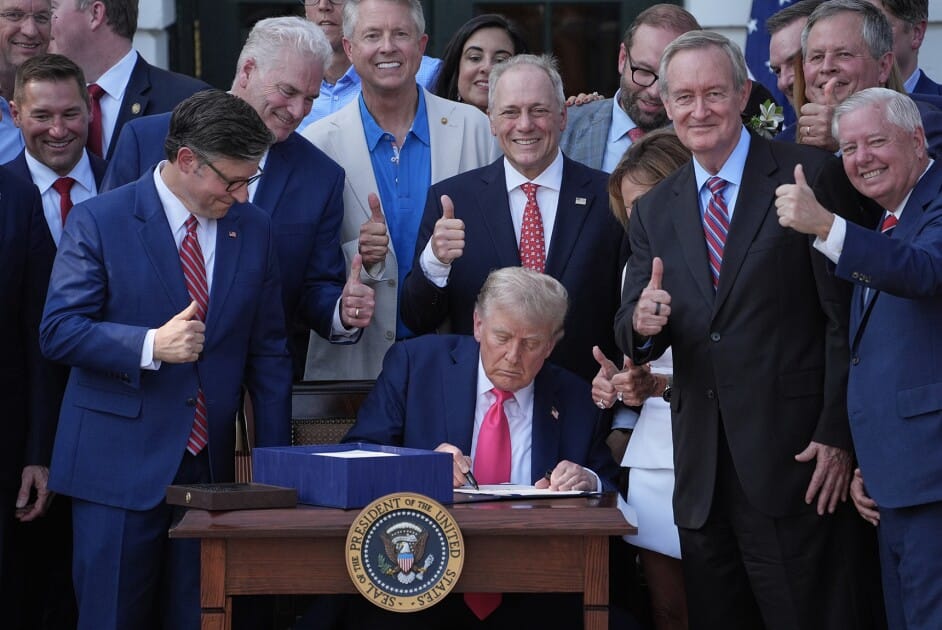
The statewide specter of these unusual cuts marks one of the first tangible ripple effects for K-12 schools nationwide from the One Big Beautiful Bill Act, approved by Congress and signed into law by President Donald Trump last July.
The legislative package contains sweeping federal tax changes that take effect immediately, including provisions that guard income from tips and overtime from taxation, a new tax deduction for seniors, and an increase to the standard deduction most taxpayers claim on their tax returns. States, in turn, have to decide whether to incorporate these changes into their own tax codes, an approach known as “conformity.” Those choices affect the amount of money on which states can base their own tax collections.
States in recent months have begun grappling with dire projections for revenue loss. Some have already moved to insulate themselves from the federal changes, or already had laws in places that protected their tax structures from federal overhauls.
But Oregon, unlike most states, automatically adopts adjustments in the federal tax code, no matter their implications for state collections. Despite lawmakers’ best efforts last fall to make last-minute changes to that longstanding policy, Oregon will likely be among the states hit hardest by the latest federal tax policy reforms.
“I’m trying to limp along to get through the end of the year. But I’m not a district with a lot of money,” Lewis said. “It’s going to be interesting.”
State fiscal challenges are only beginning to ramp up
Burak Sür/iStock/Getty
State funding makes up roughly 45 percent of annual school spending nationwide. In Oregon, the most recent federal data show the state share of school spending is over 50 percent—highlighting how stress on one of schools’ top funding sources could translate into budget pain.
On top of the federal tax changes, the Big Beautiful Bill also portends increases in the costs of states’ participation in benefit programs like SNAP and Medicaid that already represent some of their biggest budget line items.
Meanwhile, Congress still hasn’t finalized education appropriations for next school year, leaving schools’ federal allocations for key programs like Title I for low-income students up in the air. And with birth rates trending downward nationwide, and state subsidies for private education growing more common, public school enrollment losses are likely to continue to depress the amount of state education funding headed to school districts.
“All of this is colored by the fact that state budget outlooks are weaker now than they have been for the last several years,” said Carl Davis, research director for the Institute on Taxation and Economic Policy, a left-leaning nonprofit research organization. “Many of them don’t have a whole lot of breathing room to start offering brand new tax carveouts for things like tips and business investments.”
States have begun taking steps to account for the federal changes—but decisions about whether to make their tax codes “conform” to or “decouple” from the federal tax code aren’t straightforward or uniform. Unlike Congress, most states are required by law or their constitutions to pass a balanced budget each year, no matter how their tax policies change.
“There are more immediate and obvious tradeoffs with doing tax cutting at the state level,” Davis said.
Some states with laws that permit them to be selective have adopted only certain provisions from the federal bill. Maine, for instance, took up exemptions for certain small businesses’ research and development fees but won’t adopt reduced taxes on tips or overtime pay or the standard deduction increase. Delaware and Pennsylvania decoupled from certain components of federal reforms to corporate taxes.
In some places, tensions have arisen over the push to mirror the federal government’s tax reforms. Indiana lawmakers, for the first time in state history, rejected the governor’s request for a special legislative session last fall that would have focused on congressional redistricting and aligning the state and federal tax codes to help simplify filing for the upcoming tax season. Bills filed in the early weeks of the legislature’s regular session have proposed conforming the state tax code to a more limited set of Big Beautiful Bill changes.
In other Republican-led states, the prospect of a revenue shortfall from the Big Beautiful Bill isn’t raising alarm bells. Idaho’s lieutenant governor, Scott Bedke, said last month that failing to conform to the federal tax changes would give neighboring states that do conform a competitive advantage. State lawmakers in nearby Montana and North Dakota, meanwhile, have said confronting the tax changes can wait until 2027.
Oregon is feeling acute pain after failing to head off federal reforms
In Oregon, Democratic lawmakers, despite holding majorities in both state chambers, fell short of the votes to avoid adopting costly provisions of the Big Beautiful Bill like exemptions for tips and overtime.
One estimate in August projected an annual state revenue loss of $373 million, but a subsequent estimate downgraded the forecasted shortfall to $63 million. The state spends roughly $70 billion a year in total.
State agencies began drafting revised current-year budgets to account for the oncoming shortfall. Another revenue projection is due in February, just in time for state lawmakers to convene for their biennial “short session.”
“We’re kind of in a waiting pattern,” said Jackie Olsen, executive director of the Oregon Association of School Business Officials.
A softer shortfall forecast won’t spell the end of Oregon’s fiscal turbulence, Olsen predicts: “If [lawmakers] choose not to cut anything right now, there might be more cuts that have to be made in the next biennium.”
Oregon does have some alternatives for softening the blow from a mid-year school budget cut. The state since 2002 has maintained a $1 billion Education Stability Fund it can access, by law, in times of acute financial distress.
But it’s not clear whether three-fifths of lawmakers and the governor will approve tapping into it. And even if they do, the decision could come too late for school districts to reverse cuts.
Certain smaller education programs could be particularly vulnerable if the state agency aims to preserve base funding that all school districts receive by making cuts elsewhere. Future Farmers of America leaders, for instance, have raised concerns about a draft budget cut proposal that would eliminate more than $1 million that covers student fees for agriculture education programs. Another proposed cut would target a fund that helps school districts with low property wealth.
Mid-year cuts are particularly painful for school districts, which set their budgets well before the academic year begins, and don’t have much wiggle room near the end of a budget cycle.
In the Parkrose district, Lewis has already scaled back purchase card permissions for staff and is preparing a broader preview of financial challenges for an upcoming school board meeting. Other districts have held off on filling open positions, Olsen said.
Some district administrators who have been in their roles long enough to remember what they did when the 2008 financial crisis hit may be better-positioned to weather the latest storms, Olsen said. But not everyone can draw on muscle memory.
“We have had such a huge influx of new superintendents and new business managers that have never been through this,” Olsen said. “They may have had to make reductions in their budgets at times, but it hasn’t felt like a crisis.”
2026-01-13 20:43:50
Source link