
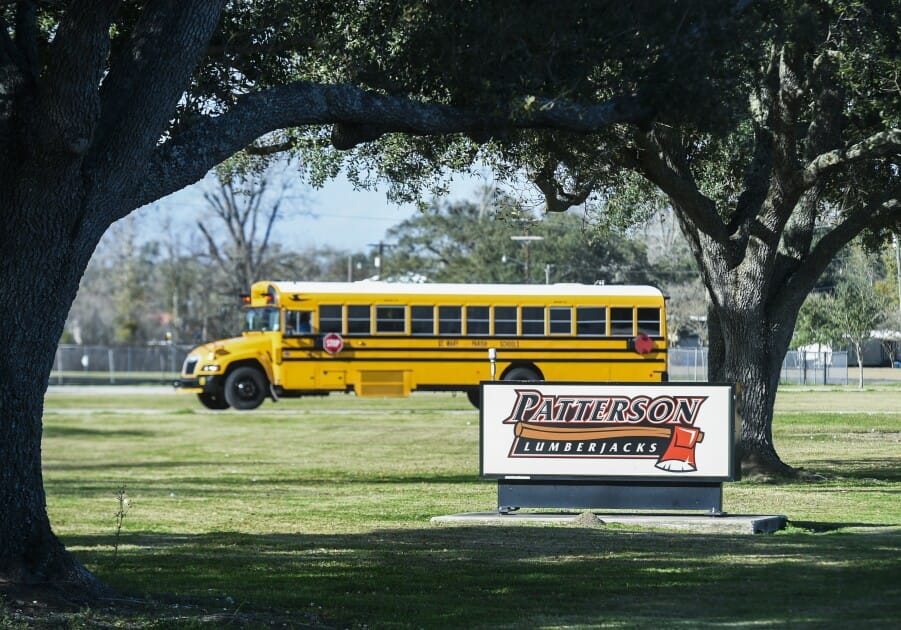
The public schools in St. Mary Parish have been under a federal order to desegregate longer than Tia Paul has been alive.
The oversight began in 1965, barring the school board from sending Black students like Paul’s mother to different schools from White students and requiring it to eliminate the effects of segregation. It continued through Paul’s graduation from Patterson High School in 1995 and remains in place now as her daughter completes her junior year there.
The orders gave Black students access to schools where they had been shut out, including formerly all-White Patterson High, which became 35% Black within several years and is still racially mixed today. They also spurred the board to take other steps, like recruiting more diverse teachers, and empowered families to call in the U.S. Department of Justice, as they did in 2016 when the district sought to close a majority Black school.
Yet by many measures, the district has become more racially imbalanced, with a larger share of schools that are disproportionately White or Black today than in 1975. Black students are suspended more often than their White peers and are less often referred for gifted and talented screening. Schools with more Black students have fewer certified teachers and more building defects, including moldy ceiling tiles, broken toilets, and pest infestations, according to the NAACP Legal Defense and Education Fund, the legal nonprofit arguing in federal court that the orders should remain in place.
“I see the same things going on now from when I was in school,” Paul said.
St. Mary Parish is on the frontlines of a legal battle to end the remaining school desegregation cases, which date back to the civil rights era and are ongoing in about a dozen parishes.
The state’s Republican leaders, who believe it is time to end the decades-old cases, have notched two recent victories: The Plaquemines Parish school district had its orders lifted last year, and a federal judge did the same for DeSoto Parish on Monday.
Lawyers for the St. Mary Parish School Board say all “direct effects” of past segregation have been eliminated, and interim Superintendent Rachael Sanders said in a statement that the board is committed to supporting every student. Louisiana Attorney General Liz Murrill’s office, which is leading the charge to dissolve the orders, argued Wednesday in the 5th U.S. Circuit Court of Appeals in New Orleans that St. Mary’s case should be dismissed.
To Murrill, Gov. Jeff Landry, and other critics of the ongoing desegregation orders, they are relics of the past that handcuff local school boards and incorrectly attribute current conditions to past practices.
“The problems of today are different than the problems of 60 years ago,” Murrill said in an interview this week. “They do not necessarily tether back to the vestiges of prior discrimination.”
Under President Donald Trump, the Justice Department has joined Louisiana in seeking to dismiss several of the cases, including one in Concordia Parish now headed to the 5th Circuit. It is a sharp reversal for the agency, which brought many of the original desegregation lawsuits and for decades enforced the orders, and the latest example of the Trump Administration pulling back from education and civil rights oversight.
In court, attorneys for the Legal Defense Fund are trying to force St. Mary Parish and other school boards to prove they have complied with the orders before they are lifted, which is customary in desegregation cases. At least two U.S. District Court judges have rejected Louisiana’s bid to skip that process and dismiss the cases on procedural grounds, and 5th Circuit judges reviewing the St. Mary case asked skeptical questions Wednesday about that approach.
Some civil rights groups and Black parents like Paul say it is irrelevant how old the desegregation orders are if racial disparities persist. More can be done to ensure Black students receive an education that is equal in quality to that of their White peers, they argue, but they fear school boards will be less inclined to take those steps without court oversight.
“Litigation hanging over their heads—that’s what they need,” Paul said. “It gives them a motivation and incentive to keep improving things because they’re being watched and held accountable.”
Are orders outdated or still necessary?
Until last year, the Justice Department was actively enforcing some of the same desegregation orders it’s now helping to terminate.
In St. Martin Parish, where the department is now seeking to withdraw from the case, it helped develop plans in 2023 for a new magnet school. In DeSoto and Plaquemines parishes, the agency’s staff was visiting schools and requesting compliance data as recently as 2024.
That same year, the Justice Department proposed a settlement in Concordia Parish’s long-running case that included moving some students between majority White and majority Black schools. Some parents railed against the deal at a December 2024 forum, where an attorney in Murrill’s office advised holding out for the incoming Trump Administration.
The board rejected the deal. Just months later, Trump’s Justice Department joined Murrill’s office in asking a federal judge to dismiss the case without a settlement or trial. U.S. District Court Judge Dee Drell declined, writing that “long established legal precedent” required a careful review of evidence before closing such cases. The parties appealed to the 5th Circuit.
The U.S. Supreme Court has said that school districts seeking to end desegregation orders must show that all traces of racial discrimination have been erased in six areas, including building quality and student assignment to schools. Derek Black, a professor at the University of South Carolina School of Law, said it is “nonsensical” to argue that a district can bypass that process.
“It’s a fundamental rejection of the rule of law,” he said.
Critics of the order say they have outlived their use, draining school resources in a futile attempt to fix problems, such as racial imbalances, that today are caused by housing patterns, not discrimination. In a legal brief last year, Murrill’s office said the St. Mary School Board’s policies are “colorblind,” while the plaintiffs want “racial engineering.”
Ruth Powers, a retired educator in Concordia Parish, said she believes in the importance of diversity, but doesn’t think forcing schools to shift students around is the right way to go about it.
“The answer is not dismantling the schools in a community in order to achieve some sort of forced racial balance,” she said. “All you’re going to do is create resentment.”

Civil rights groups say the orders still are needed because some districts have never fully uprooted the remnants of segregation. In the St. Martin Parish case, the judge found that the school board’s failure to integrate a majority White school had partly caused present-day housing patterns, not the other way around.
Reginald Weary, president of the St. Mary Parish NAACP chapter, said it’s possible for Black students there to get an excellent education—as his daughters did at racially mixed Morgan City High School. But schools with more Black students often seem to have fewer resources, he said. The majority Black Franklin Senior High School did not offer calculus for one school year, while the majority White Berwick High School had two calculus classes, according to court filings.
To Weary, the battle is no longer about putting Black and White students in the same schools.
“Now we’re fighting for equality and quality education,” he said. “From that perspective, there’s still work to be done.”
2026-01-12 21:32:18
Source link