
Student test scores in the U.S. are down from where they were a decade ago. The trend is one that education researchers accept but took most of the decade to identify.
Prior to the COVID-19 pandemic, “it was not yet obvious that there was a significant downward trend for most students,” says Martin West, a professor at the Harvard Graduate School of Education. “[But] if you look at the data over the long term, it’s very clear.”
West looks at a lot of student data, so when he started to see the decline, dating to the years after 2010, he and other researchers began searching for explanations.

There were several policy factors in the U.S. to consider — notably, a shift away from the No Child Left Behind-era emphasis on testing. The 2015 Every Student Succeeds Act removed some of the high stakes that the federal government had placed on test scores.
But when West looked beyond the United States, he saw similar patterns, even in countries with different testing strategies.
And so researchers began hunting for an outside culprit, and they began to focus on a cultural phenomenon that appeared about the same time that test scores began to drop:
“I’m 55 years old, and when my phone buzzes in my pocket, I have to resist the temptation to look at that text,” says David Figlio, a professor of economics at the University of Rochester who studies education policy. “Now imagine you’re a 14 year old.”
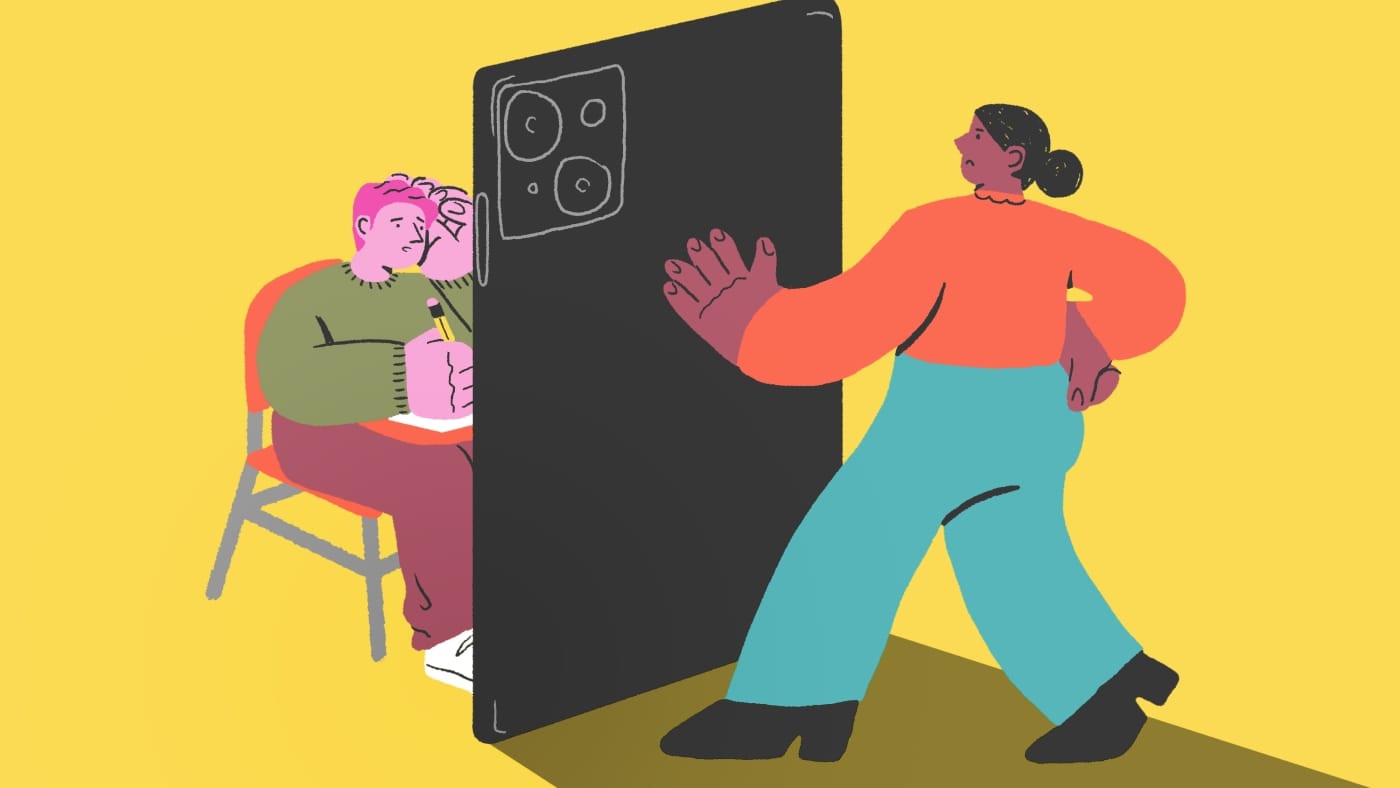
While research has yet to establish a direct link between the rise of students’ use of smartphones and declining scores, West, Figlio and others say the timing certainly raises questions.
“If we have these extremely addictive devices on our person 24 hours a day or near us 24 hours a day,” Figlio surmises, “this has to be one of the contributing factors.”
A surge of restrictions
Meanwhile, lawmakers in many U.S. states are getting out in front of the research, responding to long-standing complaints from teachers that cellphones are too distracting. At least 32 states now have some kind of restriction on student use of the devices in schools. The majority of the policies have passed in the last three years.
Researchers are scrambling to keep up with the approach. Figlio spent the last two years gathering data from a Florida district and found modest benefits from the school’s ban.
“The cellphone ban does more good than bad,” he says. “It seems to be improving student engagement, and it seems to be improving test scores.”
The caveat is that it’s a very early look at a very large change in schools. He is continuing to gather data from the district, while other similar projects are underway around the country.
Kathy Do, a researcher at the UCLA School of Education & Information Studies, recently released one of the first national surveys on the impact of cellphone bans in schools.
“Oftentimes these policy decisions are ahead of the science,” she says. “It’s important for us to slow down, look at what the research is really saying about the impacts of cellphones on learning and well-being.”
Her survey focused on the need for building healthy digital habits and how cellphones are a distraction when not used intentionally for instruction.
She adds, though, that in some classrooms, phones can be a learning tool.
“It’s more nuanced,” she says. “It’s not all bad.”
In one conversation with a teacher in a rural district, Do heard how students were using their cellphones to help conduct science experiments since the school did not have communal tablets or laptops.
In one example, “one student in each group [used] their phones to access a speedometer,” she explains, “to measure the rate at which different objects drop in their science experiment.”
She says schools shouldn’t be afraid to reimagine or change their policies as more research emerges.
And all three researchers agree that there is no one-size-fits-all approach to cellphones. As much as legislators may want this to be a quick fix, the researchers say there’s a long road ahead before any trend becomes apparent.
Sequoia Carrillo 2025-12-14 14:05:23
Source link