
Sign up for Chalkbeat Chicago’s free daily newsletter to keep up with the latest news on Chicago Public Schools.
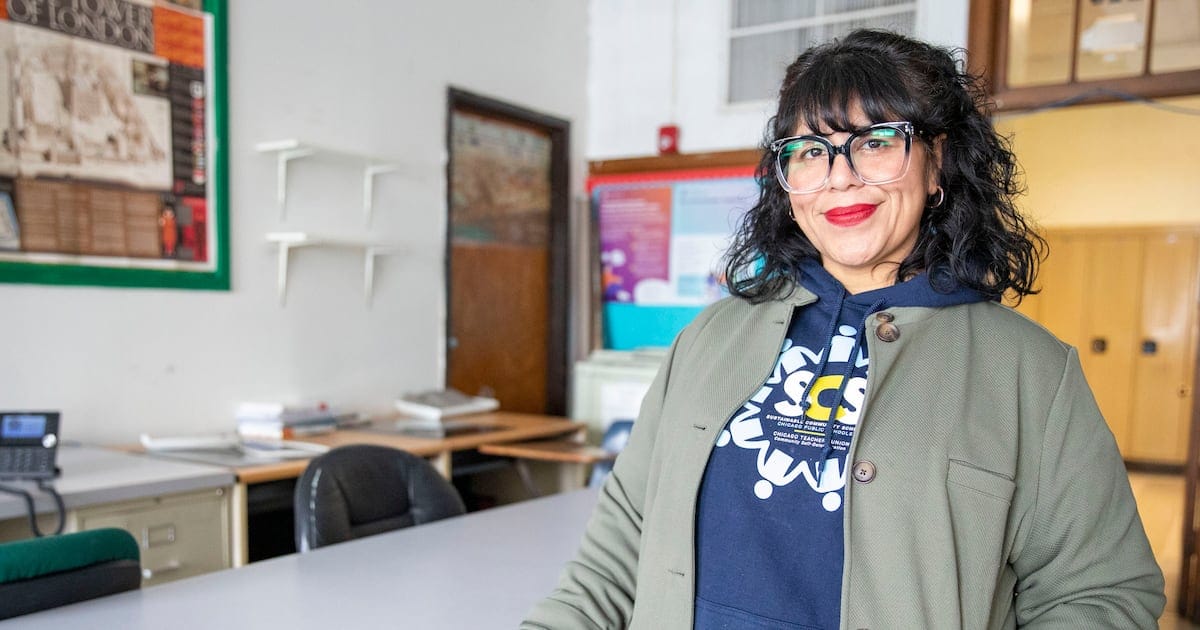
When Anna Vilchez became principal at Steinmetz College Prep four years ago, she had to quickly turn to an unexpected crisis.
Since 2018, the high school on Chicago’s Northwest Side had teamed up with the nonprofit Northwest Center as part of Sustainable Community Schools, a partnership between the school district and its teachers union. High-needs campuses and partner nonprofits receive about $500,000 a year to expand family outreach, wraparound student services, and after-school programs.
But as Vilchez took over, Steinmetz and Northwest Center were poised to part ways. Their visions for the program were at odds. Meanwhile, the nonprofit struggled to spend the money it received through the initiative. Vilchez set out to salvage the partnership.
As Chicago Public Schools and the Chicago Teachers Union gear up to expand the program from 20 to 70 schools in the next two years, their leaders say the initiative has been a boon to high-poverty campuses. It has allowed them to enlist key support staff, offer more programs, and give their communities more of a voice in school decisions.
But a Chalkbeat analysis of program spending showed schools and especially their community partners have left more than $6.6 million on the table since 2018. The initiative has also faced leadership and staff turnover, and tensions between schools and their nonprofit partner, which — along with the pandemic’s disruption to its rollout — could help explain why the model hasn’t yet given the 20 pilot schools an edge in improving student outcomes, as a Chalkbeat analysis of academic and school climate metrics found.
Clear goals and firm leadership are key to realizing the promise of the community school model, said William Corrin, an expert at the think tank MDRC.
“For Chicago, this juncture seems really critical,” he said. “We’re about to create more community schools. So what could we do to set ourselves up to do it better?”
‘There was no blueprint’ for Chicago’s community schools
Steinmetz, in a grand building in the Belmont Cragin neighborhood, was exactly the kind of school the district and union were looking for when they negotiated a 20-campus Sustainable Community Schools pilot that started in 2018. A neighborhood campus that serves predominantly low-income Latino students, including many English learners, the school was also already a community hub, with a health clinic and a Parent University.
Steinmetz teamed up with local nonprofit Northwest Center for its successful bid to join the program. Then COVID hit, disrupting the rollout.
Here, as on other campuses, turnover and some resistance from educators and staff have been key hurdles. Jesse Livingston, the resource coordinator with Northwest Center (formerly the Northwest Side Housing Center), said teachers have seen programs and reform efforts come and go over the years, leaving them skeptical that this latest initiative would last. Some have also balked at the idea of engaging students, parents, and the nonprofit in more school decisions.
“Our biggest challenge has been adult buy-in,” he said. “Every school community wants to function as a village, but there’s conflict and a clique mentality and old gunky energy.”
Earlier on, the school and the nonprofit also didn’t see eye to eye on what the program should accomplish and struggled to understand how the other did business.
Angel Hernandez, at the time the school’s program coordinator who also had experience working at a nonprofit, tried to mediate. Lack of guidance and training were big issues, he said.
“There was no blueprint,” Hernandez said. “You just had to figure it out as you went along.”
Money for community schools initiative left on the table
Northwest Center, like other community partners in the program, receives about half of the $500,000 allocated to Steinmetz. But records obtained by Chalkbeat show the nonprofit, and others in the program, are not spending all the money.
Livingston said unfilled positions and midyear turnover as well as the district’s cumbersome reimbursement process for vendors have been key challenges.
“We’ve gotten better every year,” he said. Data show the nonprofit left more than $142,000 unspent in the first year working at Steinmetz, while last year, they used all but $45,000.
Chalkbeat found money went unspent at many of the other 20 schools, though last year they came closer to using all of it. At Beidler Elementary, the school and its partner, Blocks Together, have failed to spend more than 45% of their overall SCS funding so far, which the district attributed to “operational challenges rather than a lack of need.”
The union in its last round of contract negotiations won a provision allowing schools to carry over up to $300,000 in unspent SCS dollars to the next year.
Spending and staffing data Chalkbeat obtained shows in more recent years, campuses in the program used the money to pay for relatively few staffers. Some principals said rising salary and benefit costs have meant the dollars don’t stretch nearly as much as they did in 2018. The district did not provide data on school staff hired by partner nonprofits.
Across the city from Steinmetz, Farragut High School on the Southwest Side used Sustainable Community Schools money to pay for valuable positions, including a college and career coordinator and a youth intervention specialist, principal Virag Nanavati said.
But even as the school dipped into non-SCS funds to pay for these staffers, its partner, Enlace Chicago, left more than $75,000 unspent the year before Nanavati started alone. At the time, that meant the money stayed with the district instead of flowing to the school.
Nanavati says the nonprofit struggled to staff after-school programs and ran some that were poorly attended. The nonprofit also hired a resource coordinator, an assistant to the resource coordinator, and two counselors, even as the school had to cut staff because of budget woes. Enlace did not respond to a request for comment.
The school and Enlace worked to rethink the spending, Nanavati said, pitching in for holiday celebrations that have brought in prospective families and other residents. Farragut also expanded its after-school offerings, offered attendance incentives, and launched a credit recovery program during the school day — initiatives he credits with a dramatic increase in the school’s graduation rate this year.
“Your lead partner needs to understand that it’s not their money,” he said he told a principal at one of the 16 schools joining the program this fall. “It’s money to serve students that they help manage.”
Overcoming tensions to honor the community schools model
In the weeks after she started at Steinmetz, Vilchez spent an entire day with staff at Northwest Center, talking about how to work better together and avert the looming breakup.
Vilchez says the partnership with Northwest Center is strong now. The nonprofit oversees the school’s Parent University classes, from yoga to financial literacy to suicide prevention, as well as student after-school programs. It also connects families with key resources, including foreclosure prevention, workshops for first-time home buyers, and help enrolling in public benefits.
District officials say they are trying to better prepare schools and partners to work together as 16 new campuses transition into it this school year. The district has spelled out clearer staffing and spending expectations, and provided more training to both schools and nonprofit staff, said Autumn Berg, the district’s community schools initiative director.
“There’s always going to be struggle in partnerships,” she said. “It’s a lot like being married. You have to figure out how to work together. You have to figure out how to communicate.”

Vilchez says the program is paying off at Steinmetz. The school’s restorative justice work powered by Sustainable Community Schools led to a reduction in more serious student misconduct and suspensions. The say in decisions the model gave students and parents boosted a sense of connectedness to school. This fall, a districtwide student survey captured that greater sense of belonging, she said.
But there is still a lot to do, particularly in improving student outcomes. Vilchez said she welcomes the greater focus from the district on how the program is affecting academic and other metrics.
“I just hope that they honor what the SCS model is about — giving schools autonomy and flexibility to meet the needs of that specific community,” she said.
Mila Koumpilova is Chalkbeat Chicago’s senior reporter covering Chicago Public Schools. Contact Mila at mkoumpilova@chalkbeat.org.
Mila Koumpilova 2025-12-19 23:25:00
Source link