
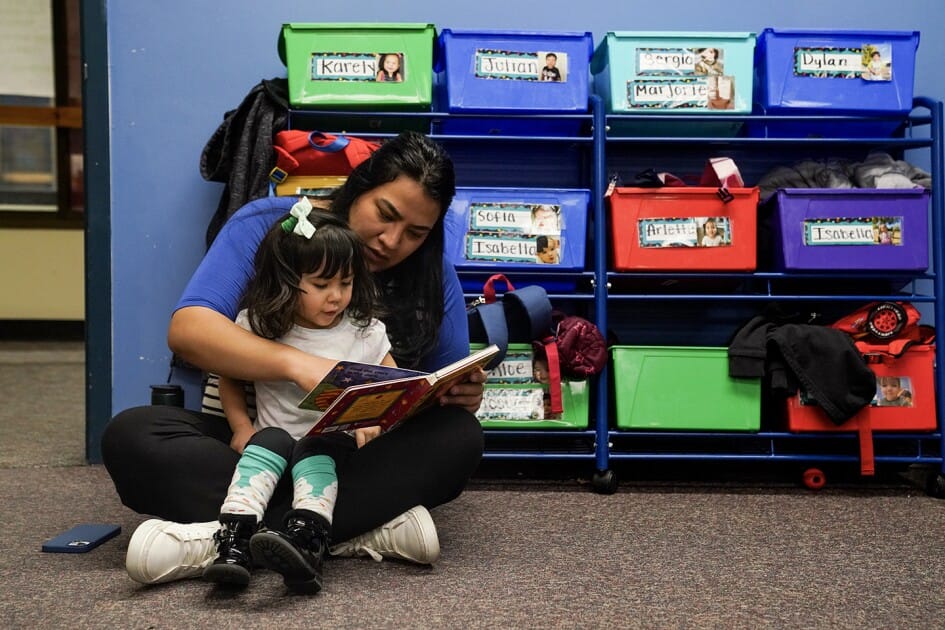
This school year, for the first time, the rural Moscow school district in Idaho has employed two full-time “community schools coordinators” who help connect students and families to social services and academic enrichment opportunities, like internships and career counseling.
Moscow Middle School opened a family resource hub, open for walk-ins three hours a week during school and once a quarter on Saturday afternoons, where any child from the community can pick up free clothing, school supplies, books, and toiletries.
Middle-school students learning about forestry got to visit a nearby university’s experimental forest three times this semester.
And the school hired a licensed practical nurse who works during the school day as well as on nights and weekends, helping families navigate the state’s byzantine health care system, and even showing up to their appointments to help them get the care they need.
But in a few weeks, both coordinators in the 2,300-student district will lose their jobs. The family resource hub will transition to an appointment-only schedule, opportunities like the forest visits will become fewer and farther between, and the nurse’s hours will be reduced to a traditional school nurse schedule.
“It feels like we’re taking a big strike to the heart throughout all of Moscow,” said Brian Smith, who oversees the district’s community schools initiatives and serves as principal of its alternative high school.
Those are just some of the immediate and far-reaching consequences of the Trump administration’s decision last Friday to abruptly cancel close to 20 ongoing five-year grants—collectively worth $168 million—through the Education Department’s Full-Service Community Schools program.
All the affected grant recipients were expecting either two or three more years of previously awarded funding, including an annual installment that was set to arrive Jan. 1.
The Education Department canceled 19 of roughly 70 ongoing five-year Community Schools grant awards, according to a list obtained by Education Week.
Those 19 grants—spread across 11 states and the District of Columbia—amounted to nearly $61 million in funds that were due to flow Jan. 1, and another $107 million that was due to flow by 2028.
The loss of those funds could lead to layoffs for dozens of public school educators nationwide within weeks. In Idaho alone, 60 community schools coordinators across 47 rural school sites have salaries funded in part or in full with the now-excised grant funds.
“These schools are the beating heart of their rural communities,” said Laura Roghaar, project manager for the Idaho Coalition of Community Schools. “To invest in them in the way they deserve, and then suddenly disinvest in them, is wild.”
Six additional grant recipients told Education Week they still haven’t heard either way whether they’re getting their next round of Community Schools grant funding.
A spokesperson for the agency didn’t respond to a request for comment. Earlier in the week, a spokesperson said, “the Trump administration is no longer allowing taxpayer dollars to go out the door on autopilot—we are evaluating every federal grant to ensure they are in line with the administration’s policy of prioritizing merit, fairness, and excellence in education.”
Grant cancellations are part of Trump efforts to eradicate DEI
The Trump administration has argued in “notices of non-continuation” to affected grantees that the programs in question may be promoting diversity, equity, and inclusion initiatives that top federal officials have characterized as divisive and harmful.
Community schools advocates, though, describe their mission as a painstaking, constantly evolving, and research-backed effort to identify and meet the specific needs of students and their families—ranging from unemployment and food insecurity to difficulty accessing medical care and navigating bureaucracy.
The federal government has invested in the community schools model since the 1970s. Under President Joe Biden, Congress ramped up annual funding for the grant program from $25 million to $150 million. Along with state funds and other local investments, the federal grants give schools the resources to pay for the social services many families need.
“These are larger societal problems that teachers can’t solve by themselves. They’re just trying to teach math and reading,” said Lisa McKinney, director of communications for Kentucky’s Prichard Committee for Academic Excellence, which manages the state’s just-canceled Community Schools grant. “We need to use other community resources to help these kids out and break down some of those barriers.”
At one Kentucky school using a portion of the state’s $50 million, five-year, federal grant, a community schools coordinator helped form a partnership with a local optometry college to offer free eye exams to 60 students. Twenty of those students ultimately needed glasses—and got them for free. “Those kids were otherwise walking around not being able to see,” McKinney said.
Many of the grants, in Kentucky and beyond, were covering salaries and benefits for community schools coordinators—full-time staff members who oversee partnerships with local nonprofits, health care providers, and social service programs, and connect students and their families to community resources they might otherwise not seek out.
The American Falls district in southeast Idaho for the last two years has had a community schools coordinator at each of its four buildings.
Two elementary coordinators have led expansions of preschool and after-school programming; the middle school coordinator has prioritized mental health resources for children and adults alike; and the high school coordinator has canvassed local employers to set up internship opportunities that prepare students for the workforce.
The district—where 70% of the 1,500 enrolled students qualify for free and reduced-price meals—has also opened a community education center with a panoply of free services for anyone in the community, including tax preparation, a dental clinic, GED programming for adult learners, and a technology assistance center for help with digital devices.
The district had been using more than $1 million a year from the federal grant. Superintendent Randy Jensen is still hoping to keep the coordinators employed even without the federal grant, but he now might have to reduce their hours or pay.
In the coming years, now that the federal grant is gone, the district might ask voters to approve a levy increase to keep programs alive, Jensen said.
“We really look at the Community Schools money as an investment, not an expense,” Jensen said. “The more people we’re able to move out of poverty, the more people we’re able to provide help to get a better education, get a better job, that just saves the community money in other ways.”
Some schools had just gotten their work off the ground
United Way of Treasure Valley, an Idaho nonprofit, distributes each year’s $10 million in federal Community Schools funds to nearly 50 Idaho school buildings in 22 rural districts.
The Moscow district’s share this year was more than $200,000. That money covers, among other expenses, salary and benefits for Melissa Godfrey, who joined the Moscow Middle School team this year after earning a master’s degree in school counseling last fall.
During Godfrey’s first weeks as community schools coordinator, a teacher asked her to lead an evening event centered around chemistry. It was a hit—more than 150 of the middle school’s 500 students came to learn from a local chemist about the properties of spices like turmeric.
Godfrey felt like she had just started to lay the groundwork for projects to grow: a new tutoring program, more connections with local businesses, and a discussion group to help prepare girls for challenges they’ll face in society and the workforce.
Just last week, Godfrey brought the school’s entire 7th grade class to a local performance of Charles Dickens’ “A Christmas Carol,” which they’d been reading in class.
“Being able to provide that learning opportunity for them was amazing,” Godfrey said. “We won’t have access to that. That’s a gut punch—not just for my students, but for our community members.”
Now she’ll have to start looking for new work as well—likely outside the school district, unless a counselor position opens up.
“I will be fine,” she said. “I’m heartbroken for our students, and what they’re losing.”
Grant terminations follow a Trump administration pattern
The Trump administration says it’s canceling the grant funding that was paying for Godfrey’s salary because of a paragraph in the original United Way grant application that mentions “culturally responsive practices to create an inclusive and welcoming environment for all” and “equity training” that centers on “recognizing biases, understanding the impact of disparities, and fostering inclusive practices.”
The United Way team included that language because the Biden administration required it as a condition for getting the award. On Sept. 26, fearing reprisal from the Trump administration, Idaho’s United Way team sent an email notifying the Education Department that it had removed all references to DEI from its grant application.
“While no project activities to date have breached such requirements, we wished to make this clarification to underscore our commitment to transparency and compliance,” they wrote to the department staffer who had been managing their grant award.
That staffer acknowledged the message three days later, according to the United Way team. But the federal agency nixed the grant anyway, citing that exact paragraph in the “notice of non-continuation” dated Dec. 12.
The non-continuation letter, as with all Education Department grant cancellation notices in recent months, bears the signature of Murray Bessette, the acting director of the department’s office of planning, evaluation, and policy development.
Each letter gives grantees a seven-day window to submit an appeal and address it to Kirsten Baesler, the recently confirmed assistant secretary of elementary and secondary education.
Most grantees from other programs who submitted appeals have gotten swift notices of rejection. The response letters are typically signed by Lindsey Burke, a top Education Department official who wrote the education section of the conservative policy document known as Project 2025.
Most notifications that grants are ending have been abrupt
The Community Schools grants are the latest in a long string of Education Department programs the Trump administration has targeted in recent months with cuts to individual grant recipients.
Under President Donald Trump and Education Secretary Linda McMahon, the federal government in 2025 has slashed previously awarded funds totaling more than $300 million for helping middle and high schoolers prepare for and apply to college; $35 million for civics education efforts; $26 million for promoting racial integration in classrooms; $20 million to train aspiring teachers from underrepresented backgrounds; $15 million for special education training and research; $9 million for statewide centers that help parents connect more regularly with school staff; and $7 million from arts education initiatives.
The dollar figure for the canceled Community Schools grants exceeds all but the highest of those.
Most of these cuts have been announced just days or weeks before grant recipients had been expecting the routine arrival of their next round of annual funding.
Long-term plans in many community schools will have to be curtailed. In Moscow, Principal Smith earlier this year told students he would supply them with club funds to spend on things like recording equipment for a literature podcast run by 7th graders and rocket materials for a high school aeronautics club.
“Now the adults that [students] trusted for all these years inside their public school are going to have to tell them, ‘You did everything right, but we can’t provide the funds anymore,’” Smith said. “I’m just coming to grips with some of those conversations I’m going to have.”
2025-12-18 21:55:43
Source link