
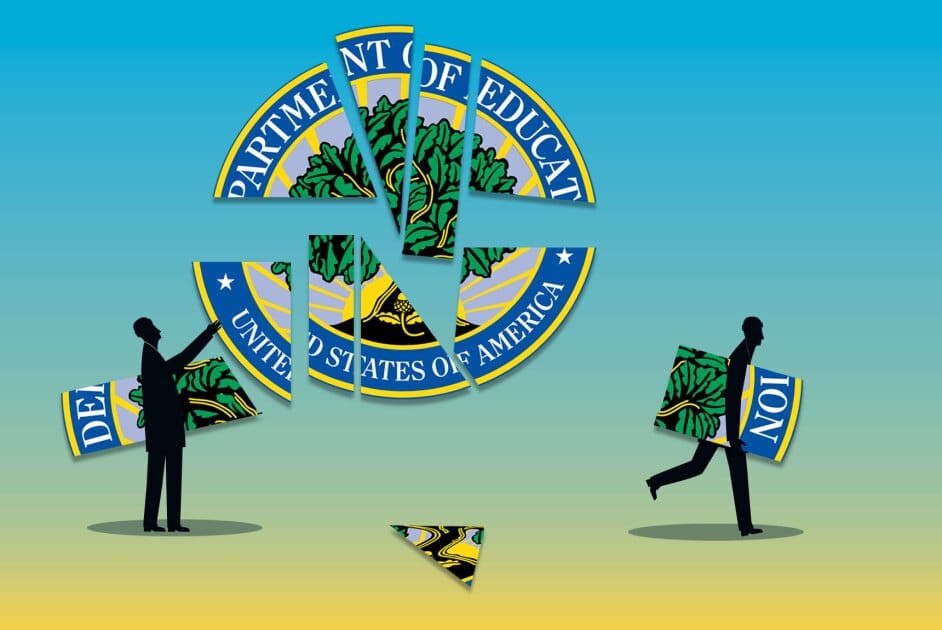
President Donald Trump didn’t fulfill his pledge to dismantle the U.S. Department of Education in 2025. But he got closer than any other president in the agency’s 46-year-old history, and his dramatic downsizing of the agency and attempts to redirect federal funding cast a shadow of uncertainty over schools and districts.
That’s why “dismantle” is Education Week’s 2025 word of the year.
Education is largely governed by states, and federal funding makes up about 10 cents for every dollar K-12 schools spend. So shifts in federal bureaucracy seem to pale compared to actions on the state and local level.
But Trump’s changes were unprecedented because of their scale and intensity, particularly affecting schools’ hiring and budgets.
For Trump’s supporters, disruption is a feature, not a bug. Calls to reconstitute funding streams into block grants, reduce red tape, and waive federal accountability requirements will give states the freedom they need to make necessary innovations, they argue.
But educational administrators said the push to dismantle federal oversight, alongside other efforts to eliminate diversity, equity, and inclusion programs, and abruptly end grant programs brought new fears about how to sustain operations at a time of declining enrollment, persistent inflation, and economic uncertainty.
How we selected our word of the year
To select EdWeek’s word of the year,we filtered through our most-read 2025 stories, polled our newsroom, and reviewed a sample of school board agendas to look for themes. “Dismantle” seemed to best capture the topics and trends of the year.
When publications select a word of the year, they generally focus on a novel word or phrase that’s characteristic of the times. That’s a challenge in education, where some of the best, most important work is done by educators who reject the urge to jump on every bandwagon or fad in favor of thoughtfully applying research-tested approaches to instruction.
How did other outlets make the call this year?
The publishers of the Oxford English Dictionary selected “rage bait,” defined as “online content deliberately designed to elicit anger or outrage by being frustrating, provocative, or offensive, typically posted in order to increase traffic to or engagement with a particular web page or social media content.” Sounds about right for 2025.
Dictionary.com selected “six-seven,” a kid catchphrase with an accompanying hand gesture that spread through schools like a cold in January.
Last year, we selected “cellphone ban,” a term reflective of the explosion of discussions about limits on personal technology in the classroom. In a similar manner, “dismantle” represents the current moment.
Trump made progress in his pledge to disrupt education
Republicans have sought to dismantle the U.S. Department of Education since President Jimmy Carter signed the bill that established it in 1979. The agency was created to distribute federal funding; enforce civil rights and special education laws; and collect data on students, teachers, administrators, and classrooms that drive research on improving education.
As U.S. Secretary of Education Linda McMahon has acknowledged, a presidential administration can’t eliminate an agency created through legislation without approval from Congress. But that didn’t stop her from making dramatic changes, many of which are subject to ongoing court challenges. A sample:
- In November, the Education Department announced plans to shift many of its core functions to other agencies. Under the agreements, a majority of federal funding for K-12 schools—more than $20 billion a year—will be administered instead by the U.S. Department of Labor.
- While the office for civil rights and the office for special education and rehabilitative services remain in the Education Department, officials have said moving them to other agencies is still on the table. Advocates protested, saying a fragmented federal education plan puts students with disabilities at risk.
- The Education Department radically downsized its footprint, shedding nearly half its staff in layoffs and buyout deals, and attempting to further slash staff during the November government shutdown.
- The Trump administration cancelled a slate of grants, including those funding programs for teacher training, preparing new school mental health personnel, STEM education research, and desegregation efforts. Because many of those multi-year programs were already underway, operators faced tough choices about slimming them down or ending them altogether after the sudden loss in funding.
- In February, the administration’s Department of Government Efficiency abruptly revoked nearly $900 million in contracts for research, pilot programs, and data collection, alarming researchers. A March court decision prompted the administration to restore some of those contracts.
Uncertainty continues into the new year
On June 30, the Trump administration told states it would withhold nearly $6.8 billion in federal funding for K-12 schools it was scheduled to dole out July 1, throwing districts’ plans to hire staff and continue programs into doubt as the new school year approached. The administration later released those funds, but the move left educators with an uncertainty hangover.
Meanwhile, ongoing funding is in doubt. House and Senate lawmakers have advanced separate federal education budget bills with vastly different funding levels for key programs in the 2026-27 school year. They have until Jan. 30 to reach an agreement—or to partially shut down the government for the second time in three months.
The Senate bill would maintain nearly all the existing federal funding streams for K-12 schools, and give a slight bump to annual funding for Title I, which supports low-income students, and the Individuals With Disabilities Education Act, serving students with disabilities. It would also explicitly prohibit the Trump administration from unilaterally withholding billions of formula dollars or moving grant programs to other agencies.
The House bill more closely resembles the White House budget proposal from earlier this year. It would zero out funding for programs like Title II for professional development and Title III for English-learner services; slash annual investment in Title I by more than 25 percent; and subtract $30 million from the roughly $15 billion annual allocation for IDEA.
Lawmakers have said they’re looking to avoid another “continuing resolution,” which would effectively punt spending decisions and carry over funding levels set during President Joe Biden’s tenure. It’s not yet clear how Republicans will balance investing in education and adhering to Trump’s vision, especially given their slim majorities and uncertain midterm election prospects.
An even bigger question mark, though, is whether shifting political considerations or upcoming U.S. Supreme Court rulings will curtail the Trump administration’s ongoing efforts to seize spending power from Congress. With no firm answers in sight, many school district leaders are already shaping budgets around massive federal reductions and bracing for continued chaos.
Honorable mentions
Here are the contenders that didn’t quite make the final cut.
Six-seven: That annoying kid catchphrase is actually an example of “childlore,” which can serve a role in children’s linguistic and social development.
AI-enabled: Discussions about artificial intelligence in education expanded beyond “how do we keep students from cheating with ChatGPT?” to “how can we use AI to do everything from tutoring students to scheduling bus routes?”
Beyond 3rd grade: After most “science of reading” bills states approved in recent years focused on elementary school students, educators sounded the alarm about a lack of resources and strategies for older students who need help with foundational literacy skills.
American exceptionalism: As states set history standards and districts weighed social studies curricula, debates surged about how to discuss the nation’s past and contributions.
2025-12-12 21:47:43
Source link