
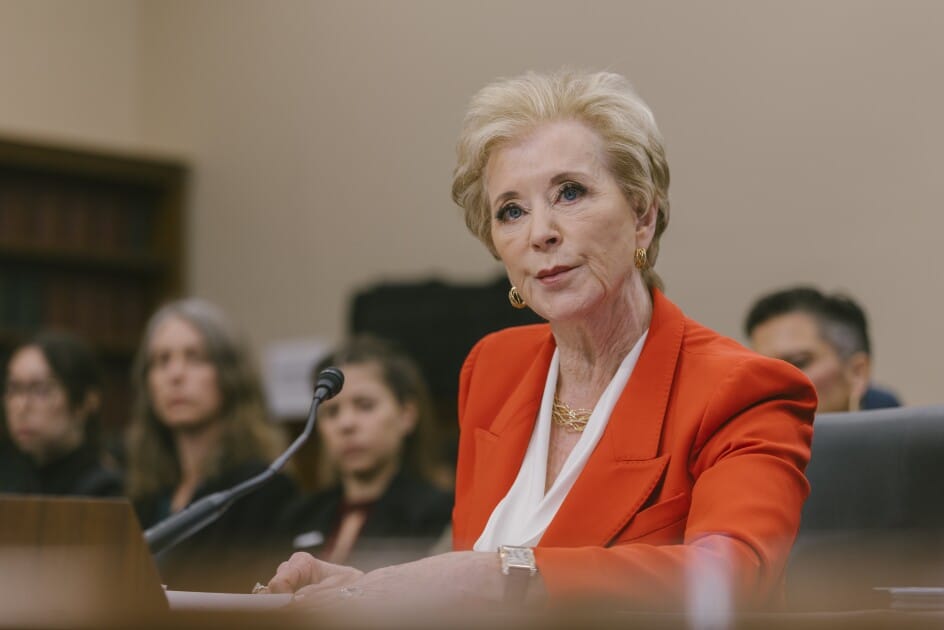
A coalition of states that sued months ago to stop mass layoffs at the U.S. Department of Education is now also challenging the department’s recent moves to shift many of its core functions to the U.S. Department of Labor and other federal agencies.
The Democratic attorneys general from 20 states and the District of Columbia argue in an amended complaint filed on Nov. 25 that federal laws require the U.S. Department of Education carry out its own programs.
But the department this year has signed seven agreements to have four other federal agencies take over day-to-day management of key grant programs. Under these agreements, the Labor Department is now tasked with managing most K-12 grant programs, distributing more than $20 billion annually to schools.
The departments of Health and Human Services, the Interior, and State have also taken over smaller parts of the Education Department’s portfolio, with the moves all stemming from a March executive order from President Donald Trump telling Secretary of Education Linda McMahon to “facilitate” the closure of her department.
The 1979 federal law that created the Education Department allows the secretary of education some latitude to reorganize the agency, but not as much latitude as the Trump administration has taken, the expanded lawsuit argues.
The Trump administration’s “plan to eliminate the department has been anything but lawful,” the lawsuit reads. “Their strategy is simple: fire the department’s employees and redistribute the department’s programs and money to other federal agencies.”
In addition to the 20 Democratic-led states and the District of Columbia, the plaintiffs in the lawsuit include two Massachusetts school districts; affiliates of unions representing teachers, paraprofessionals, university professors, and college and university employees; and a group that advocates for people with developmental and intellectual disabilities.
“It’s no surprise that blue states and unions care more about preserving the D.C. bureaucracy than about giving parents, students, and teachers more control over education and improving the efficient delivery of funds and services,” said Madi Biedermann, an Education Department spokesperson, in a statement.
The legal challenge to the interdepartmental program moves is the latest development in a legal battle dating back to March that challenged the first round of Education Department layoffs and the president’s March executive order. The lawsuits led to a temporary pause in those layoffs before the U.S. Supreme Court allowed the Trump administration to move ahead with them.
Four federal agencies have taken over Ed. Dept. programs
McMahon has acknowledged that the Trump administration needs congressional approval to eliminate the U.S. Department of Education, which was a Trump campaign pledge.
Short of securing that approval, the administration has eliminated about half of the department’s staff and started redistributing its portfolio to other federal agencies. McMahon last month described the interdepartmental moves as a “pilot program” to prove to Congress that the changes could work long term.
Under agreements the Education Department has signed so far, the Labor Department is overseeing the Education Department’s single largest grant program—the $18.4 billion Title I program that sends out funding to about 95% of school districts to support students from low-income families.
The agency is also in charge of other formula funds that schools use to pay for teacher professional development (Title II), services for English learners (Title III), after-school programs (Title IV-B), and student support and in-school enrichment activities (Title IV-A). A wide range of competitive grant programs that provide funding for charter schools, literacy initiatives, private school vouchers for District of Columbia students, and more are now under Labor Department management as well.
That agency is also taking over a number of higher education grant programs, including some that prepare K-12 students for college and fund teacher-preparation programs at historically Black colleges and other universities with large minority populations.
Schools with large amounts of federal land within their boundaries or large numbers of students with parents who work on federal property will now also receive their regular Impact Aid payments from the Labor Department.
Earlier this year, the Labor Department took over day-to-day management of the Perkins grant program, which is the largest federal funding source for career and technical education, and grants for adult education.
Some states have reported delays in accessing their Perkins funds since the switch while others have reported no hiccups.
But the lawsuit argues such a move is illegal and that it “upends decades of work that took place at the state and local level to embed CTE programs into secondary and postsecondary offerings and improve the quality of CTE and adult education.”
Other interdepartmental program changes include the movement of most grant programs focused on Native American students to the Department of the Interior; a program that provides child care to parents enrolled in college to Health and Human Services; and higher education programs supporting international and world language education to the State Department.
Education Department officials have confirmed they’re exploring other partnerships with federal agencies that could move functions including civil rights enforcement, special education oversight, and student loan administration elsewhere.
2025-12-01 19:39:06
Source link