
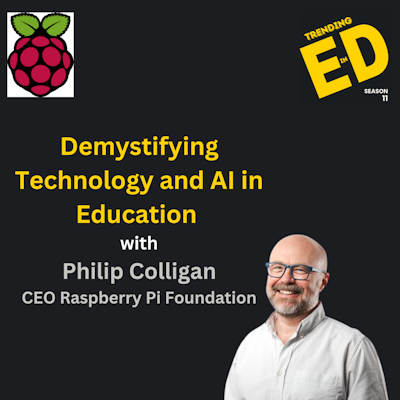
Should kids still learn to code when a one-sentence prompt can produce 4,000 lines of it? Philip Colligan’s answer is yes, and he thinks the question matters more now than it did three years ago.
On this episode of Trending in Ed, Mike Palmer sits down with Philip Colligan, CEO of the Raspberry Pi Foundation. Philip joined as employee number seven in 2015, after a career in UK government and at Nesta, where his team was asking why schools weren’t teaching computer science. He sets the record straight on an origin story most people have backwards: the charity came first. A group of Cambridge engineers worried about falling computer science applications set out to build a cheap, credit-card-sized computer and hoped to sell maybe 20,000. They’ve sold more than 80 million, and the commercial company the foundation built listed on the London Stock Exchange in 2024.
Mike shares how his seven-year-old reacted to a bare Raspberry Pi board handed down from the neighbors, which leads Philip into one of the conversation’s through-lines: technology shouldn’t feel like magic, and kids learn the most when they can see inside the box and build with it.
On the techlash, Philip starts by saying parents are largely right. If the streets of Cambridge were as dangerous for kids as the internet, he argues, there would be police on every corner. But a curfew isn’t a long-term plan, and he sees blanket bans as too crude a tool. He then makes the case from the foundation’s position paper on why coding still matters: AI lowers the cost of building software, which should raise demand for people who understand it, and kids growing up around automated decisions in healthcare, hiring, and criminal justice need to know how those systems work so they can push back on them.
The two also get into cognitive offloading versus what they agree would make a good title for a difficult second album, Cognitive Surrender. Philip previews a new research effort on how to teach with vibe coding, keeping the speed and creativity while putting back the friction where learning actually happens.
We also discuss:
- Andrew Sliwinski’s line that friction in coding is “a feature, not a bug” for learning
- Small language models that run offline, on device, for places where cost or connectivity is a barrier
- A new UK qualification where 17- and 18-year-olds train their own AI models
- Papert, Piaget, Vygotsky, and why AI feedback can’t replace learning from other people
- Why Philip wants kids to understand that AI systems can’t care about them
- Dropping his son off at university, and why adults owe young people real reasons to be optimistic, not just a better story
Everything the foundation offers is free for teachers, students, and parents.
Links:
Guest: Philip Colligan, CEO, Raspberry Pi Foundation
If you like what you heard, please subscribe, leave us a review, and share the show with a friend.
Palmer Media 2026-11-09 10:00:00
Source link