
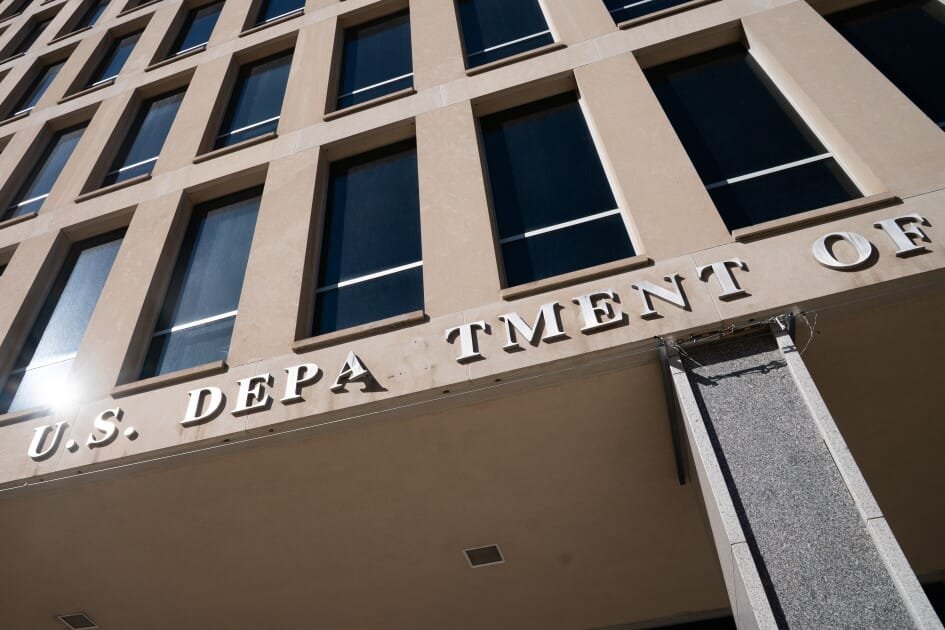
The Trump administration is pressing forward with efforts to relocate U.S. Department of Education staffers, offload agency funding, and scale back the federal role in education—even as it touts a new initiative to help state education agencies measure policy outcomes.
Administration officials have repeatedly pushed for closing the department, shifting its core functions to other agencies, and “returning education to the states.” Hundreds of Education Department staffers now work from other agencies’ buildings, and billions of dollars for education programs have recently shown up in at least one other agency’s spending accounts.
But during a call with reporters on Tuesday, an Education Department official struck a less existential note. Kirsten Baesler, the agency’s assistant secretary overseeing K-12 education, announced the Learning Agenda Playbook—a new suite of resources the Education Department helped develop for states to more strategically study over long periods of time whether they’re achieving policy goals of educational progress.
The department’s technical assistance centers—known as Comprehensive Centers and Regional Educational Laboratories—assembled the playbook over the last year, according to Baesler, in collaboration with education agencies from eight states: Arkansas, Georgia, Idaho, Kansas, New Hampshire, Tennessee, Utah, and Wisconsin.
“By strengthening states’ ability to make evidence-based decisions independently, the Playbook helps shift education away from Washington, D.C. and closer to the students, families, educators, and communities they serve,” the department said in a statement.
During the call with reporters, Baesler said the department does have a role to play in education policy: “serving the needs of states, rather than informing the needs of what states should be working on.”
Baesler also said several of the participating states have already begun using the playbook’s resources to inform efforts to track outcomes on improving literacy and numeracy instruction. The department didn’t make the full playbook available for review in time for publication.
IES programs that helped with new initiative have faced disruptions
Both the Comprehensive Centers and the Regional Educational Laboratories currently sit within the Institute of Education Sciences, the Education Department’s research arm, which the Trump administration has repeatedly targeted with disruptions to funding and staffing.
Those two programs haven’t been spared. The Trump administration has twice proposed to eliminate both. The vast majority of the active Comprehensive Centers and Regional Educational Laboratories saw their grants and contracts abruptly canceled last year, only to be revived six months later following a court ruling.
And last month, department officials told Congress they plan to reprogram 40% of the annual budget for the Regional Educational Laboratories to other priorities within IES. The department hasn’t answered inquiries about the reason for this change—or whether IES and its programs will also be transferred to another agency, as virtually every other part of the agency has.
Despite those disruptions, Baesler indicated this week that those programs will continue, with a focus on “identification of evidence.” That mirrors recommendations from a high-profile report the department published earlier this year highlighting potential reforms for IES.
“However it exists in the future, the Comprehensive Centers and the Regional Educational Laboratories are being funded, and we are working to ensure that as they exist, the RELs and the Comprehensive Centers are going to be useful and valuable supports for the states,” she said.
Staffers shift locations but retain duties
Trump administration officials have argued that students and schools won’t feel the effects of efforts at the federal level to streamline programs and shrink the education agency’s footprint.
“The teachers’ unions are going to yell and holler and scream” about moves like transferring special education to the Department of Health and Human Services, said Lindsey Burke, the department’s deputy chief of staff for policy and programs, earlier this month during a panel event in Washington.
Burke, who also wrote the education section of the conservative presidential policy document known as Project 2025, added, “At the end of the day, I think a year from now, two years from now, parents will know that they feel no difference in their services. They have access to the same services, the same teachers; they have the same experience day to day in their kids’ local school.”
That may be, in part, because the agency that’s long administered those programs hasn’t actually dissolved, even as it’s farmed out many of its functions to other Cabinet departments.
Hundreds of staffers over the next few weeks will begin relocating from the Education Department building to one of several other agencies’ buildings, as part of temporary “detail” assignments that accompanied the department’s agreements to transfer functions to one of six other agencies.
But employees’ job duties and team structures largely haven’t changed, at least so far. The agency is also currently hiring for at least 14 separate positions that all would be based out of the “Department of Education Headquarters,” though some of the postings emphasize that the “position might be detailed to another Federal agency.”
Earlier this year, the department announced plans to vacate its current building and move to a smaller one that’s a better fit for its reduced staff.
But, according to the staff union that represents Education Department workers, the department’s new home building “does not have enough room for all current Education employees.”
As a result, some or all staffers from at least five separate Education Department offices are moving to a separate new building that used to house Internal Revenue Service staff, the union said in a statement Monday.
All told, Education Department employees based in Washington will work out of nine separate federal buildings, according to the union.
“These moves to new facilities and the interagency agreements only make it harder for federal workers to do their jobs on behalf of the American public,” said Rachel Gittleman, the union’s president, in the statement.
Funding shifts also leave unanswered questions
While federal lawmakers in the U.S. House have advanced legislation that formalizes efforts to downsize the agency, the full House hasn’t yet taken up those bills, and a Senate committee has advanced a bill that would halt some program transfers. Lawmakers are unlikely to act on any of the legislation with hotly contested midterm elections approaching in less than two months.
When Congress finalized the current-year federal budget this past February, it allocated tens of billions of dollars for education programs the administration has since announced will move to other agencies.
Documents published in recent months by the White House Office of Management and Budget, which administers congressional appropriations, show more than three dozen Education Department programs now listed in spending accounts managed by the Labor Department’s Employment and Training Administration.
But funding for Education Department programs that have been announced for transition elsewhere hasn’t moved wholesale.
Across all the education programs now listed in Labor Department accounts, OMB has only reported roughly $4.8 billion of the $30 billion Congress supplied for those programs under the labor agency’s purview. More than a dozen education programs listed on Labor spending documents show no attached dollar amount.
OMB also hasn’t published any spending documents showing Education Department funding at HHS, Interior, Justice, State, or Treasury—even as several of those agencies are mentioned on recently published grant competitions for education programs, and education agency staffers have begun moving to those agencies’ buildings.
2026-09-09 13:20:00
Source link