
Sign up for Chalkbeat New York’s free daily newsletter to get essential news about NYC’s public schools delivered to your inbox.
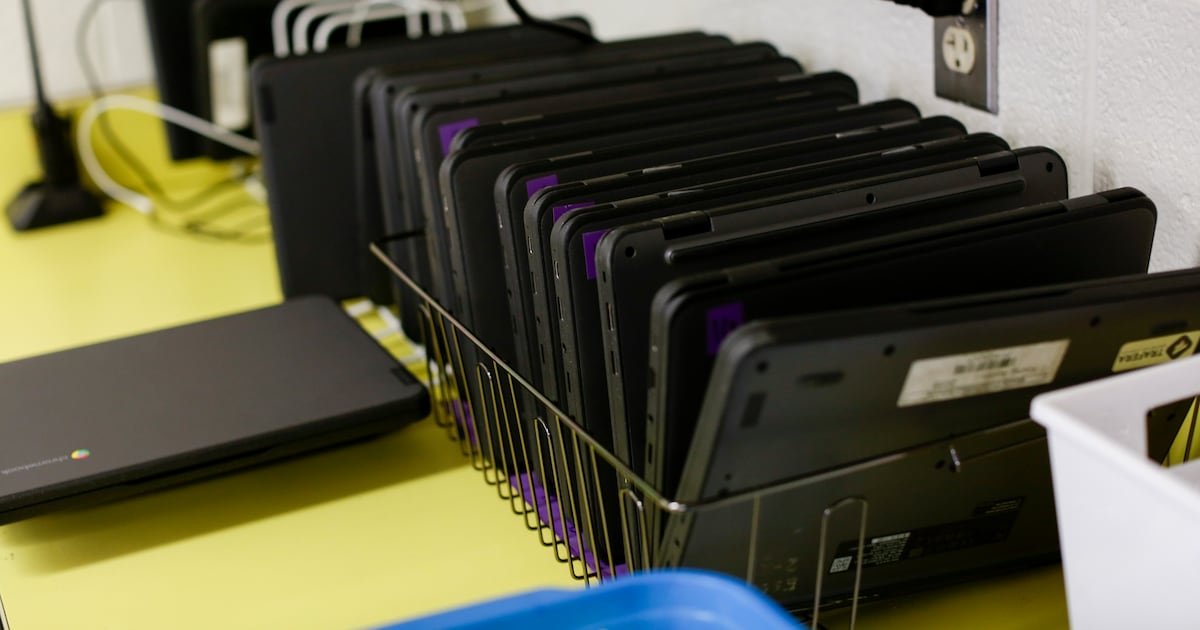
A year ago, former Mayor Eric Adams launched a sweeping, and costly, new plan to bridge the digital divide in the city’s public schools: purchasing 350,000 new Chromebook laptops equipped with free T-Mobile internet service.
The four-year contract, set to cost the city nearly $330 million, aimed to help schools with large shares of low-income and homeless families whose students lacked internet access outside of school.
But a year into the contract, Adams’ successor, Mayor Zohran Mamdani, is canceling the T-Mobile internet service portion of the contract, which costs the city roughly $3.5 million per month, officials said Thursday. Over the full four years of the contract, the internet service was expected to cost around $200 million.
Mamdani’s administration, which is looking to cut costs amid a multibillion-dollar budget deficit, said the city was paying for more internet coverage than necessary and could secure internet service for students who need it at a lower cost. Officials didn’t immediately say how much they expect to save.
The T-Mobile contract “duplicated existing resources at an unnecessary cost,” Education Department spokesperson Nicole Brownstein said. “By discontinuing this component of this contract, we are saving taxpayer dollars while continuing to deliver the internet connectivity we know our school communities rely on.”
The move also comes amid a growing backlash against the reliance on technology in city classrooms. Critics, including some parents and educators, say screen time has become too pervasive, detracting from learning.
Even before the city inked the T-Mobile contract, an existing program allowed principals to secure LTE service for students who need it for $10 per student per month, Education Department officials said. Officials said that service comes through Verizon, and can add internet to any school-issued Chromebooks or iPads.
Officials notified principals Thursday that the T-Mobile student data plans will end Aug. 31. They asked school leaders to compile lists of students who need internet access and purchase service through the Verizon program by the start of school on Sept. 10. Officials said they have already purchased all 350,000 Chromebooks and distributed them to schools, but didn’t say how many were given to students or how many students were using the internet service.
Several principals, who spoke on the condition of anonymity for fear of reprisal, described mixed experiences with the massive internet-enabled laptop distribution.
At one Manhattan high school, about one in five students used the new devices and relied on them to connect to the internet at home, according to the school leader.
The principal worried that ending the T-Mobile contract would shift more costs to the school’s budget.
But at a Brooklyn high school, dozens of the computers sit unused in a storage room.
“It’s a tremendous waste,” the principal said, adding that students prefer to access the internet through their phones. Plus, the school has shifted away from using Chromebooks during class because of concerns that an overreliance on technology was getting in the way of student learning, the principal said.
Some officials and lawmakers began expressing concerns about the T-Mobile contract in the months after it was signed, New York Focus reported last December. One official told the outlet that the city did not approach competing wireless providers, and was stuck paying a flat fee for the service regardless of how many students used it.
Lawmakers also worried the city was paying for internet service for far more students than needed it. A state Education Department survey from 2020 estimated that about 13% of the city’s public school students lacked sufficient internet at home, according to New York Focus. The city’s public schools currently enroll about 793,000 K-12 students, meaning about 104,000 would lack internet if the 13% estimate held.
City officials said in 2025 that about 30% of households, containing around 2.5 million residents, did not have both home broadband and mobile internet access. City officials have separately launched efforts to improve Wi-Fi in homeless shelters.
Adams said the T-Mobile school internet deal was funded in part by savings the city made through another deal that made T-Mobile the city’s major service carrier.
The Education Department spends roughly $13 billion a year on contracts, and Mamdani has identified the agency’s contracting — and particularly its spending on student devices — as ripe for cost-cutting.
Officials said the T-Mobile contract was approved by the Panel for Educational Policy, which oversees Education Department contracts, but was held by the city’s Office of Technology and Innovation.
City officials purchased and distributed some 725,000 devices for students during the COVID pandemic but have not tracked how many of those devices remain operational.
Gov. Kathy Hochul, who instituted a statewide bell-to-bell cellphone ban last school year, is considering imposing limits on screen time for younger kids. The Education Department is revising its artificial intelligence guidance for schools and has barred schools from purchasing new software until the guidance is finalized.
Michael Elsen-Rooney is a reporter for Chalkbeat New York, covering NYC public schools. Contact Michael at melsen-rooney@chalkbeat.org.
Michael Elsen-Rooney 2026-08-27 16:58:47
Source link