
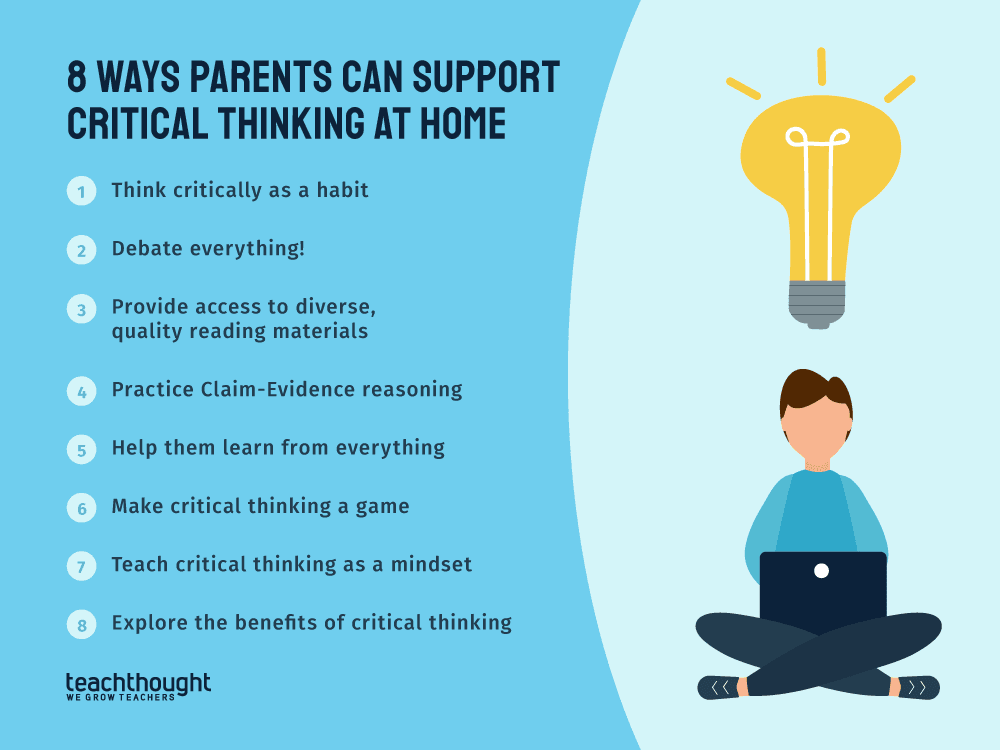
contributed by Lee Caroll, PhD and updated by TeachThought Staff
Research agrees that the strongest students emerge from homes supportive in the learning process, and below we’ve listed a few ways parents can support students at home.
In 8 Science-Based Strategies For Critical Thinking, we looked at ways we can use ‘thinking like a scientist’ to improve our own critical thinking skills. Below, we’re following that post up with a quick read: How to help children think critically at home.
8 Ways Parents Can Support Critical Thinking At Home
1. Think critically as a habit
Whether you’re thinking critically about the news or thinking critically about music, food, and video games, what’s more important than if students can think critically is if they will think critically–unprompted and as a matter of habit.
Practicing critical thinking in their ‘native environments–at home, with friends, reading self-selected texts, on social media, and more–is a useful strategy to build their cognitive muscles.
See also The Effect Of Parental Involvement On Academic Achievement
2. Debate everything!
Debate everything!
Science, for example. Debate is useful for a couple reasons: it helps students look at alternate explanations—good for analyzing experimental results—and can also develop teens’ natural communication skills. For example, “Should Bottled Water Be Banned?” Another useful resource here is NPR’s Intelligence Squared debates.
3. Provide access to diverse, quality reading materials
And then give them time to read them and discuss the reading. Even ask students to make claims based on the reading and support those claims with evidence.
4. Practice Claim-Evidence reasoning
Claim-Evidence-Reasoning. When they make a claim, ask for their evidence to build in the analytical habit of mind. My Dad did this every evening at dinner. (See #1.)
5. Help them learn from everything
Help them see that learning is a mindset–as is science and critical thinking. They don’t have to simply learn from ‘school’ or books, but nature and conversations and games and observation. Then help them make claims and provide evidence for those claims as a result
6. Play games
Video games are treasure troves of critical thinking opportunities–if for no other reason than many students enjoy playing and thinking about them. Read more about teaching with video games here.
Of course, you don’t have to use video games. Teach them to play Chess! Download a chess program or find a chess summer camp. This ancient game proves helpful in creating a growth mindset because to be effective a player must consider alternate moves before selecting the best one. Research also shows that playing chess improves SAT scores.
It also encourages quiet contemplation over an extended period of time without input or outside stimulation.
6. Make critical thinking a game
Make critical thinking a kind of game. Use Devil’s Advocate playfully to consider alternative perspectives, for example. This is a useful way to make critical thinking a habit.
7. Teach critical thinking as a mindset
Understanding that critical thinking is a kind of mindset rather than merely a ‘skill’ can help it become a kind of habit. This is true partly because critical thinking gives reasoning a purpose and tone–which can be difficult without the kind of cognitively agile and creatively playful mindset that promotes critical thinking.
Put another way, critical thinking comes more naturally in some states of mind (playful, safe, curious, and empowered) than others (directed, monitored, forced, and evaluated).
8. Explore the benefits of critical thinking
And do so in ways credible to children rather than espousing the benefits of critical thinking 25 years from now.
TeachThought Staff 2025-12-17 01:30:00
Source link