
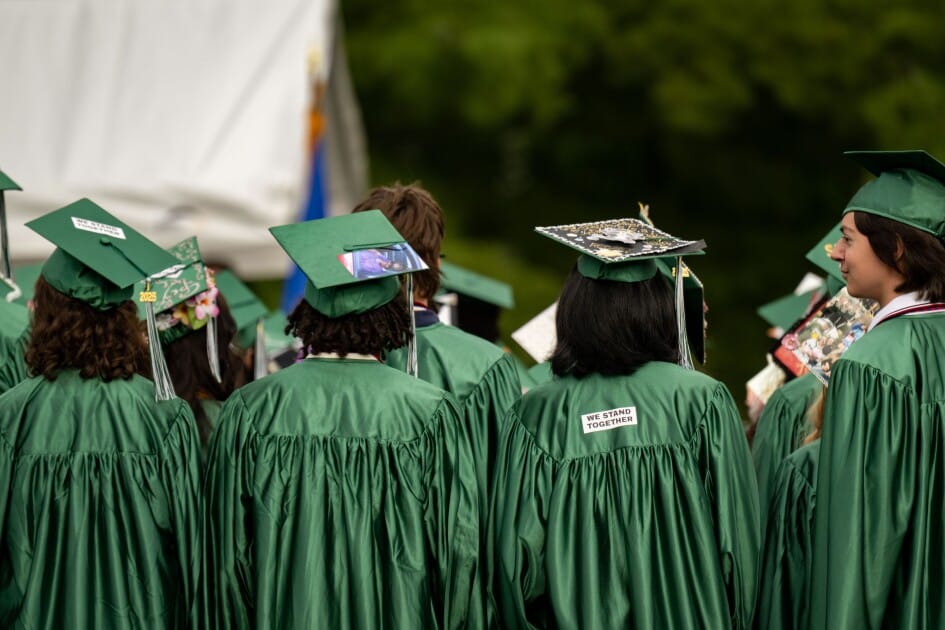
Undocumented students are reaching the end of high school in districts across the U.S. at a time of heightened uncertainty, as federal and state-level immigration policy changes threaten their ability to remain in the country and pursue postsecondary education.
A new analysis from the Migration Policy Institute using U.S. Census and national graduation rate data found that an estimated 90,000 undocumented students have reached the end of high school each year within the last five or so years, while an estimated 75,000 graduate from high school.
The estimates reveal both the academic progress and persistent struggles undocumented students face on the path to graduation, said Jeanne Batalova, a senior policy analyst at the Migration Policy Institute. The findings also come at a time when these students are facing more barriers to both K-12 and higher education after the Trump administration rescinded federal policy that shielded K-12 schools from immigration enforcement activities. In addition, some states have moved to eliminate in-state tuition options for undocumented students pursuing postsecondary education.
“It is really important to think about what’s next for them, what are the barriers, and how to make it potentially easier for them to overcome these barriers,” Batalova said.
Republican governor calls in-state tuition for undocumented students a ‘slap in the face’ to taxpayers
Historically, there has been bipartisan support for efforts to allow undocumented students whose parents brought them to the U.S. to receive college education, Batalova said.
Policies that made undocumented students eligible for in-state tuition rates like their U.S.-born peers, started in Texas in 2001 under former Republican Gov. Rick Perry.
But the national rhetoric on immigration has greatly shifted in the last decade, Batalova said.
The MPI analysis found that the top five states where undocumented students are graduating high school are Texas, California, Florida, New York, and New Jersey.
In 2025, Texas and Florida state leaders moved to repeal undocumented students’ access to in-state tuition, and other states adopted similar policies.
“I don’t think you should be admitted to college in Florida if you’re here illegally,” Republican Gov. Ron DeSantis said last year, adding that giving undocumented students in-state tuition rates was a “slap in the face to taxpayers.”
Equitable in-state tuition policies have a big impact on undocumented students’ high school academic achievement and on high school completion rates, said Corinne Kentor, a senior manager of research and policy at the Presidents’ Alliance on Higher Education and Immigration.
“It is a real motivating factor for students when they’re able to see an option beyond high school and see how they can put their knowledge to work,” Kentor said.
It’s why Kentor advises high school counselors to continue to inform students about equitable tuition policies where they are still legally in effect.
Counseling undocumented high schoolers has gotten harder
Many of the strategies meant to help undocumented students graduate high school are similar to those used to support the overall student population, Kentor said.
That includes ensuring that they have access to supportive resources needed to complete their coursework; providing access to language support; and making sure that families feel comfortable and included in the school system.
But lately, Kentor has heard from experienced high school counselors that they are shying away from having conversations with students and families about high school graduation and postsecondary options. The reason: Those counselorsfeel they can no longer promise students that their information will be safe when applying and attending colleges and universities, as immigration enforcement operations heighten across the country.
Her advice: “Don’t make promises to students because you can’t predict the future,” said Kentor, referring to the direction of immigration policies and enforcement. “Your job is to talk students through what you do and don’t know and help them work through complicated decisions.”
2026-02-18 19:38:03
Source link